01 Skin Type & Ingredients
Can All Skin Types Use Retinol?
Most skin types can use retinol, but it is one of the more demanding ingredients in skincare, and sensitive or very dry skin usually need a slower, gentler introduction to avoid irritation.
Quick answerYes, most skin types, including oily, combination, normal, and mature skin, can use retinol successfully. Dry and sensitive skin can use it too, but usually need a lower starting strength, less frequent application, and a longer adjustment period.
Retinol tolerance has less to do with fixed skin type and more to do with how gradually it is introduced. Almost any skin type can eventually adapt if the starting concentration and frequency respect where the skin is right now.

Skin snapshot
Best fitOily, combination, mature
Needs cautionDry, sensitive
Adjustment period2–6 weeks
Sun sensitivityIncreased
Can everyone use retinol?
Retinol suits most skin types eventually, but success depends heavily on starting low and building tolerance gradually.
Works best for
Oily, combination, normal, and mature skinDry and sensitive skin with a slow introductionNot ideal for
Pregnancy or breastfeedingActively flaring eczema or rosaceaRetinol snapshot
What to expect during adjustment
- Weeks 1–2Possible dryness or flaking
Common as skin adjusts to increased turnover.
- Weeks 3–6Irritation usually eases
Most people notice improved tolerance by this point.
- 8–12 weeksVisible texture and tone changes
Longer-term benefits typically become clearer.
Retinol by skin type
oily
Often tolerates well, may help breakouts.
combination
Generally adjusts well over time.
mature
A common, well-supported use case.
dry
Needs extra hydration, slower start.
sensitive
Lowest strength, least frequent use.
Short version
Story in brief
Retinol works by speeding up cell turnover and supporting collagen-related processes, which is why it is widely used for fine lines, texture, and uneven tone.
Oily and combination skin often adjust to it relatively easily, sometimes even finding it helps manage breakouts over time. Dry and sensitive skin are more prone to the flaking, redness, and tightness commonly described as "retinization," especially if introduced too quickly.
The single biggest factor in whether any skin type can use retinol successfully is pacing: starting low, going slow, and building tolerance rather than starting with a high-strength formula used every night.
Mental model
Visual explanation
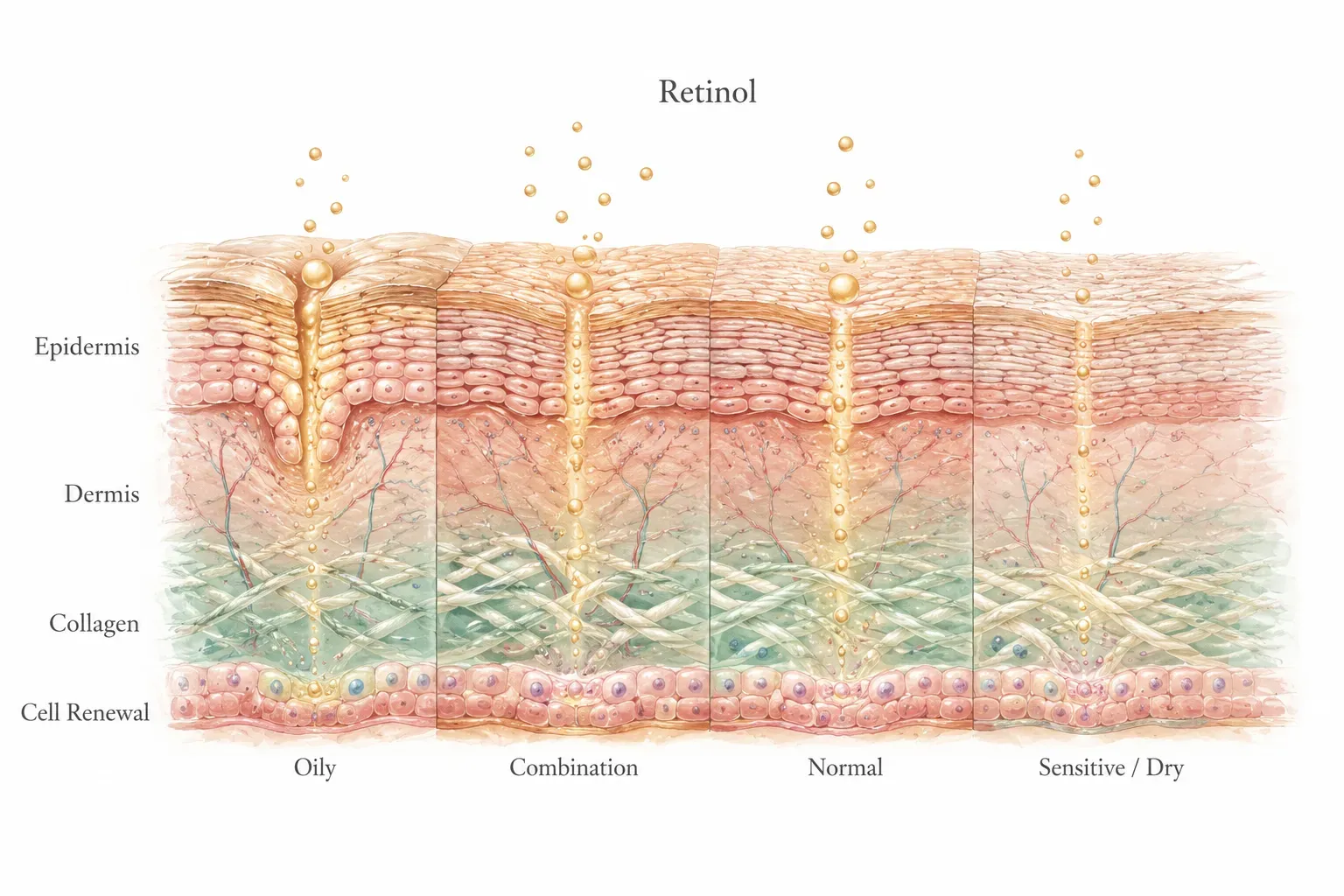
How to read it
The diagram should show a gradual ramp labeled "introduction speed," with oily and normal skin able to move along it a bit faster, and dry and sensitive skin needing a longer, gentler ramp with more spacing between applications.
Useful context
Skin facts
Turnover
Retinol accelerates skin cell turnover, which is central to its effect on texture and tone but also the source of early irritation.
Retinization
The initial adjustment period, sometimes called retinization, commonly includes dryness, flaking, or mild redness in the first few weeks.
Frequency
Starting with two to three nights per week is a common strategy for reducing irritation across all skin types.
Sun Sensitivity
Retinol increases sun sensitivity, making daily sunscreen important regardless of skin type.
What is retinol?
Retinol is a vitamin A derivative used in skincare to support cell turnover, collagen-related processes, and a more even-looking texture and tone over time.
Retinol by skin type
Most skin types can use retinol, though the ideal starting point differs considerably.
- Oily skin — often tolerates it well, may help manage breakouts
- Combination skin — generally adjusts well with gradual introduction
- Mature skin — a common and well-supported use case
- Dry skin — can use it, but needs extra hydration and a slower start
- Sensitive skin — often needs the lowest strength and least frequent use
When to be more cautious
Some situations call for extra care or medical guidance before starting retinol.
- Pregnancy or breastfeeding, where retinoids are generally avoided
- Active eczema, rosacea flare-ups, or a compromised skin barrier
- Already using other strong exfoliating actives
- Very reactive or historically retinoid-intolerant skin
Possible side effects during adjustment
The early weeks of retinol use commonly involve some degree of adjustment, regardless of skin type, though the severity varies.
- Dryness and flaking, especially in the first few weeks
- Mild redness or sensitivity
- Increased sun sensitivity
- Temporary breakout flare in some cases
Common myths about retinol and skin type
Myth
Sensitive skin can never use retinol.
Reality
Many sensitive skin types can use it successfully with a slow, low-strength approach.
Myth
More frequent use gives faster results.
Reality
Overuse increases irritation risk without necessarily speeding up results.
Guardrails
Common mistakes
The small misreads that usually make skincare advice harder to use.
Mistake
Starting with a high concentration or nightly use
Better move
Begin with a low strength two to three times a week and build up gradually.
Mistake
Skipping moisturizer during the adjustment period
Better move
Layer moisturizer before or after retinol to reduce dryness and irritation.
Mistake
Combining retinol with strong acids too soon
Better move
Introduce one active at a time so you know what your skin is reacting to.
Action plan
What to do next
A clean order of operations you can follow without overbuilding the routine.
- 1
Choose a low starting strength
A gentle formula, especially for dry or sensitive skin, reduces the risk of irritation.
- 2
Build up frequency slowly
Two to three nights a week is a reasonable starting point for most skin types.
- 3
Support the barrier throughout
Pair with a good moisturizer and daily sunscreen to manage dryness and sun sensitivity.
Remember this
Key takeaways
- 1
Most skin types can use retinol successfully with the right introduction strategy.
- 2
Oily, combination, and mature skin often adjust relatively easily.
- 3
Dry and sensitive skin usually need a lower strength and slower pace.
- 4
The adjustment period, or retinization, is common and usually temporary.
- 5
Daily sunscreen becomes especially important while using retinol.
FAQ
Short answers to common practical questions.
Can sensitive skin use retinol?
Yes, often with a low-strength formula, infrequent application, and a gradual introduction.
Is retinol bad for dry skin?
Not necessarily, but dry skin should pair it with extra hydration and a slower introduction to reduce flaking.
How long does skin take to adjust to retinol?
Most people notice the initial adjustment period easing within two to six weeks of consistent, gradual use.
Can oily skin use retinol every night?
Some oily skin types tolerate frequent use well, but it is still safer to build up gradually rather than starting nightly.
How to use this guide
Skincare reactions vary. Introduce retinol gradually and stop use if severe irritation occurs.