Evidence
What the evidence shows
The mistake isn't using oily-skin products on combination skin, it's using them uniformly, when the whole point of combination skin is that it doesn't behave uniformly.
Whole face or T-zone only?
T-zone onlyNeed extra moisturizer elsewhere?
Yes, on the cheeks
Use this section to decide
Does this advice apply to me?
Find the concern or goal closest to yours, then use the fit signal to decide how much weight to give this guide.If your goal is
T-zoneDepends- Fit signal
- Possible fit
Oil-prone
If your goal is
CheeksUse caution- Fit signal
- Limited evidence
Normal to dry
If your goal is
ApproachUsually relevant- Fit signal
- Often useful
Zoned routine
If your goal is
RiskDepends- Fit signal
- Possible fit
Over-drying cheeks
Explanation
How it works
Absorb excess oil
Ingredients like clay or silica soak up surface sebum.
Reduce shine
Mattifying agents create a temporary matte finish.
Minimize pore appearance
Less surface oil can make pores look smaller.
Support gentle exfoliation
Some formulas include mild acids to reduce congestion.
Practical use
How to use it
Identify your zones
Note where your skin gets oily and where it tends to feel dry or normal.
Apply selectively
Use oil-control products on the T-zone and a richer moisturizer on the cheeks.
Adjust with the seasons
Reassess your zones as weather and humidity change.
Safety
Side effects and cautions
- Applying oily-skin products to the entire face
Limit them to the T-zone and use a gentler formula elsewhere.
- Assuming combination skin needs one single product
A zoned routine usually works better than a one-size-fits-all approach.
- Skipping moisturizer on drier areas out of fear of oil
The cheeks still need hydration, even if the T-zone doesn't.
Fit
Who should be careful
- Full-face application on very dry cheeks
Worth noting
Small details that can change the answer
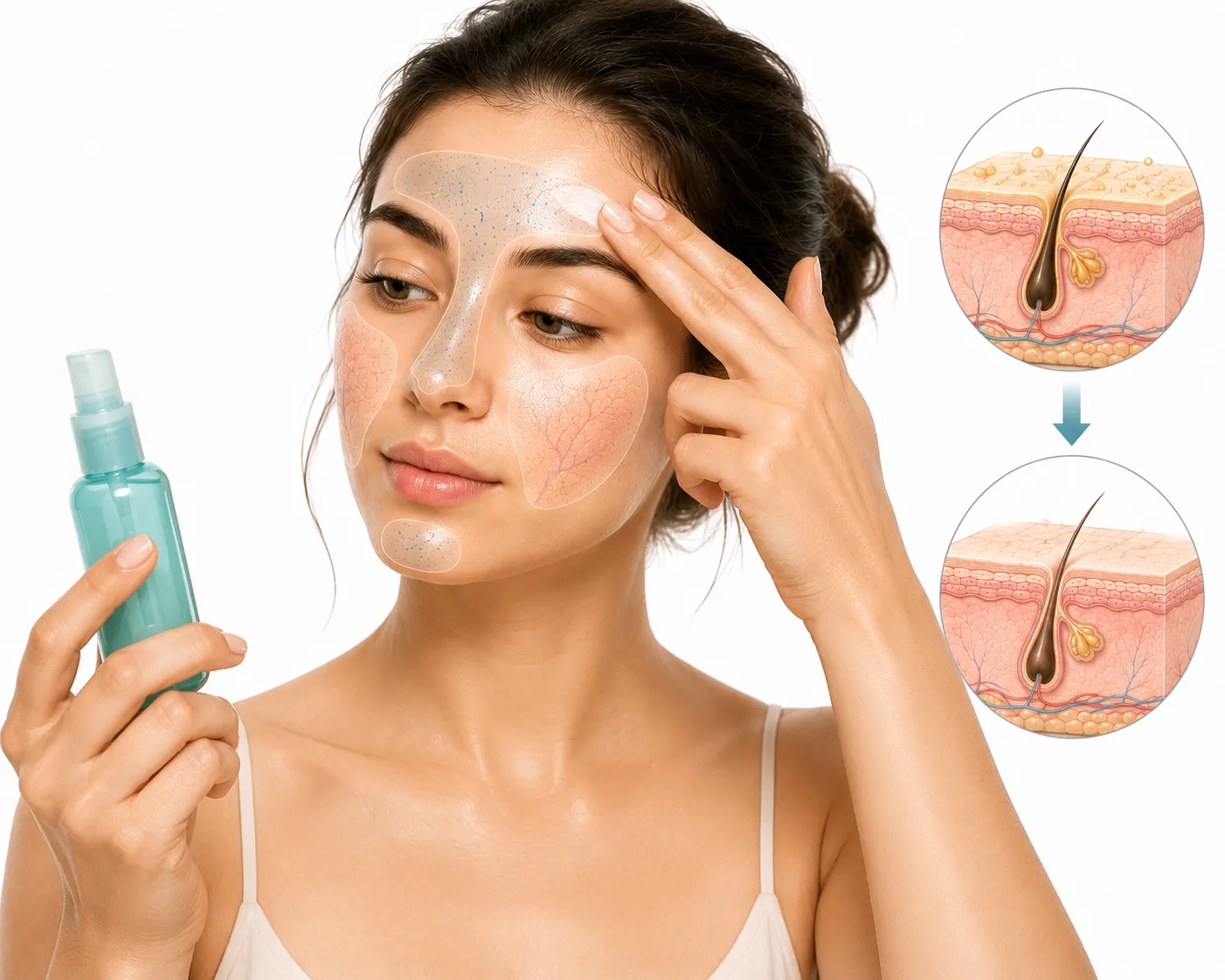
- Zoned Behavior. Combination skin typically shows more oil in the T-zone and less on the cheeks.
- Product Mismatch Risk. Applying oily-skin formulas across the whole face can over-dry the cheeks and jawline.
- Multi-Masking. Using different products on different facial zones is a common approach for combination skin.
- Seasonal Shift. The balance between oily and dry zones can shift with weather and humidity.
Combination skin can use oily-skin products, but generally only on the oilier T-zone.
Applying oil-control formulas across the whole face risks over-drying the cheeks.
A zoned or multi-masking approach matches how combination skin actually behaves.
The cheeks and jawline usually need a richer moisturizer than the T-zone does.
The balance between zones can shift seasonally, so routines may need adjusting.
Explanation
Why zoning works better than a single routine
Combination skin doesn't produce oil evenly, so a product designed to reduce oil will only be beneficial where oil is actually a problem. Applying it everywhere ignores the fact that the cheeks may already be closer to a normal or dry baseline.
Dos Donts
Applying oily-skin products on combination skin
Do
That's where excess oil is concentrated.
Prevents over-drying in less oily areas.
Avoid
Can leave cheeks feeling tight or flaky.
Increases the risk of irritation.
Decision Helper
Matching the product to the zone
Shiny T-zone by midday
Use a lightweight, oil-absorbing product on the forehead, nose, and chin.Targets where sebum production is highest.
Tight or flaky cheeks
Apply a hydrating, non-comedogenic moisturizer to the cheeks and jawline.Supports the drier areas without adding oil-control ingredients they don't need.
Questions
Frequently asked questions
Can I use a mattifying moisturizer all over my face?
It's generally better limited to the T-zone, with a richer formula on the cheeks.
Will oil-control products make my dry patches worse?
If applied to already-dry areas, yes, which is why zoning matters.
Is multi-masking necessary for combination skin?
It's not mandatory, but it's a practical way to address both oily and dry zones.
How do I know where my T-zone actually is?
It typically covers the forehead, nose, and chin, forming a T shape across the face.