Evidence
What the evidence shows
Evidence-based risk factors and screening recommendations.
UV exposure → skin cancer
Well-established linkABCDE rule utility
Validated screening toolEarly detection benefits
Dramatically improves outcomes
Use this section to decide
Does this advice apply to me?
Find the concern or goal closest to yours, then use the fit signal to decide how much weight to give this guide.If your goal is
BCCDepends- Fit signal
- Possible fit
Pearly, waxy bump with visible blood vessels
If your goal is
SCCDepends- Fit signal
- Possible fit
Firm, red bump with scaly surface
If your goal is
MelanomaUse caution- Fit signal
- Limited evidence
Asymmetric, irregular borders, multiple colors
Practical use
How to use it
Perform regular skin checks
Examine your skin monthly, using mirrors to check hard-to-see areas.
Apply the ABCDE rule
Look for asymmetry, irregular borders, multiple colors, large diameter, or changes.
See a dermatologist for any concerns
Don't wait - early detection saves lives.
Safety
Side effects and cautions
- Assuming a spot is harmless because it doesn't look "scary"
Skin cancer can appear in many forms - any new or changing spot should be evaluated.
- Delaying a doctor visit due to fear
Early detection dramatically improves outcomes.
- Relying solely on photos from the internet for self-diagnosis
Professional medical evaluation is essential for accurate diagnosis.
- New or changing mole
Common · Evaluate with ABCDE rule; see a doctor if concerned
- Sore that doesn't heal
Common in BCC and SCC · See a doctor immediately
- Scaly or bleeding bump
Common in SCC · Medical evaluation needed
Fit
Who should be careful
- Self-diagnosis - always consult a professional
Worth noting
Small details that can change the answer
- ABCDE Rule. The ABCDE rule is the standard screening tool: Asymmetry, Border, Color, Diameter, Evolution.
- BCC Appearance. Basal cell carcinoma often looks like a shiny, pearly bump with visible blood vessels.
- SCC Appearance. Squamous cell carcinoma appears as a firm, red bump with a rough, scaly surface.
- Melanoma. Melanoma can appear in colors ranging from black to brown to pink or even white.
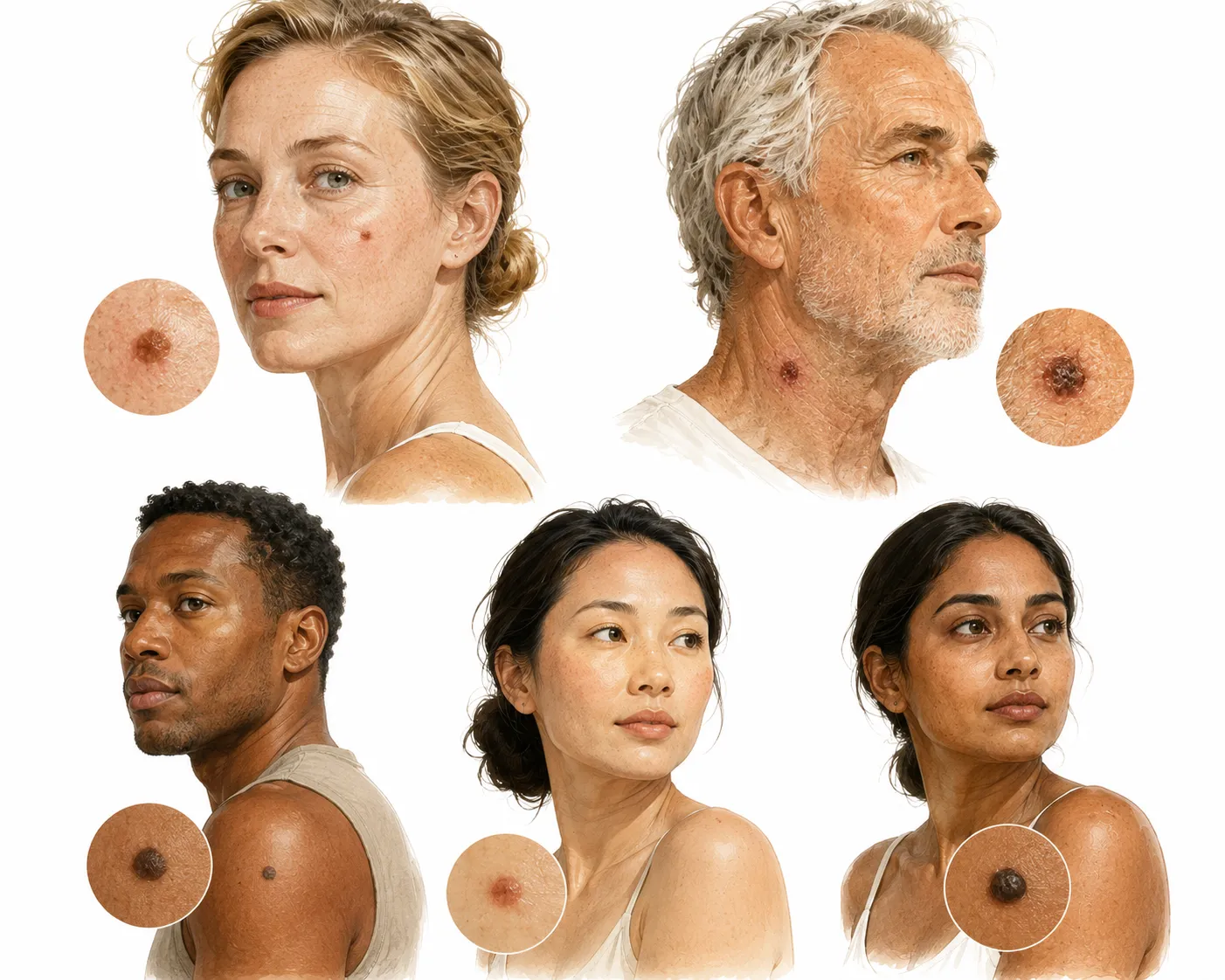
The three main types of skin cancer look different: BCC is pearly, SCC is scaly, melanoma is often dark and irregular.
The ABCDE rule is a simple screening tool that can help you spot potential melanomas.
Any new, changing, or unusual skin growth should be evaluated by a doctor.
Skin cancer is highly treatable when detected early.
Regular self-examinations and dermatological checks are essential for prevention.
Definition
Basal cell carcinoma (BCC)
BCC is the most common type of skin cancer. It typically appears on sun-exposed skin, especially the face, ears, neck, and hands. It may look like: a pearly or waxy bump (often with visible blood vessels), a flat, flesh-colored or brown scar-like lesion, or a sore that bleeds or doesn't heal.
Definition
Squamous cell carcinoma (SCC)
SCC is the second most common type. It appears on sun-exposed skin and can also develop in scars or ulcers. It often looks like: a firm, red nodule with a rough, scaly surface, a flat lesion with a scaly crust, or a sore that doesn't heal.
Definition
Melanoma
Melanoma is the most dangerous form of skin cancer. It can develop anywhere on the body, including skin not typically exposed to the sun. The ABCDE rule helps identify potential melanomas: Asymmetry, irregular Border, multiple Colors, Diameter greater than 6mm, Evolving (changing in size, shape, or color).
Risks
When to see a doctor immediately
Any skin growth that is new, changing, or unusual should be evaluated by a medical professional. Pay particular attention to:
- Moles that are asymmetric or have irregular borders
- Lesions with multiple colors or uneven pigmentation
- Spots that are growing or changing over time
- Sores that don't heal or keep returning
- Bumps that are painful, itchy, or bleeding
Clinical Guidance
Medical guidance
- Perform regular skin self-examinations, checking all areas of the body.
- Use the ABCDE rule as a screening tool, not a diagnostic tool.
- Schedule routine dermatological skin checks, especially if you have risk factors.
- Take photos of moles or spots to track changes over time.
- See a dermatologist immediately if you notice any concerning changes.
Questions
Frequently asked questions
Is all skin cancer dark or black?
No - BCC and SCC are often flesh-colored, pink, or red. Melanoma can be dark but can also be pink or skin-colored.
Can skin cancer appear on skin that's not sun-exposed?
Yes - melanoma, in particular, can appear anywhere on the body.
Does the ABCDE rule apply to all skin cancers?
It's primarily for melanoma, but BCC and SCC also have distinct visual signs.
What if I have many moles?
Having many moles is a risk factor - you should have regular dermatological checks.