Evidence
What the evidence shows
The skin's DNA repair enzymes work best on recent damage. Once UV damage accumulates over years, the skin reaches a point where natural repair can't keep pace, which is why prevention matters more than correction.
DNA repair
Well-established mechanism in human skinStructural repair
Limited natural capacity for collagen restorationPrevention value
Strongly supported for avoiding further damage
Use this section to decide
Does this advice apply to me?
Find the concern or goal closest to yours, then use the fit signal to decide how much weight to give this guide.If your goal is
DNA repairUsually relevant- Fit signal
- Often useful
Yes, limited
If your goal is
Collagen repairUse caution- Fit signal
- Limited evidence
No
If your goal is
Pigment fadingDepends- Fit signal
- Possible fit
Partial
If your goal is
Best supportUse caution- Fit signal
- Limited evidence
Sunscreen + antioxidants
Research notes already in this guide
- Skin cells have robust DNA repair capacity, particularly for UVB-induced damage.
- Self-repair of collagen and elastin is minimal once breakdown has occurred.
- Pigmentation changes often diminish somewhat over time but rarely resolve completely.
- Antioxidant support from diet and skincare can support the body's natural repair systems.
Explanation
How it works
Damage recognition
Enzymes detect UV-damaged DNA segments and mark them for repair.
Excision and replacement
The damaged DNA is cut out and replaced with healthy copies.
Oxidative stress response
Antioxidant systems neutralize free radicals generated by UV exposure.
Cellular turnover
Damaged cells are sloughed off and replaced by new cells from the basal layer.
Practical use
How to use it
Protect first
Daily broad-spectrum sunscreen is non-negotiable while your skin attempts repair.
Support with antioxidants
Vitamin C and other antioxidants help neutralize free radicals and support repair.
Consult a professional
For established sun damage, a dermatologist can recommend treatments like retinoids or laser therapy.
Safety
Side effects and cautions
- Thinking complete repair is possible
Sun damage accumulates; self-repair is helpful but limited.
- Waiting to address damage
Early intervention supports the skin's natural repair mechanisms.
- Skipping sunscreen during repair
Preventing new damage is essential for repair to be effective.
- Accumulating photodamage
Common · Use sunscreen daily
- Premature skin aging
Common · Support with active ingredients
- Skin cancer risk
Variable · See a dermatologist for skin checks
Fit
Who should be careful
- Established collagen loss and deep wrinkling
- Chronic photodamage with visible changes
Worth noting
Small details that can change the answer
- DNA Repair. Skin cells have natural DNA repair mechanisms that can fix UV-induced damage within 24-48 hours.
- Collagen Reality. Once collagen fibers are broken down by UV exposure, the body has very limited ability to rebuild them.
- Melanin Protection. Melanin provides some natural UV protection, but it also makes visible pigmentation changes that can be stubborn.
- Time Dependence. The likelihood of self-repair drops dramatically after 72 hours of UV exposure.
Sun-damaged skin can repair DNA damage but has limited capacity to restore structural damage.
Self-repair is most effective for recent, acute sun exposure.
Chronic photodamage accumulates and is largely irreversible without intervention.
Antioxidants and sun protection support the body's natural repair systems.
The best approach is prevention first, support second, and treatment for established damage.
Science
The two types of sun damage
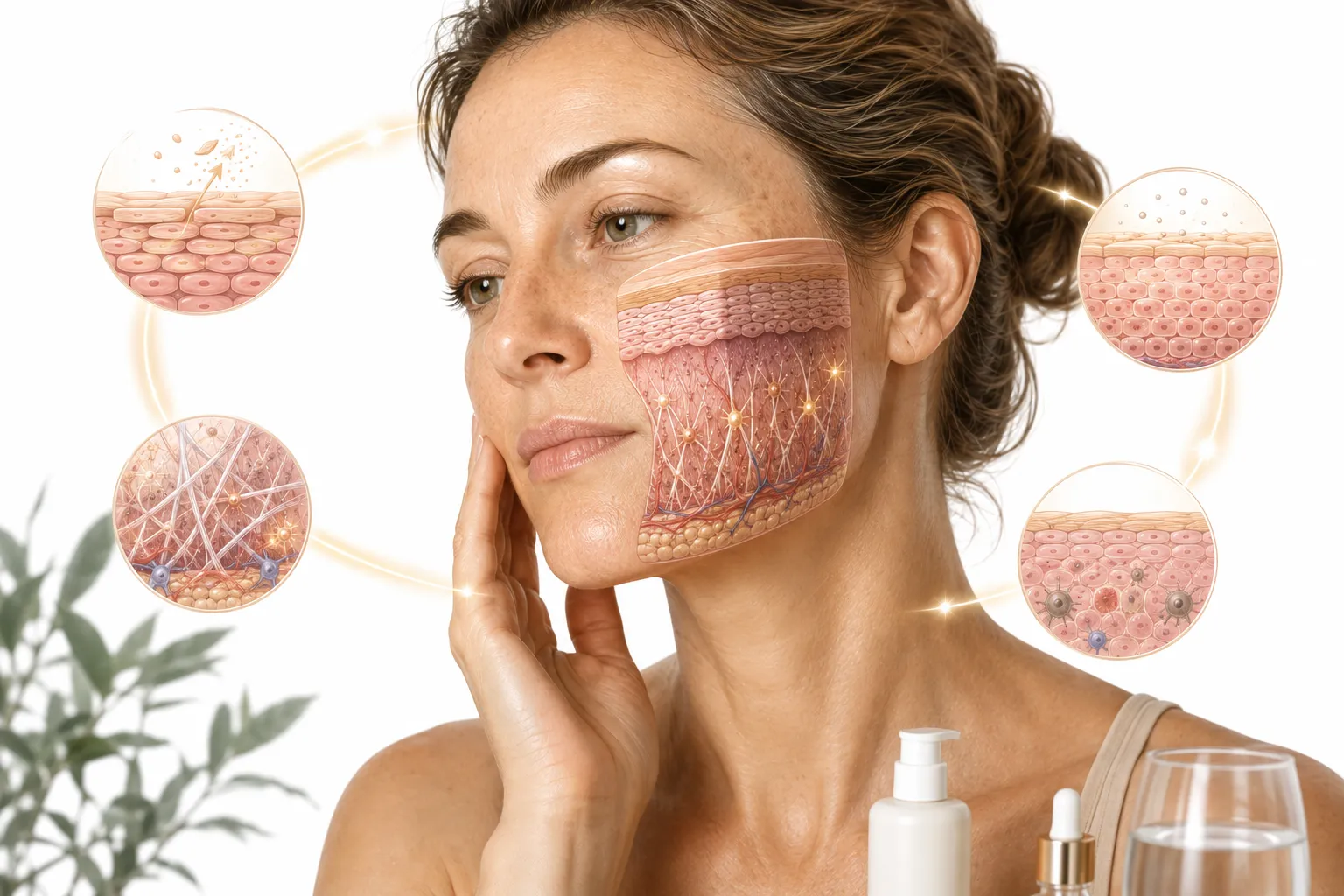
UV radiation causes two distinct categories of damage. The first is direct DNA damage, where UV energy causes mutations in the genetic code of skin cells. The second is indirect damage through oxidative stress, where UV generates free radicals that break down structural proteins and cause cellular inflammation.
- Nucleotide Excision Repair
- The body's primary mechanism for repairing UV-induced DNA damage by removing and replacing damaged segments.
- Photodamage
- Chronic skin damage from sun exposure, characterized by collagen loss, pigmentation changes, and DNA mutations.
Benefits
What you can do to support self-repair
While your skin does its own repair work, you can give it a helping hand.
- Use daily sunscreen to prevent new damage while repair happens
- Include antioxidants like vitamin C and E in your routine
- Support DNA repair with ingredients like niacinamide
- Stay hydrated and maintain a nutrient-rich diet
- Get good sleep, as most repair happens overnight
Questions
Frequently asked questions
How long does it take for sun-damaged skin to repair itself?
DNA repair happens within 24-48 hours after UV exposure, but structural damage like collagen loss is generally not repaired.
Can the skin repair all types of sun damage?
No. The skin can repair some DNA damage but not collagen degradation, elastin damage, or established hyperpigmentation.
Does age affect skin's self-repair capacity?
Yes. DNA repair efficiency and collagen production both decline with age.
Can supplements help skin repair sun damage?
Antioxidants like vitamin C, vitamin E, and certain botanical extracts can support the skin's natural repair processes.
References
Sources
The notes below are drawn from the evidence already cited in this guide. They are not a complete bibliography.
- Skin cells have robust DNA repair capacity, particularly for UVB-induced damage.
- Self-repair of collagen and elastin is minimal once breakdown has occurred.
- Pigmentation changes often diminish somewhat over time but rarely resolve completely.
- Antioxidant support from diet and skincare can support the body's natural repair systems.