Evidence
What the evidence shows
The skin barrier has impressive self-repair capabilities, but these mechanisms are based on continuous production - not quick fixes. Repair takes time because new cells and lipids must be manufactured from scratch.
Use this section to decide
Does this advice apply to me?
Find the concern or goal closest to yours, then use the fit signal to decide how much weight to give this guide.If your goal is
Can it repair itself?Usually relevant- Fit signal
- Often useful
Yes
If your goal is
Primary mechanismsUse caution- Fit signal
- Limited evidence
Turnover + lipid synthesis
If your goal is
TimelineDepends- Fit signal
- Possible fit
1-4 weeks (depending on severity)
If your goal is
Best supportUsually relevant- Fit signal
- Often useful
Ceramides + niacinamide
Explanation
How it works
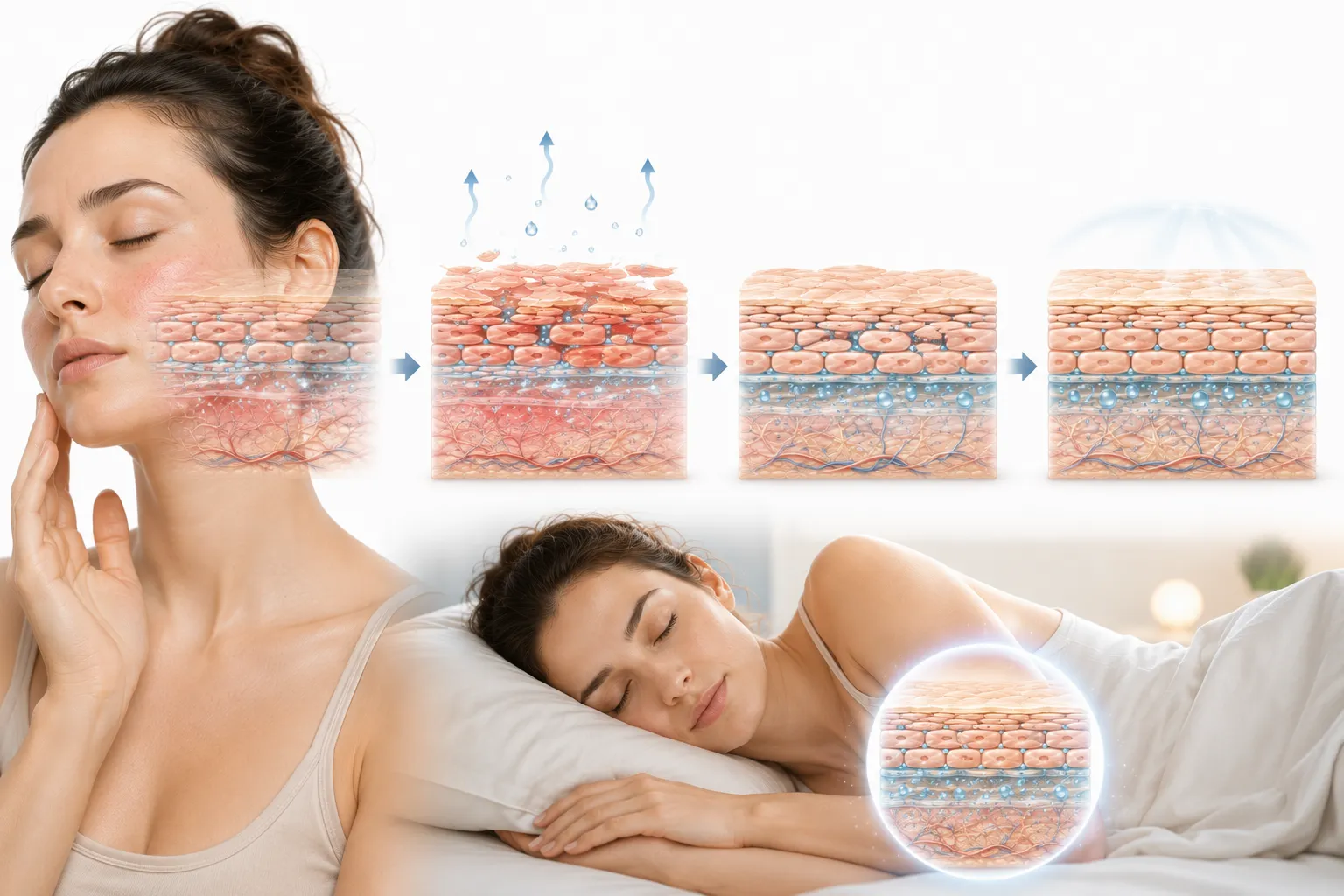
Damage detected
Keratinocytes sense barrier disruption and activate repair signaling.
Cell production accelerates
Basal cells divide more rapidly to replace damaged corneocytes.
Lipid production increases
Ceramide, cholesterol, and fatty acid synthesis ramp up.
Barrier restored
New cells and lipids rebuild the barrier structure over time.
Expected results
Results and timeframe
Repair takes time - 1-4 weeks depending on severity.
Barrier-supporting skincare can accelerate and improve repair.
Seek professional help if there's no improvement after 4-6 weeks.
Practical use
How to use it
Remove all irritants
Stop using exfoliants, retinoids, vitamin C, and any products that sting.
Use a barrier-supporting moisturizer
Look for ceramides, niacinamide, panthenol, and squalane.
Give it time
Allow at least 4-6 weeks for the barrier to fully repair itself.
Safety
Side effects and cautions
- Continuing to use actives while waiting for self-repair
Stop all exfoliants, retinoids, and acids during the repair period.
- Not being patient enough with the process
The barrier takes weeks to fully repair; give it at least 4 weeks.
- Assuming all skin can self-repair equally well
Some skin types and conditions need more support than others.
Fit
Who should be careful
- Severe or chronic damage that needs medical intervention
Worth noting
Small details that can change the answer
- Self-Repair Rate. The skin barrier can repair itself within 1-4 weeks depending on the extent of damage.
- Lipid Replenishment. Ceramide production is upregulated in response to barrier disruption to accelerate repair.
- Turnover Time. Complete epidermal turnover takes approximately 28 days in healthy skin.
- Repair Limits. Chronic damage can overwhelm the repair capacity of even healthy skin.
The skin barrier has powerful self-repair mechanisms through cell turnover and lipid synthesis.
Removing the source of damage is the first and most important step.
Science
The molecular machinery of barrier repair
When the skin barrier is disrupted, keratinocytes in the epidermis detect the change and activate a series of repair pathways. These include increased expression of genes involved in lipid synthesis, acceleration of cell differentiation and migration, and upregulation of the natural moisturizing factors that help maintain hydration. The process is coordinated by a complex network of signaling molecules, including calcium gradients, cytokines, and growth factors.
- Keratinocyte
- The primary cell type in the epidermis, responsible for producing keratin and forming the barrier.
- Lipid Synthesis
- The production of ceramides, cholesterol, and fatty acids that form the barrier's "mortar."
Benefits
How to support your skin's self-repair capacity
Your skin can do the heavy lifting, but you can create the conditions for optimal repair.
- Stop using active ingredients, acids, and retinoids during repair
- Use a gentle, pH-balanced cleanser
- Apply a barrier-supporting moisturizer with ceramides and niacinamide
- Protect your skin from UV exposure and environmental stress
- Maintain adequate hydration and a balanced diet
Risks
When self-repair isn't enough
There are situations where the skin's natural repair mechanisms can't keep up.
- Severe chemical burns or injuries
- Underlying conditions like eczema, psoriasis, or ichthyosis
- Chronic over-exfoliation that persists for weeks or months
- Immune suppression due to medication or illness
- Nutritional deficiencies affecting skin health
Clinical Guidance
When to seek professional help
- Consult a dermatologist if your skin doesn't improve within 4-6 weeks of a simplified routine.
- Seek immediate medical attention for chemical burns, severe allergic reactions, or signs of infection.
- A dermatologist can prescribe barrier-repair creams with specific ceramide ratios.
- They can also rule out underlying conditions that may be impairing self-repair.
- In some cases, prescription treatments like topical corticosteroids or calcineurin inhibitors may be needed.
Questions
Frequently asked questions
Can the skin barrier repair itself without moisturizer?
It can, but moisturizer provides the raw materials (ceramides, fatty acids) that speed the process.
How long does it take for the skin barrier to repair itself?
Mild damage: 1-2 weeks; moderate damage: 2-4 weeks; severe damage: 4-6 weeks or more.
Can a damaged skin barrier heal completely?
Yes, the skin has remarkable healing capacity, and a healthy barrier can be fully restored.
Does stress affect skin barrier self-repair?
Yes, stress elevates cortisol, which can impair the skin's natural repair mechanisms.