Evidence
What the evidence shows
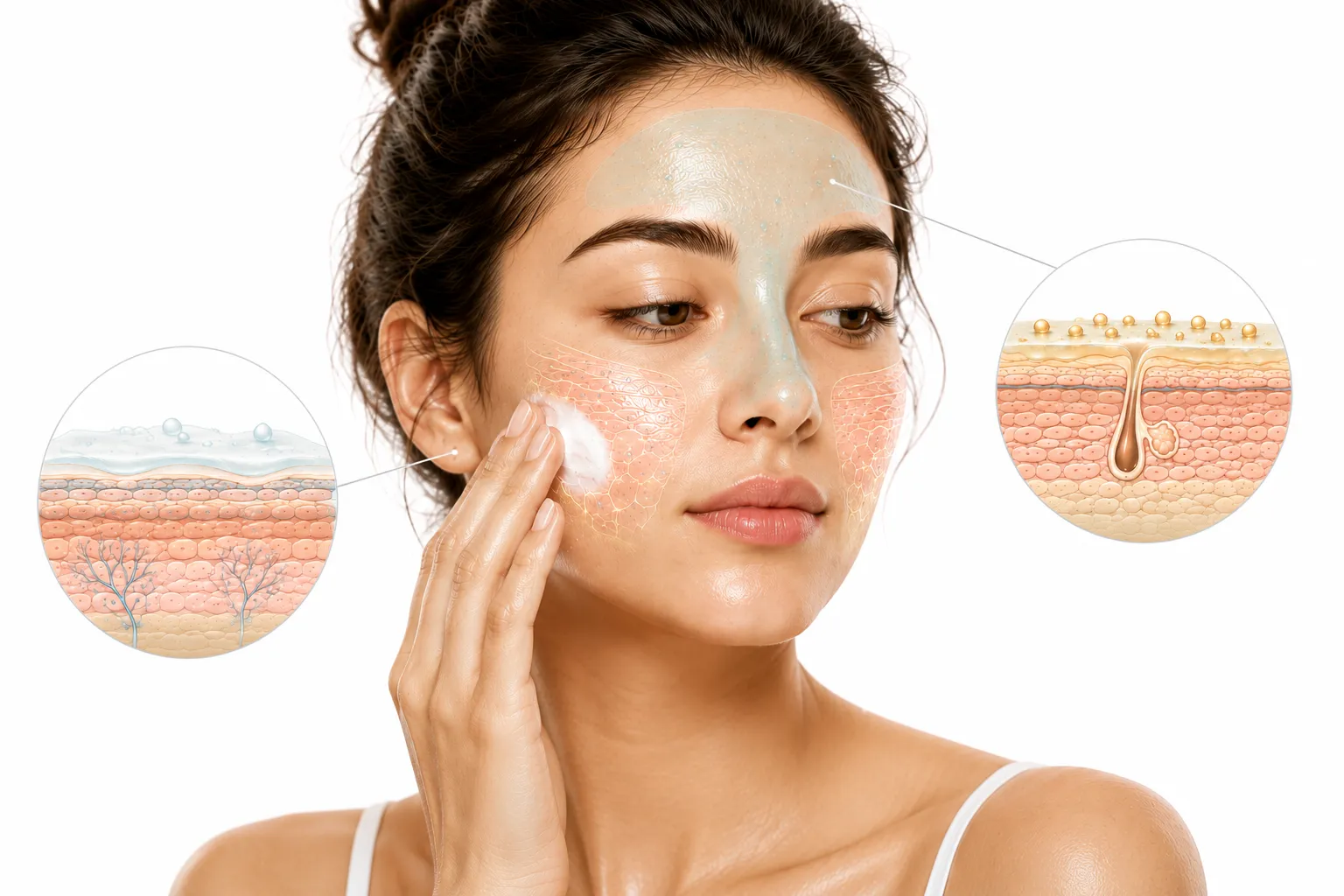
The label on a product matters less than the product itself - some "dry skin" ingredients benefit combination skin, while others are just too heavy for the T-zone.
Product has shea butter?
Use only on cheeks - avoid T-zone.Product has ceramides?
May work on both zones - check texture.Product has heavy oils?
Avoid on combination skin entirely.
Use this section to decide
Does this advice apply to me?
Find the concern or goal closest to yours, then use the fit signal to decide how much weight to give this guide.If your goal is
Use onUsually relevant- Fit signal
- Often useful
Dry areas only (cheeks, eyes)
If your goal is
Avoid onDepends- Fit signal
- Possible fit
T-zone
If your goal is
Best ingredientsUsually relevant- Fit signal
- Often useful
Ceramides, hyaluronic acid
If your goal is
Avoid ingredientsDepends- Fit signal
- Possible fit
Heavy oils, butters
Practical use
How to use it
Assess which areas need richer products
Identify your dry areas - usually the cheeks and eye area.
Apply dry skin products only where needed
Keep rich products off the T-zone.
Monitor T-zone response
If your T-zone feels congested, the product is too heavy.
Safety
Side effects and cautions
- Using a rich cream all over
Use rich creams only on the cheeks - keep them off the T-zone.
- Assuming all dry skin products are too heavy
Some lightweight dry skin products may work everywhere.
- Buying based on label alone
Check ingredients and texture, not just the label.
Fit
Who should be careful
- Those who want to use one product all over - you need a zonal approach
Worth noting
Small details that can change the answer
- Zonal Approach. Dry skin products should be used only on the dry areas of combination skin.
- T-Zone Rule. Keep rich, heavy products off the T-zone.
- Ingredient Nuance. Some dry skin ingredients (ceramides) work everywhere - others (heavy oils) should be zonal.
- Texture Matters. The texture and weight of a product matter more than the label.
Combination skin can use dry skin products, but only on the dry areas.
Keep rich creams and heavy oils off the T-zone to avoid clogging.
Some dry skin ingredients (ceramides, hyaluronic acid) can work everywhere.
Texture and ingredients matter more than the label.
Monitor your T-zone for any signs of congestion or breakouts.
Dos Donts
Dos and don'ts for using dry skin products on combination skin
Do
Addresses the needs of cheeks without affecting T-zone
Ceramides, hyaluronic acid, and other barrier ingredients can work everywhere
Lightweight products may work everywhere; rich creams should be zonal
Ensures they don't cause issues on either area
Avoid
Will clog T-zone pores
Some lightweight ones may work everywhere
Can cause breakouts
T-zone reactions tell you if a product is too heavy
Skin Type Suitability
Product suitability for combination skin
Products for dry skin work well on the cheeks
Avoid on the T-zone - can cause breakouts
Use on dry areas only; avoid on oily areas
Ingredient Comparison
Ingredients in dry skin products - what works for combination skin
Ceramides
bestBest for: Both zones benefit - supports barrier functionBarrier support · Non-comedogenic
Hyaluronic Acid
bestBest for: Both zones benefit - hydration without oilHydrating · Lightweight · Oil-free
Shea Butter
goodBest for: Dry areas only - can be too heavy for T-zoneRich hydration
Limitations: Can be comedogenicHeavy Oils (Olive, Coconut)
avoidBest for: Not recommended for combination skinVery hydrating
Limitations: Highly comedogenicExplanation
Reading the label for combination skin
When considering a dry skin product for combination skin, look beyond the label. Check the ingredients and texture. Products with lightweight, non-comedogenic ingredients like ceramides, hyaluronic acid, and niacinamide may work well on both zones. Products with heavy oils, rich butters, and thick occlusives are best reserved for the cheeks. The formulation matters more than the "for dry skin" label.
Questions
Frequently asked questions
Can I use dry skin moisturizer on my cheeks only?
Yes - that's a great approach for combination skin.
Are all dry skin products comedogenic?
No - many contain non-comedogenic ingredients that can be used safely.
Can I use dry skin serums on combination skin?
Yes, if they're not too heavy - check the ingredients.
How do I know if a dry skin product is too heavy?
If your T-zone develops breakouts or feels congested, the product is too heavy.