Evidence
What the evidence shows
Vitamin C is one of the few actives that doesn't need to be zoned differently across combination skin, since its benefit isn't tied to oil level the way exfoliants or mattifiers are.
Use this section to decide
Does this advice apply to me?
Find the concern or goal closest to yours, then use the fit signal to decide how much weight to give this guide.If your goal is
ApplicationUsually relevant- Fit signal
- Often useful
Even, whole face
If your goal is
Best timeUse caution- Fit signal
- Limited evidence
Morning
If your goal is
Zoning neededUsually relevant- Fit signal
- Often useful
No
If your goal is
Formula sensitivityDepends- Fit signal
- Possible fit
Varies
Practical use
How to use it
Choose a suitable formula
Consider a gentler derivative if your skin is irritation-prone.
Apply each morning
Use after cleansing and before moisturizer.
Follow with sunscreen
Always finish the morning routine with SPF.
Safety
Side effects and cautions
- Assuming vitamin C needs to be zoned like an oil-control product
It can generally be applied evenly across combination skin.
- Skipping sunscreen because vitamin C offers some protection
Vitamin C complements sunscreen but doesn't replace it.
- Choosing a high-percentage L-ascorbic acid formula right away
Starting with a gentler derivative can reduce irritation risk.
Fit
Who should be careful
- Those very sensitive to L-ascorbic acid
Helpful context
What else is worth knowing
Vitamin C at a glance
Worth noting
Small details that can change the answer
- Broadly Applicable. Vitamin C's antioxidant function doesn't depend on a skin zone's oil level.
- Formulation Variability. Pure L-ascorbic acid formulas can be more irritating than derivative-based ones.
- Morning Use. Vitamin C is most commonly used in the morning to support daytime antioxidant defense.
- Layering Order. It's typically applied after cleansing and before moisturizer and sunscreen.
Combination skin can use vitamin C serum without needing to zone application.
Its antioxidant benefit applies evenly regardless of local oil levels.
Formulation, not skin type, is the main factor to consider.
L-ascorbic acid is potent but can be more irritating than gentler derivatives.
Vitamin C works best as part of a consistent morning routine with sunscreen.
Explanation
Why vitamin C doesn't need zoning
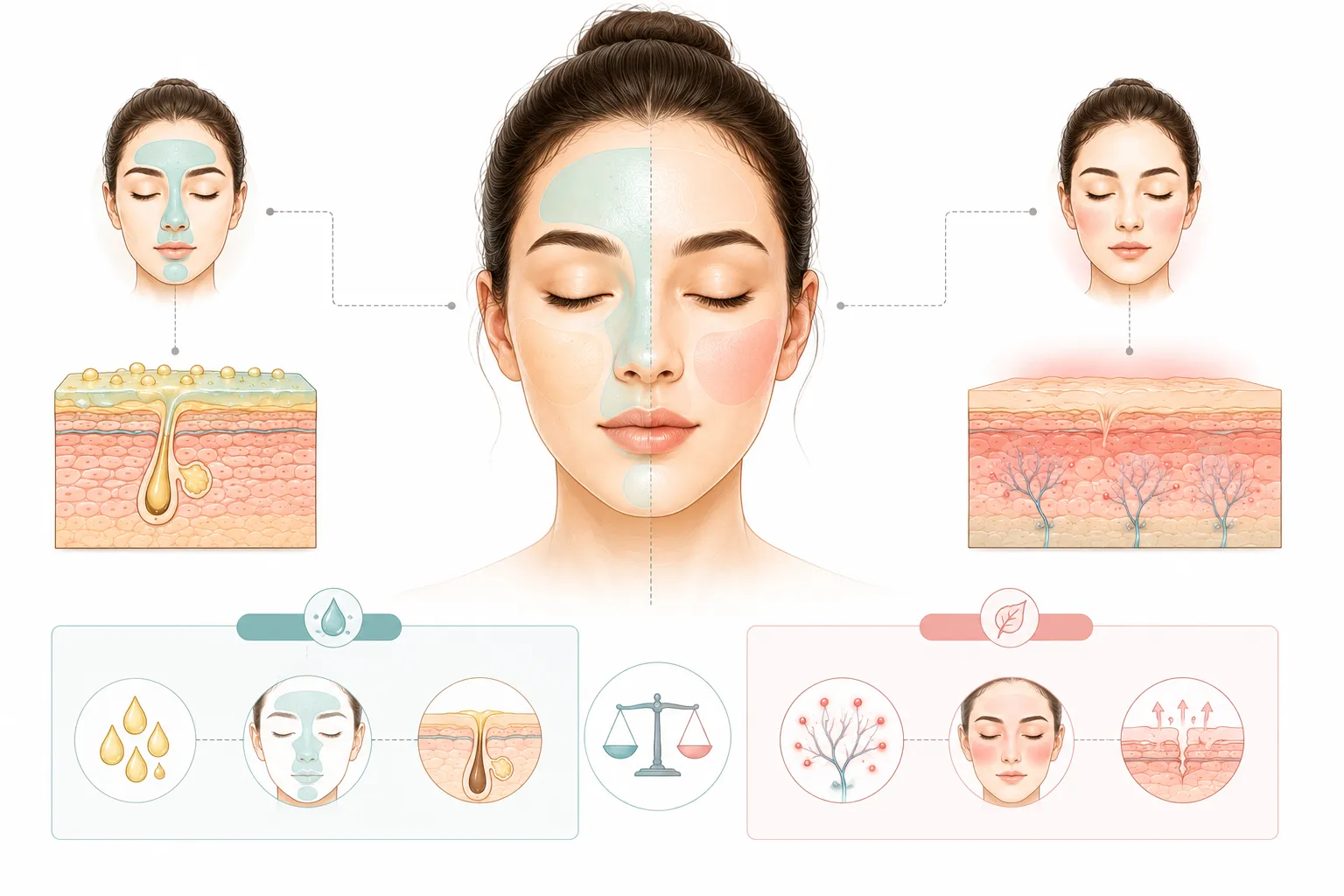
Unlike oil-control or exfoliating ingredients, vitamin C's core benefit, antioxidant protection, is not tied to how much sebum a given area produces. This makes it one of the more straightforward actives to apply evenly across combination skin.
Benefits
What vitamin C serum offers combination skin
Combination skin can generally expect the same core benefits from vitamin C as any other skin type.
- Antioxidant protection against environmental stress
- Support for a more even-looking skin tone
- A brightening effect over consistent use
- Complementary protection alongside daily sunscreen
Ingredient Comparison
Choosing a vitamin C formula
L-ascorbic acid
goodBest for: Those wanting the most researched, potent formStrong antioxidant activity
Limitations: Can be more irritating · Less stableSodium ascorbyl phosphate
goodBest for: Combination or sensitive-leaning skinGentler · More stable
Limitations: Generally less potentBeginner Guide
Introducing vitamin C serum
- 1Week 1 · Every other morning
Watch for any tingling or redness.
- 2Weeks 2-3 · Daily mornings
Increase to daily if well tolerated.
- 3Ongoing · Daily
Always follow with sunscreen.
Questions
Frequently asked questions
Do I need to apply vitamin C differently on my T-zone versus cheeks?
Generally no, it can be applied evenly across combination skin.
Can vitamin C serum make oily skin oilier?
Most formulas are lightweight and unlikely to noticeably increase oiliness.
Is vitamin C serum drying for combination skin?
Some formulas can feel slightly drying, particularly pure L-ascorbic acid versions.
Can I use vitamin C serum with other actives?
Yes, though introducing one new active at a time helps track tolerance.