Evidence
What the evidence shows
Retinol's barrier-damaging effects are temporary and manageable. The key is to introduce it slowly and support the barrier with moisturizers and gentle care during the adjustment period.
Use this section to decide
Does this advice apply to me?
Find the concern or goal closest to yours, then use the fit signal to decide how much weight to give this guide.If your goal is
Damage RiskDepends- Fit signal
- Possible fit
High during adjustment
If your goal is
DurationUse caution- Fit signal
- Limited evidence
4-6 weeks temporary
If your goal is
Safe IntroductionUsually relevant- Fit signal
- Often useful
Slow, low concentration
If your goal is
Barrier SupportUsually relevant- Fit signal
- Often useful
Essential
Research notes already in this guide
- Studies show retinol temporarily increases TEWL and decreases barrier function.
- Research demonstrates that the barrier adapts and recovers with continued use.
- Slow introduction and barrier support significantly reduce retinol irritation.
- Prescription retinoids (tretinoin) have a higher risk of barrier damage than OTC retinol.
Expected results
Results and timeframe
This is typically temporary - the barrier adapts over 4-6 weeks.
Week 1-2 - Initial irritation - Dryness, flaking, increased sensitivity - this is normal.
Week 3-4 - Adaptation begins - Sensitivity decreases as the barrier starts to adapt.
Week 5-6 - Barrier recovery - The barrier strengthens and irritation typically resolves.
Week 6+ - New normal - The barrier is stronger and retinol benefits become visible.
Practical use
How to use it
Start low and slow
Begin with a low concentration (0.1-0.25%) and use it 1-2 times per week.
Use the sandwich method
Apply moisturizer, then retinol, then another layer of moisturizer.
Support your barrier
Use ceramide-rich moisturizers and be gentle with your skin.
Safety
Side effects and cautions
- Starting with too high a concentration
Start low (0.1-0.25%) and work your way up.
- Using retinol every day from the start
Start with 1-2 times per week and gradually increase.
- Not using moisturizer with retinol
Use barrier-supporting moisturizers with retinol.
Fit
Who should be careful
- Compromised barriers
- Starting without proper preparation
Helpful context
What else is worth knowing
Retinol barrier effects
During adjustment period
Resolves with adaptation
Barrier recovers
Minimizes damage
Retinol barrier adjustment timeline
- Week 1-2Initial irritation
Dryness, flaking, increased sensitivity - this is normal.
- Week 3-4Adaptation begins
Sensitivity decreases as the barrier starts to adapt.
- Week 5-6Barrier recovery
The barrier strengthens and irritation typically resolves.
- Week 6+New normal
The barrier is stronger and retinol benefits become visible.
What experts say about retinol and barrier damage
Dr. Shereene IdrissRetinol irritation is normal but manageable. Start slow and support your barrier.
Dr. Whitney BoweThe "sandwich method" (moisturizer-retinol-moisturizer) can significantly reduce retinol irritation.
Worth noting
Small details that can change the answer
- Cell Turnover. Retinol increases cell turnover, which can temporarily thin the barrier.
- TEWL Increase. Retinol can increase transepidermal water loss during the adjustment period.
- Adaptation. The barrier typically adapts within 4-6 weeks of consistent use.
- Barrier Recovery. With proper care, the barrier becomes stronger after retinol adaptation.
Retinol can temporarily damage the barrier during the adjustment period.
Start with a low concentration and introduce it slowly.
Use barrier-supporting moisturizers to minimize irritation.
The long-term benefits of retinol often outweigh the temporary barrier effects.
Definition
How retinol affects the skin barrier
Understanding the mechanism.
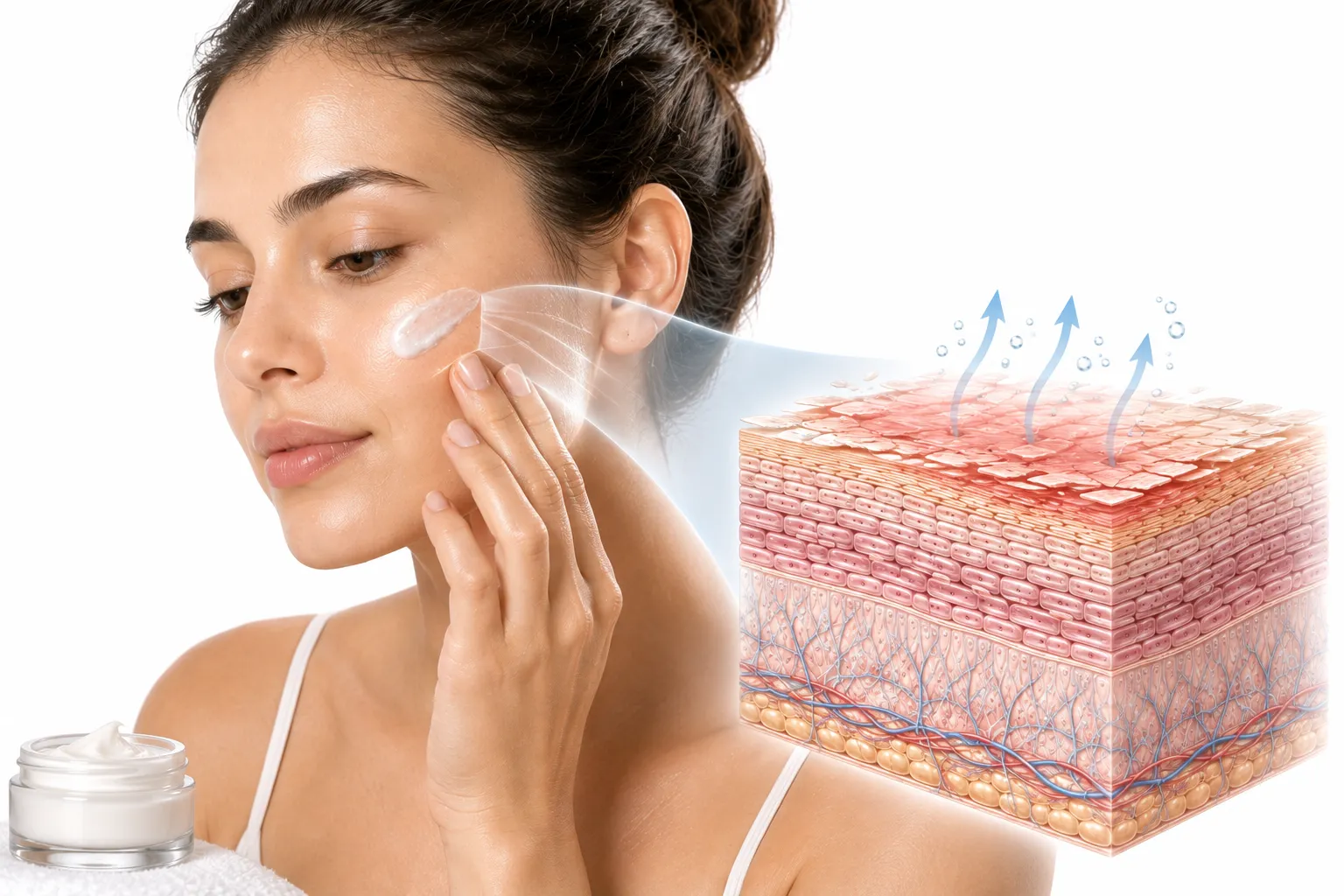
Retinol temporarily thins the stratum corneum by increasing cell turnover. This can lead to increased water loss, dryness, and sensitivity. However, this is typically temporary and the barrier adapts over time.
Explanation
Why retinol causes barrier disruption
Retinol works by speeding up the skin's renewal process. This means cells move to the surface more quickly, which can temporarily disrupt the lipid structure of the barrier. The good news is that the barrier adapts and becomes stronger over time.
When retinol is most likely to damage the barrier
Here are situations where retinol barrier damage is more likely.
- Starting with too high a concentration (e.g., 1% without building up)
- Introducing it too quickly (daily from the start)
- Using it on a compromised barrier
- Layering it with other strong actives
- Not using barrier-supporting moisturizers
How to use retinol without damaging the barrier
Here's how to minimize retinol-related barrier damage.
- Start with a low concentration (0.1-0.25% OTC)
- Introduce it slowly - start with 1-2 times per week
- Use the "sandwich" method - moisturizer, retinol, moisturizer
- Apply only to clean, dry skin
- Use barrier-supporting moisturizers with ceramides and fatty acids
- Be patient - the adjustment period typically lasts 4-6 weeks
Questions
Frequently asked questions
Does retinol permanently damage the skin barrier?
No, the barrier damage is typically temporary and resolves as the skin adapts.
How long does retinol barrier damage last?
The adjustment period typically lasts 4-6 weeks.
Is retinol safe for sensitive skin?
Yes, with careful introduction. Start with a low concentration and use it slowly.
Can I use retinol on a compromised barrier?
No - wait until your barrier is intact before introducing retinol.
References
Sources
The notes below are drawn from the evidence already cited in this guide. They are not a complete bibliography.
- Studies show retinol temporarily increases TEWL and decreases barrier function.
- Research demonstrates that the barrier adapts and recovers with continued use.
- Slow introduction and barrier support significantly reduce retinol irritation.
- Prescription retinoids (tretinoin) have a higher risk of barrier damage than OTC retinol.