Evidence
What the evidence shows
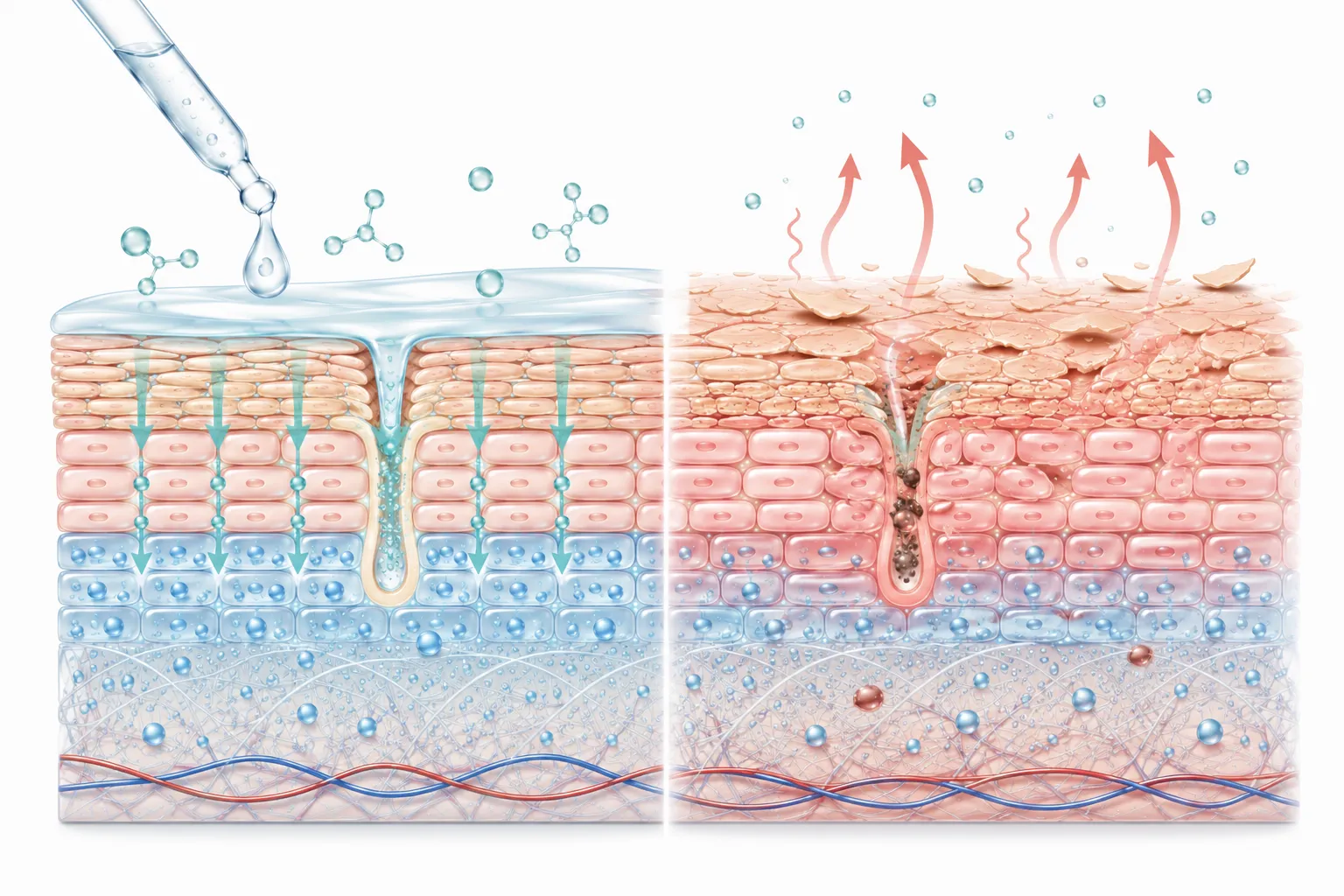
Salicylic acid's ability to penetrate pores (its greatest strength) is also its biggest risk to the barrier. It dissolves the lipids that hold skin cells together, which is how it works - and if overused, it can dissolve too much.
Use this section to decide
Does this advice apply to me?
Find the concern or goal closest to yours, then use the fit signal to decide how much weight to give this guide.If your goal is
Damage RiskDepends- Fit signal
- Possible fit
Moderate-High with overuse
If your goal is
Safe ConcentrationUsually relevant- Fit signal
- Often useful
0.5-2%
If your goal is
Safe FrequencyUsually relevant- Fit signal
- Often useful
1-3 times per week
If your goal is
Barrier SupportUsually relevant- Fit signal
- Often useful
Essential
Research notes already in this guide
- Studies show salicylic acid can increase TEWL when overused.
- Research confirms it can disrupt the lipid matrix of the barrier.
- Safe use (low concentration, limited frequency) minimizes barrier damage.
- Barrier damage from salicylic acid is typically reversible with barrier-supporting care.
Expected results
Results and timeframe
The key to safe use is low concentration (0.5-2%) and limited frequency (1-3 times per week).
Practical use
How to use it
Use a low concentration (0.5-2%)
Start with the lowest concentration that works for you.
Use it 1-3 times per week
Avoid daily use - this is where barrier damage happens.
Apply only to areas that need it
Focus on the T-zone rather than applying to your entire face.
Support your barrier
Use ceramide-rich moisturizers alongside salicylic acid.
Safety
Side effects and cautions
- Using salicylic acid every day
Use it 1-3 times per week - more isn't better.
- Using salicylic acid on a compromised barrier
Wait until your barrier is intact before using any exfoliant.
- Layering it with other exfoliants
Avoid using multiple exfoliants together.
- Not using moisturizer with salicylic acid
Barrier support is essential when using exfoliants.
Fit
Who should be careful
- Daily use
- Use on compromised barriers
- Dry or sensitive skin without careful introduction
Helpful context
What else is worth knowing
Salicylic acid barrier effects
How it exfoliates—can over-dissolve
Standard for home use
Avoid daily use
Safe for pores
What experts say about salicylic acid and barrier damage
Dr. Shereene IdrissSalicylic acid is effective but can be harsh. Use it sparingly and support your barrier.
Dr. Mona GoharaSalicylic acid is not for daily use. 1-3 times per week is plenty for most people.
Worth noting
Small details that can change the answer
- Lipid Solubility. Salicylic acid is oil-soluble, allowing it to penetrate pores and dissolve lipids.
- Barrier Lipids. It can dissolve the lipid matrix that forms the barrier if overused.
- Concentration. 0.5-2% is the standard safe concentration for home use.
- Frequency. Daily use increases barrier damage risk - 1-3 times per week is safer.
Salicylic acid can damage the barrier if overused - it's a potent exfoliant.
Never use salicylic acid on a compromised barrier.
Support your barrier with ceramide-rich moisturizers.
Consider using it as a wash-off treatment rather than a leave-on product.
Definition
How salicylic acid affects the skin barrier
Understanding the mechanism.
Salicylic acid is a lipid-soluble exfoliant that dissolves the bonds between skin cells. This is how it works - but overuse can dissolve too much, disrupting the barrier and leading to dryness, irritation, and inflammation.
Explanation
Why salicylic acid can damage the barrier
Salicylic acid's oil solubility allows it to penetrate the skin and dissolve the lipid matrix that holds the barrier together. In small amounts, this is beneficial - it exfoliates and clears pores. In large amounts or too frequently, it can over-dissolve, damaging the barrier.
When salicylic acid is most likely to damage the barrier
Here are situations where salicylic acid barrier damage is more likely.
- Using it daily when your skin doesn't need it
- Using a high concentration (2% or more) too frequently
- Using it on a compromised barrier
- Layering it with other exfoliants or strong actives
- Using it without barrier-supporting moisturizers
- Using it on dry or sensitive skin without proper precautions
How to use salicylic acid safely
Here's how to minimize the risk of barrier damage.
- Use a low concentration (0.5-2%)
- Use it 1-3 times per week, not daily
- Apply it only to areas that need it (often the T-zone)
- Use barrier-supporting moisturizers with ceramides
- Never use it on a compromised barrier
- Consider using it as a wash-off treatment rather than a leave-on product
Questions
Frequently asked questions
Is salicylic acid safe for sensitive skin?
It can be, with careful use - low concentration, limited frequency, and never on a compromised barrier.
How often should I use salicylic acid?
1-3 times per week is generally safe. Daily use increases barrier damage risk.
Can salicylic acid cause long-term barrier damage?
No, the damage is typically reversible with barrier-supporting care.
What concentration of salicylic acid is safe?
0.5-2% is the standard safe concentration for home use.
References
Sources
The notes below are drawn from the evidence already cited in this guide. They are not a complete bibliography.
- Studies show salicylic acid can increase TEWL when overused.
- Research confirms it can disrupt the lipid matrix of the barrier.
- Safe use (low concentration, limited frequency) minimizes barrier damage.
- Barrier damage from salicylic acid is typically reversible with barrier-supporting care.