Evidence
What the evidence shows
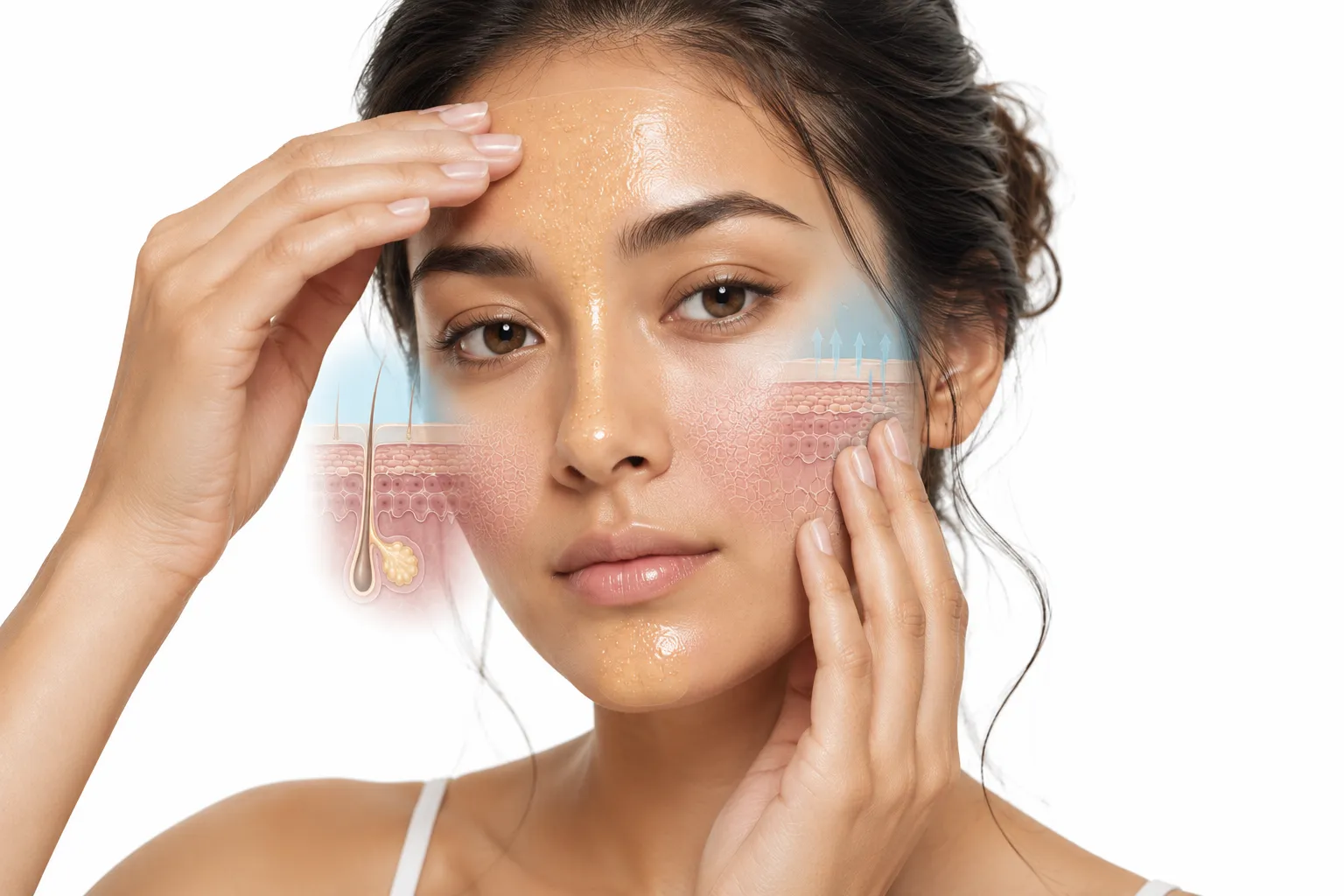
Combination skin isn't a compromise or a "problem" - it's a skin type with two distinct characteristics that need to be managed separately. The key is respecting both zones.
Use this section to decide
Does this advice apply to me?
Find the concern or goal closest to yours, then use the fit signal to decide how much weight to give this guide.If your goal is
Oily areasUse caution- Fit signal
- Limited evidence
T-zone (forehead, nose, chin)
If your goal is
Dry areasUse caution- Fit signal
- Limited evidence
Cheeks, eye area, jawline
If your goal is
Best approachUsually relevant- Fit signal
- Often useful
Zone-specific care
If your goal is
Key challengeDepends- Fit signal
- Possible fit
Balancing both zones
Explanation
How it works
T-zone has more oil glands
The forehead, nose, and chin have the highest density of sebaceous glands.
T-zone glands are more responsive
These glands are more sensitive to hormones that stimulate oil production.
Cheeks have fewer oil glands
The cheeks have a lower density of sebaceous glands.
Cheeks are less responsive
The glands on the cheeks are less sensitive to hormonal oil stimulation.
Practical use
How to use it
Identify your zones
Map out where you're oily and where you're dry.
Choose products for each zone
Select products that address each area's specific needs.
Apply products selectively
Don't just slather everything on your whole face - use targeted application.
Safety
Side effects and cautions
- Using the same products on the whole face
Different zones need different care.
- Using products for oily skin on the whole face
This will dry out the cheeks unnecessarily.
- Using products for dry skin on the whole face
This can cause breakouts in the T-zone.
Fit
Who should be careful
- Using a one-size-fits-all approach to skincare
Worth noting
Small details that can change the answer
- T-Zone Oil. The T-zone has more sebaceous glands, making it oily.
- Cheek Dryness. Cheeks have fewer sebaceous glands, making them prone to dryness.
- Hormonal Influence. Androgens stimulate oil production more in the T-zone than on the cheeks.
- Management. Combination skin needs different care for different zones.
Combination skin is both oily and dry - oily in the T-zone, normal or dry on the cheeks.
This duality is due to differences in sebaceous gland density and sensitivity.
The key to management is zone-specific care.
Use different products on different parts of your face.
Don't use a one-size-fits-all approach - it won't work.
Definition
What is combination skin?
Combination skin is defined by having at least two different skin types on different areas of the face. The classic combination is an oily T-zone (forehead, nose, chin) with normal or dry cheeks, eye area, and jawline. Some people may also have combination skin with sensitive areas alongside oily ones.
- Oily T-zone: Shiny, prone to blackheads and enlarged pores
- Normal/dry cheeks: May feel tight, rough, or flaky
- Dry eye area: Prone to fine lines and sensitivity
- Variable jawline: May be oily, dry, or normal depending on the individual
Science
The biology of oily and dry areas on the same face
Sebaceous gland density varies across the face. The T-zone has 10-20 times more sebaceous glands per square centimeter than the cheeks. These glands are also more responsive to androgens, which stimulate oil production. This combination of more glands and greater sensitivity to hormones creates the oily T-zone, while the cheeks with fewer glands and less sensitivity remain normal or dry.
- Sebaceous Gland Density
- The number of oil-producing glands per area of skin, which varies across the face.
- Androgen Sensitivity
- The responsiveness of sebaceous glands to male hormones that stimulate oil production.
Benefits
How to balance oily and dry areas
The key to managing combination skin is zone-specific care.
- Use a gentle, pH-balanced cleanser overall
- Apply oil-controlling products (niacinamide, BHA) to the T-zone only
- Apply hydrating products (hyaluronic acid, ceramides) to the cheeks
- Use a lightweight moisturizer on the T-zone
- Use a richer moisturizer on the cheeks
Dos Donts
Balancing oily and dry zones do's and don'ts
Do
Avoids irritating either zone.
Addresses the needs of each area.
Hydrates cheeks without over-oiling the T-zone.
Avoid
This will irritate the dry cheeks.
This can cause breakouts in the T-zone.
This creates imbalances.
Questions
Frequently asked questions
Can I have oily T-zone and dry cheeks?
Yes, that's the classic definition of combination skin.
Is it normal to have different skin conditions on the same face?
Yes, it's the most common skin type and affects up to 70% of people.
Do I need two different moisturizers for combination skin?
Not necessarily, but many people find a lighter one for the T-zone and a richer one for the cheeks works best.
Can combination skin be sensitive too?
Yes, some people have combination skin with sensitive areas, especially on the cheeks.