Evidence
What the evidence shows
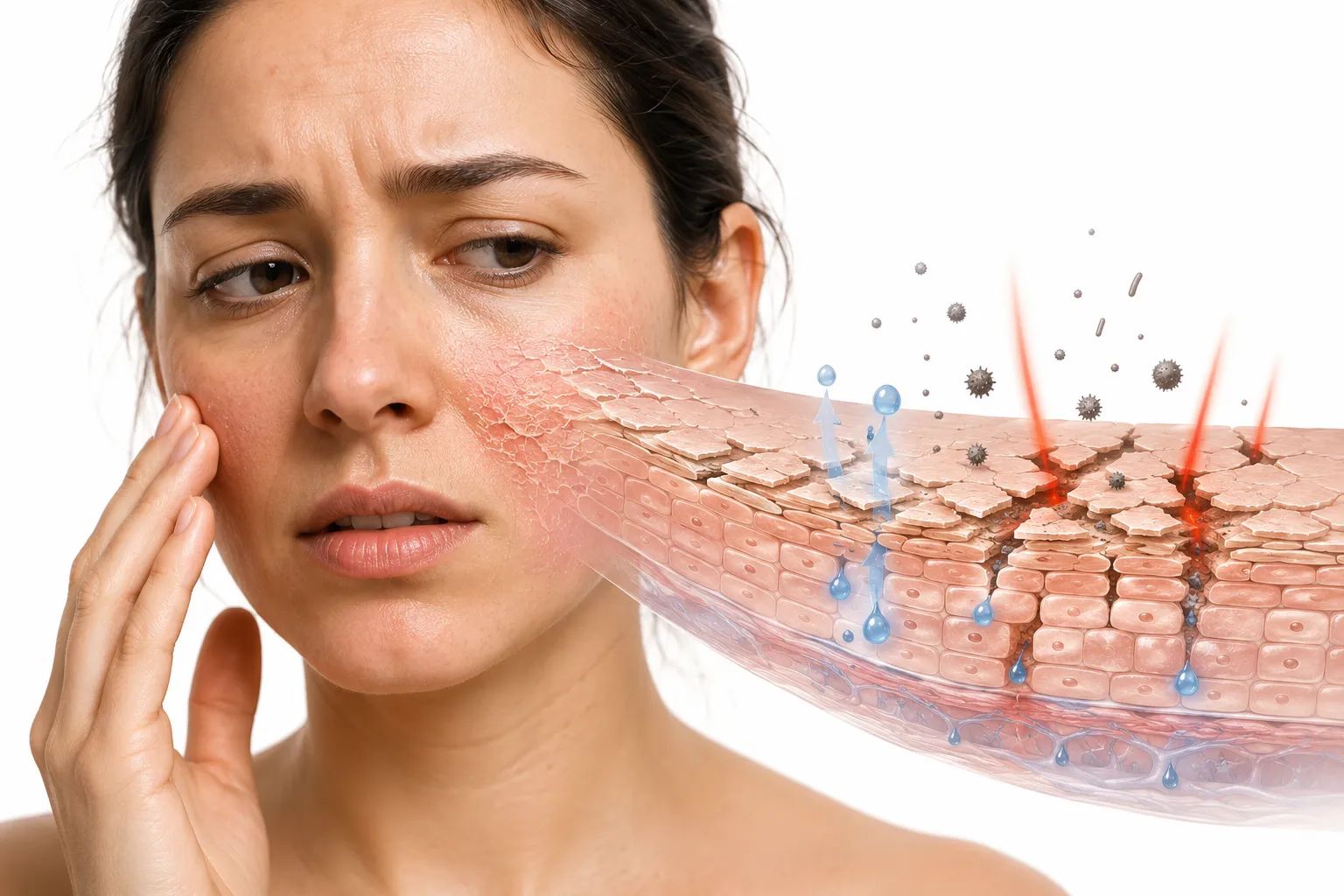
A damaged barrier often isn't caused by one dramatic event, it's more commonly the cumulative result of small, repeated stresses like over-cleansing or over-exfoliating that add up over time.
Use this section to decide
Does this advice apply to me?
Find the concern or goal closest to yours, then use the fit signal to decide how much weight to give this guide.If your goal is
Main signsDepends- Fit signal
- Possible fit
Redness, stinging, tightness
If your goal is
Top causesDepends- Fit signal
- Possible fit
Over-exfoliation, harsh cleansers
If your goal is
Recovery timeUse caution- Fit signal
- Limited evidence
Several weeks
If your goal is
Key fixUsually relevant- Fit signal
- Often useful
Ceramide-rich moisturizer
Explanation
How it works
Repeated stress
Harsh cleansers, over-exfoliation, or weather gradually strip barrier lipids.
Structure weakens
Gaps form between skin cells as the lipid "mortar" thins.
Moisture escapes
Water evaporates from the surface more quickly than normal.
Irritants penetrate
Substances that would normally be blocked reach living skin more easily.
Expected results
Results and timeframe
Recovery usually takes several weeks with a simplified, supportive routine.
Practical use
How to use it
Simplify your routine
Strip back to a gentle cleanser and a ceramide-rich moisturizer.
Pause active ingredients
Hold off on exfoliating acids and retinoids until irritation settles.
Reintroduce gradually
Add products back slowly once redness and sensitivity have improved.
Safety
Side effects and cautions
- Continuing to exfoliate through visible irritation
Pause active ingredients and let the barrier settle first.
- Introducing multiple new products while barrier is compromised
Simplify to a gentle cleanser and barrier-repairing moisturizer.
- Expecting overnight recovery
Allow several weeks of consistent, gentle care for the barrier to rebuild.
- Redness and stinging
Common · Simplify your routine and avoid further irritation
- Increased product reactivity
Common · Pause new actives until skin settles
- Persistent tightness
Occasional · Add a ceramide-rich moisturizer
Fit
Who should be careful
- Diagnosing conditions like eczema or rosacea without professional input
Worth noting
Small details that can change the answer
- Brick and Mortar Model. The skin barrier is often described as skin cells (bricks) held together by lipids (mortar).
- Increased Water Loss. A damaged barrier lets more water escape from the skin's surface than normal.
- Cumulative Cause. Barrier damage often builds gradually from repeated over-cleansing or over-exfoliation.
- Reversible. Most barrier damage can improve over several weeks with a simplified, supportive routine.
A damaged skin barrier means the outer layer of skin has lost some of its ability to retain moisture and block irritants.
Common causes include over-exfoliation, harsh cleansers, and environmental stress.
Signs include redness, stinging, tightness, and increased sensitivity to products.
Ceramide-containing moisturizers help rebuild the barrier's structure during recovery.
Definition
Defining a damaged skin barrier
A damaged skin barrier occurs when the outermost layer of skin loses its ability to retain moisture and block irritants effectively, usually as a result of harsh products, over-exfoliation, or environmental stress.
- Reduced moisture retention
- Increased irritant penetration
- Often reversible with supportive care
Science
How the barrier normally works
The outer skin layer is often described using a brick and mortar model, where skin cells act as bricks and lipids like ceramides act as the mortar holding them together, forming a seal that regulates moisture and blocks irritants.
- Transepidermal water loss
- The rate at which water evaporates from the skin's surface, which increases when the barrier is compromised.
- Ceramides
- Lipids that help form the structure holding skin cells together in the outer barrier.
Avoid
Common causes of barrier damage
Repeated exfoliation can strip barrier lipids faster than they're replenished
Can strip natural oils and disrupt the barrier's lipid structure
Environmental stress can weaken the barrier over time
Before After Expectation
What recovery typically looks like
Timeframe: Several weeks with consistent, gentle care
Before starting
- Redness, stinging, and tightness
- Increased reactivity to previously tolerated products
Realistic result
- Reduced redness and sensitivity
- Better tolerance of a gradually reintroduced routine
Recovery time varies depending on the extent of the damage and individual skin.
Questions
Frequently asked questions
How long does it take to repair a damaged skin barrier?
Recovery typically takes several weeks of consistent, gentle care, though it varies by individual and severity.
What ingredients help rebuild the skin barrier?
Ceramides, cholesterol, and fatty acids help restore the barrier's lipid structure.
Should I stop using active ingredients if my barrier is damaged?
Yes, pausing exfoliating acids and retinoids is generally recommended until irritation settles.
What are the most common causes of barrier damage?
Over-exfoliation, harsh cleansers, and environmental stress are among the most common causes.