Evidence
What the evidence shows
Combination skin is well-understood with clear management principles.
Distribution patterns
Well documentedManagement strategies
Evidence-basedIndividual variation
Significant
Use this section to decide
Does this advice apply to me?
Find the concern or goal closest to yours, then use the fit signal to decide how much weight to give this guide.If your goal is
T-zoneUsually relevant- Fit signal
- Often useful
Oily
If your goal is
CheeksUsually relevant- Fit signal
- Often useful
Normal to dry
If your goal is
PoresUse caution- Fit signal
- Limited evidence
Enlarged in T-zone
If your goal is
Key approachUse caution- Fit signal
- Limited evidence
Zone-based care
Research notes already in this guide
- The distribution of sebaceous glands and its correlation with skin type is well documented.
- The behavior of combination skin in response to different treatments is widely studied.
- Management strategies for combination skin are based on solid dermatological principles.
- Individual variation is significant, making personalized approaches essential.
Explanation
How it works
Why oil production varies across your face.
Sebaceous gland density
The T-zone has more oil-producing glands per square centimeter than the cheeks.
Hormonal influence
Androgens stimulate sebum production, particularly in the T-zone.
Uneven skin needs
The T-zone needs oil control, while the cheeks often need more hydration.
Practical use
How to use it
Cleanse gently all over
Use a mild, sulfate-free cleanser that cleanses the T-zone without stripping the cheeks.
Treat by zone
Apply oil-controlling serums or toners to the T-zone only. Use hydrating serums on the cheeks.
Moisturize strategically
Use a lightweight, gel-based moisturizer on the T-zone and a richer cream on the cheeks.
Safety
Side effects and cautions
- Applying the same moisturizer all over your face
Use a lighter moisturizer on the T-zone and a richer one on the cheeks to address different needs.
- Using harsh, drying products in the T-zone and leaving them on the cheeks
Apply oil-controlling treatments only to the T-zone, avoiding the cheeks.
- Skipping moisturizer because your T-zone is oily
Your whole face needs moisture. Use a lightweight, oil-free moisturizer everywhere, and add extra to the cheeks if needed.
Fit
Who should be careful
- Looking for a one-size-fits-all solution
Helpful context
What else is worth knowing
Is this information for you?
Oily combination skin affects different people differently.
If your T-zone is oily and your cheeks are dry or normal, this is your skin type.
Slightly oily combinationIf your T-zone is slightly oily and your cheeks are normal, you have a milder form.
Hormonal combinationIf your combination pattern shifts with your cycle, you're dealing with hormonal influences.
Worth noting
Small details that can change the answer
- Sebaceous Gland Density. The T-zone has up to 900 sebaceous glands per square centimeter, while cheeks have only about 400.
- Common Distribution. About 80% of people have some degree of combination skin, making it the most common skin type.
- Hormonal Influence. Combination skin can shift with hormonal changes, becoming oilier in the T-zone around menstruation.
- Age Factor. Combination skin often becomes drier overall with age, though the T-zone may remain the oiliest area.
Oily combination skin features an oily T-zone and normal to dry cheeks.
It's the most common skin type, affecting about 80% of people to some degree.
The uneven distribution of sebaceous glands drives the T-zone's oiliness.
Managing combination skin requires a zone-by-zone approach rather than a one-size-fits-all product.
A gentle, balanced routine with strategic moisturizing is the most effective approach.
Definition
What exactly is oily combination skin?
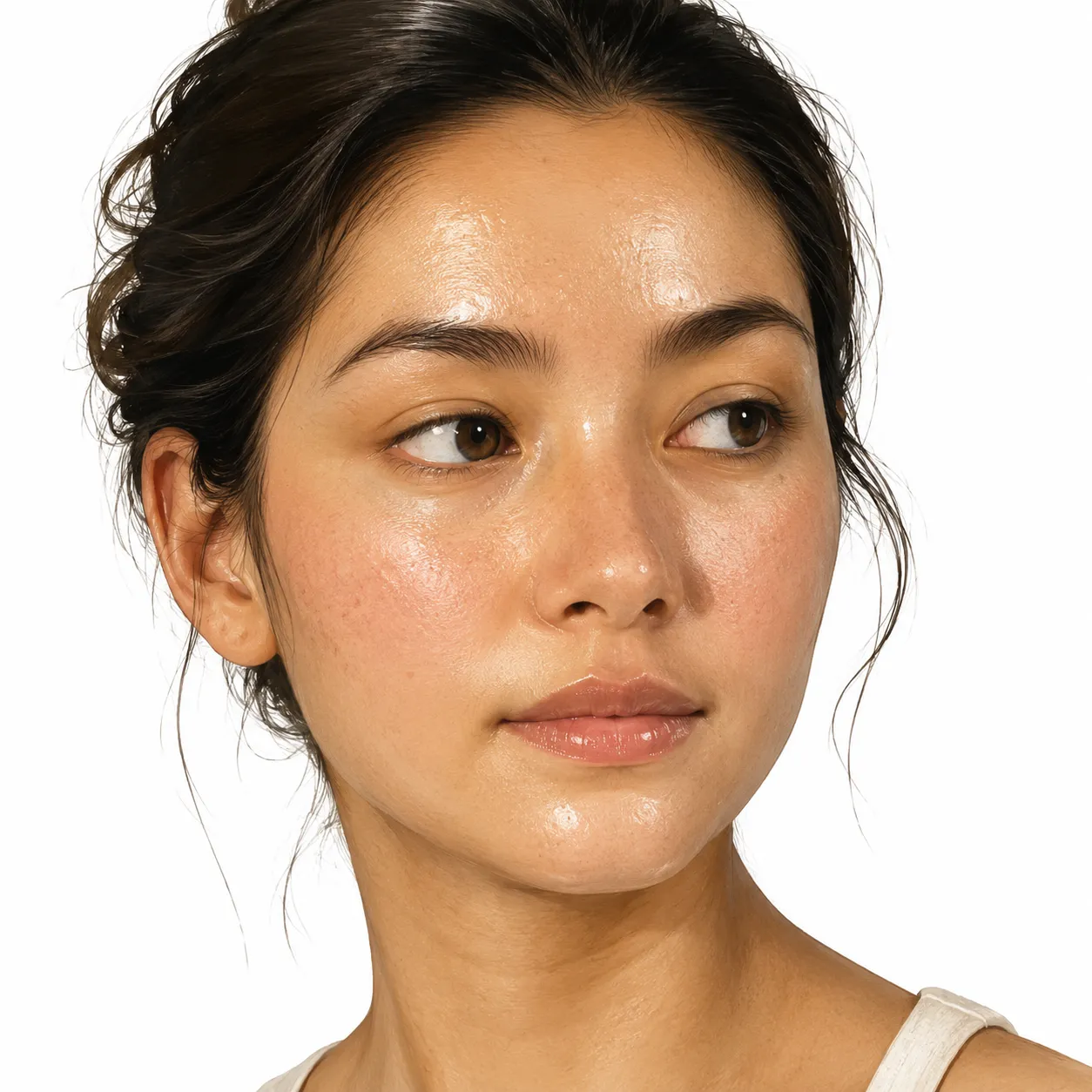
Oily combination skin is a skin type where different areas of the face have different oil production levels. The T-zone - the forehead, nose, and chin - tends to be oily, while the cheeks and sometimes the jawline are normal or dry. This is due to the varying density of sebaceous glands across different facial zones.
- Oily T-zone: forehead, nose, chin
- Normal or dry cheeks and jawline
- Pores may be larger and more visible in the T-zone
- Breakouts and congestion typically occur in the T-zone
- Cheeks may feel tight or dry, especially in cold weather
Science
Why does combination skin happen?
Combination skin is primarily driven by the uneven distribution of sebaceous glands across the face. The T-zone has a higher concentration of these oil-producing glands, leading to more sebum production in this area. Factors like genetics, hormones, and environment also play significant roles in how much oil your skin produces.
- Sebaceous glands
- Microscopic exocrine glands in the skin that produce sebum, an oily substance that lubricates and protects the skin and hair.
- T-zone
- The area of the face that includes the forehead, nose, and chin, which typically has more oil-producing glands.
- Androgens
- Male hormones present in both men and women that stimulate sebum production, particularly around puberty.
Benefits
How to manage oily combination skin effectively
Managing combination skin is about matching products to zones rather than trying to find a single product that does it all for every area.
- Use a gentle, non-stripping cleanser that won't dry out your cheeks
- Apply lightweight, oil-free moisturizer to the T-zone
- Use a richer moisturizer on the cheeks if they feel dry
- Consider targeted treatments: salicylic acid on the T-zone, hydrating serums on the cheeks
Risks
What can go wrong with combination skin management?
The main risk with combination skin is mismanagement - either using products that are too heavy for the T-zone and causing congestion, or using products that are too drying for the cheeks and causing irritation.
- Using harsh cleansers that strip the cheeks while only briefly managing the T-zone
- Ignoring the cheeks and allowing them to become dehydrated and irritated
- Applying heavy, occlusive products to the T-zone that lead to blocked pores and breakouts
- Over-treating the T-zone with active ingredients and causing damage
Questions
Frequently asked questions
Is combination skin the same as oily skin?
No. Oily skin is oily everywhere, while combination skin is oily in some areas (the T-zone) and normal or dry in others.
Can combination skin become more oily or more dry?
Yes. Hormonal changes, weather, and aging can shift your skin's balance, making the T-zone oilier or the cheeks drier.
Is combination skin harder to manage than other skin types?
It can be because you're dealing with two different skin states on the same face. But with a strategic, zone-based approach, it's entirely manageable.
Do I need different cleansers for different zones?
Not necessarily. A gentle, balanced cleanser works everywhere. It's more about what you apply after cleansing.
References
Sources
The notes below are drawn from the evidence already cited in this guide. They are not a complete bibliography.
- The distribution of sebaceous glands and its correlation with skin type is well documented.
- The behavior of combination skin in response to different treatments is widely studied.
- Management strategies for combination skin are based on solid dermatological principles.
- Individual variation is significant, making personalized approaches essential.