Evidence
What the evidence shows
Barrier creams are among the most evidence-supported skincare products.
Mechanism of action
Well establishedClinical efficacy
Extensively studiedOptimal ratios
Rigorously researched
Use this section to decide
Does this advice apply to me?
Find the concern or goal closest to yours, then use the fit signal to decide how much weight to give this guide.If your goal is
Primary functionUsually relevant- Fit signal
- Often useful
Barrier repair
If your goal is
Key ingredientsUsually relevant- Fit signal
- Often useful
Ceramides, cholesterol
If your goal is
Best forUse caution- Fit signal
- Limited evidence
Dry, sensitive skin
If your goal is
EvidenceUsually relevant- Fit signal
- Often useful
Strong
Research notes already in this guide
- The role of ceramides, cholesterol, and fatty acids in barrier function is extensively documented.
- Clinical trials have demonstrated the efficacy of barrier creams in reducing TEWL and improving skin hydration.
- Barrier repair formulations are a standard recommendation in dermatology for compromised skin.
- The optimal lipid ratio of 3:1:1 has been established through rigorous research.
Expected results
Results and timeframe
Consistent use over weeks to months is needed for significant barrier improvement.
Practical use
How to use it
Choose the right barrier cream
Look for a cream with ceramides, fatty acids, and cholesterol in a fragrance-free, non-comedogenic formula.
Apply correctly
Apply to slightly damp skin after cleansing to trap extra water and enhance absorption.
Be consistent
Barrier repair takes time. Use the cream consistently for at least 4-6 weeks to see significant improvement.
Safety
Side effects and cautions
- Assuming all moisturizers are barrier creams
Standard moisturizers are about hydration. Barrier creams are about structural repair. They're not the same thing.
- Using barrier cream on already broken-out skin
Some barrier creams can clog pores. Look for non-comedogenic options if breakouts are a concern.
- Expecting immediate results
Barrier repair takes time - typically weeks to months of consistent use for significant improvement.
Fit
Who should be careful
- Very oily, non-sensitive skin
Helpful context
What else is worth knowing
Is this information for you?
Barrier creams benefit different skin types in different ways.
Worth noting
Small details that can change the answer
- Ceramide Content. Ceramides make up about 50% of the skin's barrier lipids. Low ceramide levels are a hallmark of compromised skin.
- Cholesterol Role. Cholesterol is a critical component of the barrier structure, helping to maintain fluidity and integrity.
- Fatty Acid Importance. Fatty acids like linoleic acid are essential for barrier function and can be deficient in dry, compromised skin.
- Optimal Ratio. The ideal barrier cream often replicates the skin's natural ceramide:cholesterol:fatty acid ratio of 3:1:1.
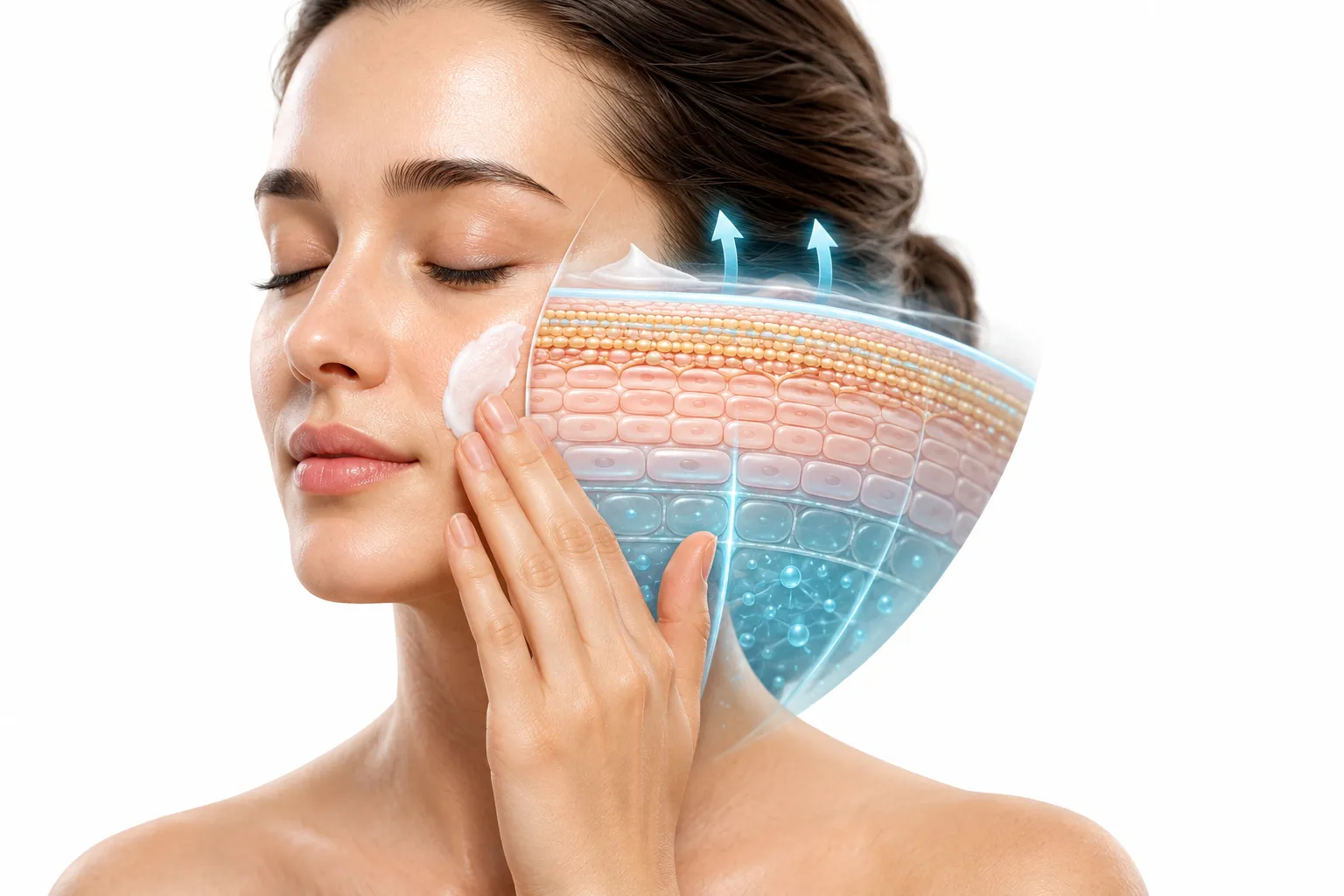
Skin barrier cream is a specialized moisturizer that provides skin-identical lipids for barrier repair.
Key ingredients include ceramides, fatty acids, and cholesterol in ratios that mimic the skin's natural composition.
It's particularly useful for dry, sensitive, compromised, and aging skin.
Barrier creams work on structural repair, not just surface hydration.
Definition
What exactly is skin barrier cream?
Skin barrier cream is a specialized moisturizer that contains high concentrations of skin-identical lipids - ceramides, fatty acids, and cholesterol - in formulations designed to mimic the skin's natural barrier composition. Unlike standard moisturizers that primarily add water and seal it in, barrier creams provide the raw materials for barrier repair.
- High in ceramides, the primary lipid in the skin barrier
- Contains cholesterol and fatty acids in balanced ratios
- Often has a richer, more occlusive texture
- Typically fragrance-free and minimally formulated to avoid irritation
- Aimed at supporting barrier repair and resilience
Science
The science behind barrier repair creams
The skin barrier is structured like bricks and mortar. The corneocytes (skin cells) are the bricks, and the lipids (ceramides, fatty acids, cholesterol) are the mortar. When the mortar is damaged, water escapes and irritants enter. Barrier creams deliver these exact lipids in the right ratios to restore the mortar and repair the barrier.
- Ceramides
- Lipids that are the primary structural component of the stratum corneum, making up about 50% of the barrier.
- Stratum corneum
- The outermost layer of the epidermis, which is the main barrier between the body and the environment.
- Transepidermal water loss
- The movement of water from the skin to the outside environment, which is reduced when the barrier is intact.
Benefits
Who should use skin barrier cream?
While anyone can use a barrier cream, it's particularly valuable for specific skin situations.
- Dry and dehydrated skin that struggles to retain moisture
- Sensitive skin that reacts easily to products and environment
- Compromised skin from over-exfoliation or harsh products
- Aging skin, which naturally has lower ceramide levels
- Skin conditions like eczema, where barrier function is compromised
Risks
Are there any downsides to barrier cream?
Barrier creams are generally safe and well-tolerated, but there are a few considerations.
- The richer texture can feel heavy on very oily skin
- Some barrier creams may clog pores if formulated with heavy occlusives
- Not all barrier creams are created equal - ingredient ratios matter
- They're not a replacement for targeted treatments for specific skin concerns
Questions
Frequently asked questions
Is barrier cream the same as a regular moisturizer?
No. Standard moisturizers hydrate the skin's surface, while barrier creams provide the raw materials for structural barrier repair.
Can oily skin use barrier cream?
Yes, but choose a lighter formulation that's non-comedogenic. The barrier is important for all skin types.
How long does it take for barrier cream to work?
Some improvement can be seen within days, but significant barrier repair typically takes 4-6 weeks of consistent use.
Is barrier cream good for aging skin?
Yes. Ceramide levels naturally decline with age, so barrier support becomes increasingly important over time.
References
Sources
The notes below are drawn from the evidence already cited in this guide. They are not a complete bibliography.
- The role of ceramides, cholesterol, and fatty acids in barrier function is extensively documented.
- Clinical trials have demonstrated the efficacy of barrier creams in reducing TEWL and improving skin hydration.
- Barrier repair formulations are a standard recommendation in dermatology for compromised skin.
- The optimal lipid ratio of 3:1:1 has been established through rigorous research.