Evidence
What the evidence shows
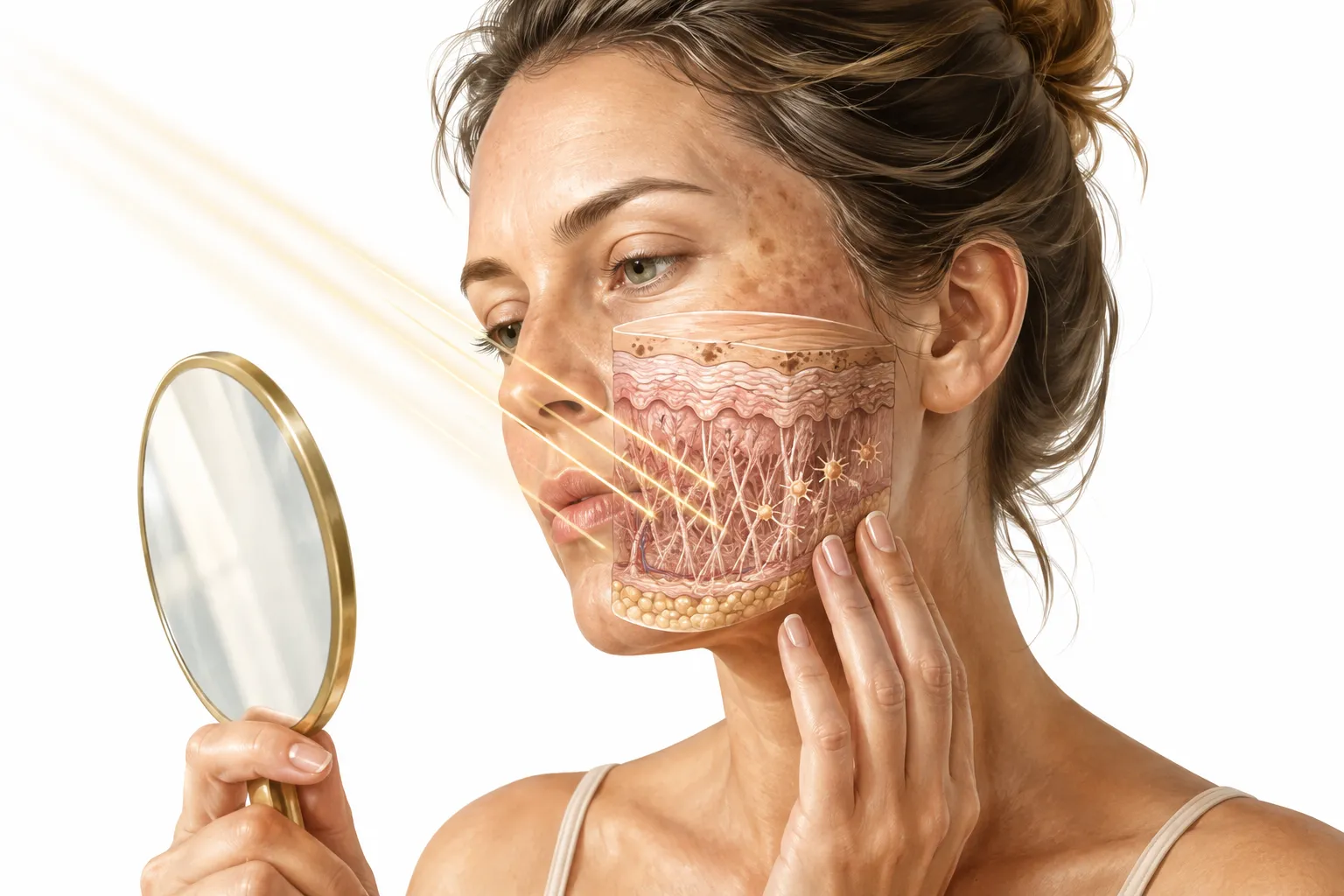
Sun damage is a photoaging process that affects the skin's structural proteins, not just surface pigmentation. The visible signs are the tip of the iceberg; beneath them lies significant degradation of the skin's framework.
UV causes photoaging
UV causes photoagingSunscreen prevents damage
Sunscreen prevents damageRetinoids can help
Retinoids can help
Use this section to decide
Does this advice apply to me?
Find the concern or goal closest to yours, then use the fit signal to decide how much weight to give this guide.If your goal is
Primary CauseUsually relevant- Fit signal
- Often useful
UV radiation
If your goal is
Key EffectUsually relevant- Fit signal
- Often useful
Collagen breakdown
If your goal is
Visible SignsDepends- Fit signal
- Possible fit
Wrinkles, pigmentation
If your goal is
PreventionUse caution- Fit signal
- Limited evidence
Sunscreen, shade
Research notes already in this guide
- Decades of dermatological research have established UV radiation as the primary cause of photoaging.
- Twin studies show that sun exposure is the single largest contributor to visible aging.
- Skin biopsies demonstrate the structural changes in sun-damaged skin, including collagen fragmentation and elastosis.
Explanation
How it works
UV radiation reaches the skin
UVA and UVB rays penetrate different layers of the skin.
Damage occurs at a cellular level
DNA is damaged, and reactive oxygen species are generated.
Inflammation is triggered
The skin responds with an inflammatory cascade.
Structural proteins are broken down
Collagen and elastin fibers are degraded by MMPs.
Expected results
Results and timeframe
Sun-damaged skin is a direct result of UV radiation breaking down collagen and elastin over time.
Photoaging accounts for the majority of visible skin aging.
Practical use
How to use it
Start daily sun protection
Use a broad-spectrum sunscreen of SPF 30 or higher every day, regardless of the weather.
Seek shade
Avoid direct sun exposure, particularly between 10 AM and 4 PM when UV rays are strongest.
Consider topical antioxidants
Vitamin C and other antioxidants can help neutralize free radicals and support skin repair.
Safety
Side effects and cautions
- Thinking a tan is healthy
A tan is actually a sign of UV damage as the skin produces melanin in a protective response.
- Believing that only sunburn is harmful
Chronic, low-level exposure without sunburn still accumulates damage over time.
- Assuming that sun damage is purely cosmetic
Beyond appearance, UV damage increases the risk of skin cancer.
Fit
Who should be careful
- Those who have already developed skin cancer, who should seek medical treatment
Worth noting
Small details that can change the answer
- UV Impact. UVA rays penetrate deeper into the dermis and are primarily responsible for wrinkling and sagging.
- UVB Impact. UVB rays affect the epidermis and are the main cause of sunburn and DNA damage that can lead to skin cancer.
- Collagen Loss. Sun exposure can reduce the skin's collagen content by up to 20 percent over a lifetime.
- Free Radicals. UV exposure generates free radicals that damage not just collagen but also cell membranes and DNA.
It's a cumulative process - even without sunburn, low-level exposure adds up.
The damage goes beyond the surface, affecting the skin's deeper structural components.
Prevention through sunscreen and protective clothing is the most effective strategy.
Definition
Photoaging: The scientific term for sun-damaged skin
Photoaging is the term dermatologists use to describe skin damage caused by chronic UV exposure. It is distinct from chronological aging - the natural aging process that happens to everyone, even in the absence of sun. Photoaging accelerates and amplifies the visible signs of aging, and it accounts for up to 90 percent of the visible changes we associate with aging skin.
- Fine lines and wrinkles, especially on sun-exposed areas
- Loss of elasticity and firmness
- Uneven pigmentation and age spots
- Rough or leathery texture
- Broken capillaries and redness
Science
The science of UV damage at the cellular level
UV radiation, particularly UVA, penetrates the dermis and interacts with cellular components. It generates reactive oxygen species (ROS) that oxidize lipids, proteins, and DNA. This oxidative stress is a key driver of photoaging. The damaged cells trigger an inflammatory response, which in turn activates the matrix metalloproteinases that break down collagen and elastin. Over time, the skin's ability to repair itself diminishes, and the damage accumulates.
- Reactive Oxygen Species (ROS)
- Unstable molecules generated by UV radiation that damage cells and contribute to aging and disease.
- Matrix Metalloproteinases (MMPs)
- Enzymes that break down collagen and other structural proteins in the skin.
Questions
Frequently asked questions
What is the difference between sun-damaged skin and normal aging?
Normal aging, or chronological aging, is genetically determined. Sun damage, or photoaging, is caused by UV exposure and accelerates the aging process.
Can sun-damaged skin be reversed?
It cannot be fully reversed, but treatments like retinoids, chemical peels, and laser therapy can improve its appearance.
Is sun damage visible immediately?
Most sun damage is not visible immediately. It accumulates over years and becomes noticeable later in life.
Does sun damage only affect older people?
No. Sun damage begins in childhood and accumulates over time, which is why it is essential to start sun protection early.
References
Sources
The notes below are drawn from the evidence already cited in this guide. They are not a complete bibliography.
- Decades of dermatological research have established UV radiation as the primary cause of photoaging.
- Twin studies show that sun exposure is the single largest contributor to visible aging.
- Skin biopsies demonstrate the structural changes in sun-damaged skin, including collagen fragmentation and elastosis.