Evidence
What the evidence shows
Irritation from deodorant is rarely about antiperspirant versus deodorant - it's almost always about specific irritating ingredients, with baking soda being the most common culprit.
My main issue is odor, not sweat
Choose a deodorant, which focuses on bacteria control.I sweat heavily and want to reduce that first
Choose an antiperspirant, which reduces moisture.I'm reactive to almost everything I've tried
Choose a fragrance-free, baking-soda-free deodorant.
Use this section to decide
Does this advice apply to me?
Find the concern or goal closest to yours, then use the fit signal to decide how much weight to give this guide.If your goal is
AvoidUse caution- Fit signal
- Limited evidence
Baking soda, alcohol, fragrance
If your goal is
Look forUsually relevant- Fit signal
- Often useful
Magnesium hydroxide, zinc ricinoleate
If your goal is
Best formatUse caution- Fit signal
- Limited evidence
Stick or cream
If your goal is
Price rangeUse caution- Fit signal
- Limited evidence
$10-25, mid-range
Practical use
How to use it
Patch test first
Apply a small amount to the inner arm and wait 24 hours to check for any reaction before using on underarms.
Start with a baking-soda-free formula
This eliminates the most common cause of irritation right from the start.
Apply to clean, dry skin
Damp or freshly washed skin can increase penetration of potentially irritating ingredients.
Safety
Side effects and cautions
- Assuming natural always means gentler
Natural deodorants often contain baking soda, which is highly irritating for many people.
- Applying too much product
A thin layer is sufficient; more product increases the chance of irritation.
- Applying immediately after shaving
Shaving creates micro-tears and removes barrier protection, making irritation far more likely.
Fit
Who should be careful
- Those who sweat excessively and require clinical-strength antiperspirant
Worth noting
Small details that can change the answer
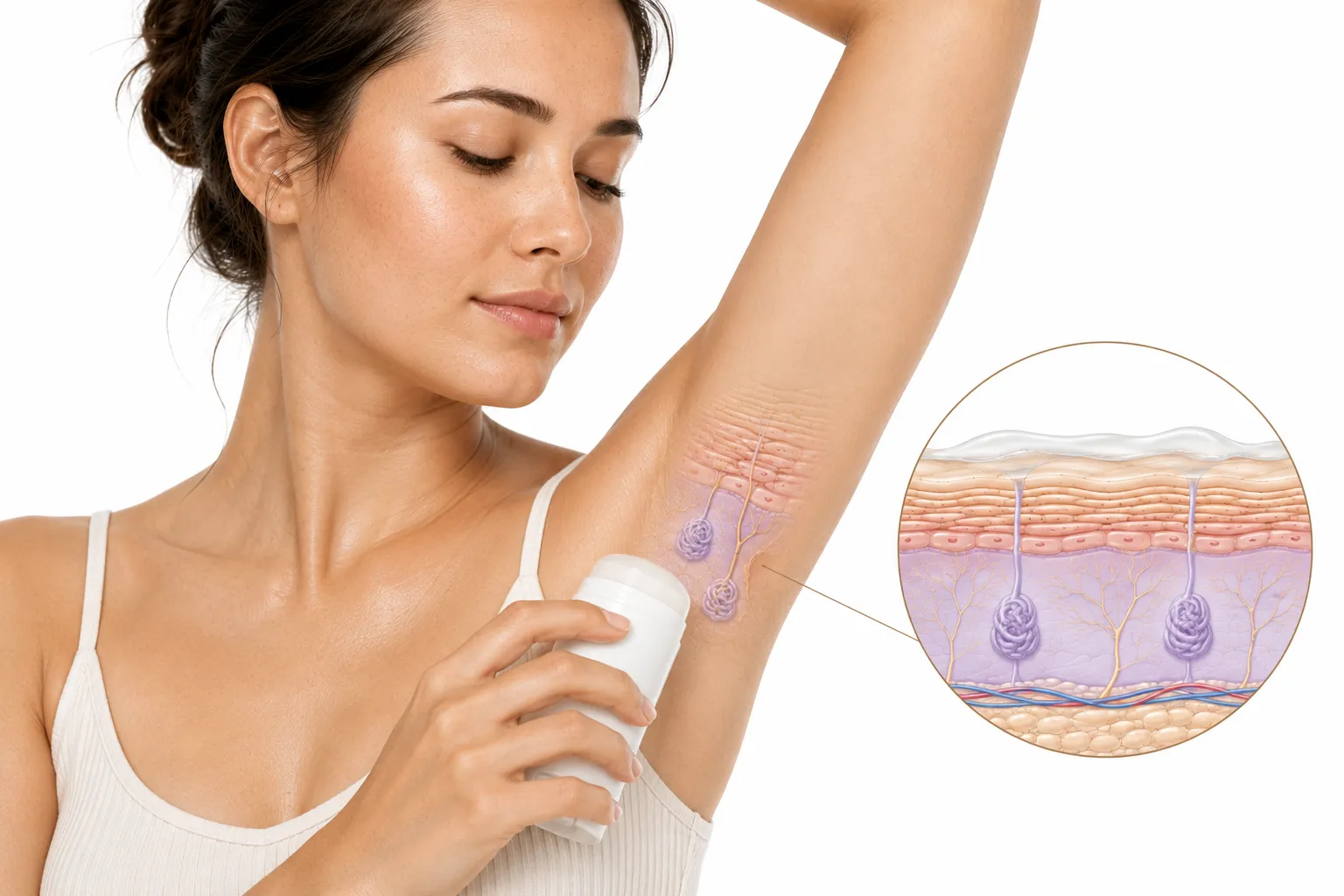
- Skin Thickness. Underarm skin is approximately 30 percent thinner than skin on the arms or legs, making it more prone to irritation.
- Baking Soda Effect. Baking soda has a pH of around 9, which is significantly higher than skin's natural pH of around 4.5 to 5.5.
- Odor Cause. Body odor is caused by bacteria breaking down sweat, not by sweat itself, which is why deodorants target bacteria rather than moisture.
- Fragrance Sensitivity. Synthetic fragrances are among the most common contact allergens in personal care products.
The most common cause of deodorant irritation is baking soda, not aluminum compounds or essential oils.
Gentle alternatives use magnesium hydroxide, zinc ricinoleate, or clay to control odor.
Fragrance-free formulations significantly reduce the risk of allergic reactions.
Underarm skin is thinner and more sensitive than most other areas, requiring special care.
Patch testing before full use is essential for anyone with sensitive skin.
Definition
What actually is deodorant?
Deodorant is a product applied to the underarms to reduce or eliminate body odor. Unlike antiperspirants, which reduce sweating, deodorants work by neutralizing or covering odor compounds, typically through antibacterial ingredients that reduce odor-causing bacteria. For sensitive skin, this distinction matters because antiperspirants have their own set of potential irritants, primarily aluminum compounds.
- Works by controlling odor-causing bacteria
- Does not prevent sweating
- Available in sticks, sprays, creams, and roll-ons
- For sensitive skin, cream or stick forms tend to be gentler than sprays
Explanation
Why sensitive skin reacts to deodorants
The underarm area has a unique combination of features that make it particularly reactive. It's warm, moist, and often occluded by clothing, which can trap ingredients against the skin and enhance their effects. When an irritating ingredient is applied, the thin barrier allows deeper penetration, triggering inflammation, redness, itching, and sometimes peeling. The reaction isn't always immediate - it can build up over several days of use, making it difficult to pinpoint the cause.
Risks
Ingredients to avoid with sensitive underarms
Not every sensitive skin reacts to the same things, but certain ingredients are known to be problematic for a significant number of people. Here's what tends to cause the most issues.
- Baking soda (sodium bicarbonate): raises skin pH and causes chemical burns in those prone to sensitivity
- Alcohol denat: dries the skin and strips the natural barrier
- Synthetic fragrance and essential oils: common contact allergens
- Propylene glycol: can be sensitizing with repeated use
- Aluminum chlorohydrate: can cause irritation in some individuals, particularly in higher concentrations
Benefits
What to look for in a sensitive-skin deodorant
The right deodorant for sensitive skin prioritizes gentleness without sacrificing effectiveness. These features indicate a formula designed with sensitivity in mind.
- Fragrance-free or only lightly scented with safe, non-sensitizing ingredients
- Uses magnesium hydroxide or zinc ricinoleate instead of baking soda
- Contains soothing ingredients like aloe vera, allantoin, or colloidal oatmeal
- Has a smooth, non-gritty texture that doesn't abrade skin on application
- Is clearly labeled as suitable for sensitive skin by a reputable brand
Questions
Frequently asked questions
Is aluminum the problem for sensitive skin?
Not typically. While some avoid aluminum for other reasons, actual irritation from aluminum compounds is less common than irritation from baking soda or fragrance.
Can I use antiperspirant if I have sensitive skin?
Yes, but look for one that uses a lower concentration of aluminum and contains soothing ingredients. Always patch test first.
How long does it take to know if a deodorant irritates my skin?
Irritation can appear within hours or take several days to develop. Patch testing is the safest way to check.
Are crystal deodorants better for sensitive skin?
Crystal deodorants (potassium alum) are gentle and fragrance-free, making them a good option for many with sensitive skin, though they don't work for everyone.