Evidence
What the evidence shows
The foaming agents that make cleansers lather are often the same ingredients that strip sensitive skin's barrier. The best face wash for sensitive skin often produces very little foam.
Use this section to decide
Does this advice apply to me?
Find the concern or goal closest to yours, then use the fit signal to decide how much weight to give this guide.If your goal is
Best textureUsually relevant- Fit signal
- Often useful
Cream, milk, or non-foaming gel
If your goal is
AvoidUse caution- Fit signal
- Limited evidence
Sulfates, fragrance, alcohol
If your goal is
Key ingredientsUse caution- Fit signal
- Limited evidence
Glycerin, ceramides, aloe
If your goal is
FrequencyUse caution- Fit signal
- Limited evidence
Once daily (evening)
Practical use
How to use it
Choose a cleanser that doesn't foam
Cream, milk, or gel cleansers with low-foaming formulations are usually much gentler.
Use lukewarm water
Splash gently, avoid rubbing, and pat dry with a soft towel.
Wash for 30-60 seconds
Gentle circular motions, let the cleanser do the work, don't scrub.
Safety
Side effects and cautions
- Equating more foam with better cleansing
Foam is a cosmetic feature, not a cleansing requirement, and aggressive foaming comes from aggressive surfactants.
- Washing with hot water
Hot water strips the skin barrier; use lukewarm water.
- Scrubbing with washcloths or silicone scrubbers
Friction is a major irritant; gentle fingertips are safest.
Fit
Who should be careful
- Very oily skin that requires stronger cleansing
Helpful context
What else is worth knowing
What to look for in a gentle cleanser
These ingredients suggest the formula is designed with sensitivity in mind.
Attracts moisture during and after washing
Replenishes what cleansing may remove
Calms redness and irritation
Eases itching and inflammation
Worth noting
Small details that can change the answer
- Barrier Difference. Sensitive skin can have up to 30 percent fewer lipids in its stratum corneum, making it more vulnerable to cleanser damage.
- Sulfate Effect. SLS can strip skin of its natural oils and disrupt the barrier in concentrations as low as 1 percent.
- pH Importance. The face wash should have a pH close to skin's natural 5.5 - alkaline cleansers disrupt the acid mantle and increase sensitivity.
- Water Temperature. Hot water can strip the barrier as much as harsh cleansers; lukewarm is best for sensitive skin.
The best face wash for sensitive skin avoids sulfates, fragrance, and alcohol entirely.
Foaming cleansers are almost always more stripping; choose cream or milk cleansers instead.
Lukewarm water and gentle application are as important as the cleanser itself.
Ingredients like glycerin, aloe, and oat extract support the skin during the wash.
If your skin feels tight or shiny after washing, your cleanser is too harsh for you.
Definition
What is a face wash?
A face wash or cleanser is a water-based product designed to remove dirt, oil, makeup, and environmental pollutants from the face. Unlike soap, which can be overly alkaline and stripping, face washes are formulated with synthetic surfactants that can be adjusted for mildness. For sensitive skin, the difference between a suitable and unsuitable face wash is significant.
- Removes surface debris and pollutants
- Can be foaming, non-foaming, gel, cream, or oil-based
- Should be rinsed off with water
- For sensitive skin, cream or milk cleansers are often gentlest
Science
Why sensitive skin reacts to cleansers
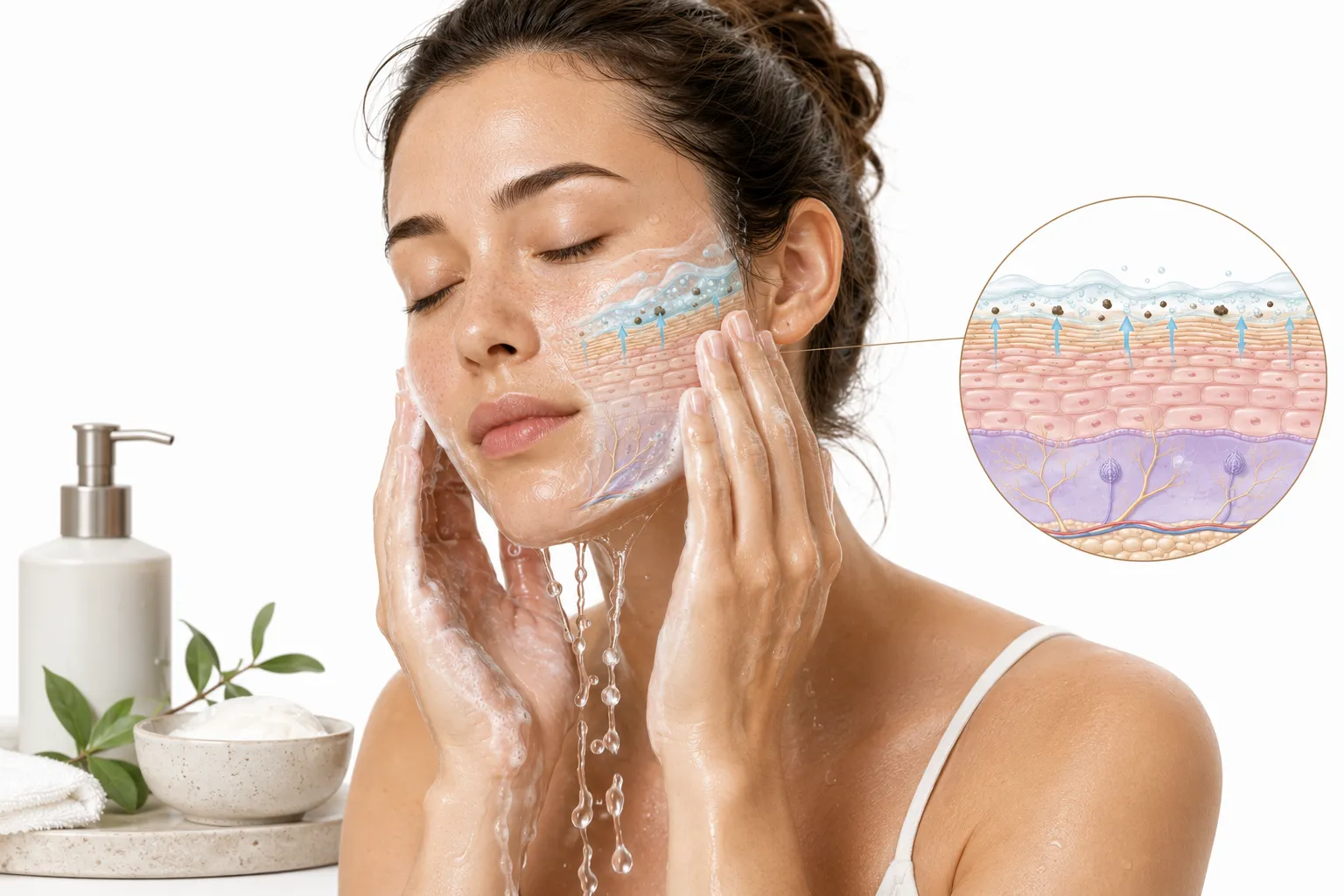
Sensitive skin reacts to cleansers because the barrier is already vulnerable. Most cleansers contain surfactants, molecules that have both a water-loving and oil-loving end, allowing them to lift and wash away oils from the skin. However, these molecules can also bind to and remove the skin's own structural lipids - ceramides, cholesterol, and fatty acids - that form the barrier. When this happens, water evaporates more quickly, irritants penetrate more easily, and inflammation follows.
- Surfactant
- A molecule that reduces surface tension, allowing water to mix with oils and lift them away - the cleaning agent in face washes.
- Lipid Barrier
- The layer of fatty molecules in the outermost skin that prevents water loss and blocks irritants.
Benefits
What the right face wash does for sensitive skin
The right cleanser doesn't just clean - it actively supports the skin's ability to maintain itself. Here's what a well-chosen face wash can offer.
- Removes impurities without leaving skin tight or dry
- Maintains the acid mantle at a healthy pH level
- Leaves the skin barrier intact and functional
- Reduces redness and stinging over time
- Contains humectants that attract water during the wash
Avoid
Ingredients and traits to avoid
Strong surfactants that strip the barrier and cause irritation in sensitive individuals.
Common contact allergens that serve no functional purpose in a face wash.
Drying and stripping, exacerbates barrier dysfunction.
Adds unnecessary chemical load with no skin benefit.
Questions
Frequently asked questions
Can sensitive skin use foam cleansers?
Some foam cleansers can be gentle, but as a rule of thumb, they are more stripping than cream cleansers. Look for low-foaming, fragrance-free foams if you prefer the texture.
Should I double cleanse with sensitive skin?
Double cleansing is often too stripping for sensitive skin. If you wear makeup, try a single-step cleansing balm followed by a gentle wash.
Is natural or organic face wash better for sensitive skin?
Natural doesn't necessarily mean gentle - many "natural" cleansers contain essential oils that are potent allergens. Base your choice on ingredient list, not marketing.
How often should I wash sensitive skin?
Once daily (evening) is sufficient for many people with sensitive skin; morning can be a simple water splash.