Evidence
What the evidence shows
Red light therapy's plausible benefit comes from a well-understood cellular mechanism, but the size of the real-world effect on sun-damaged skin is still less certain than at-home device marketing implies.
Cellular mechanism
Well understood in principle.Real-world results
Vary by device power and consistency of use.
Use this section to decide
Does this advice apply to me?
Find the concern or goal closest to yours, then use the fit signal to decide how much weight to give this guide.If your goal is
MechanismUse caution- Fit signal
- Limited evidence
Mitochondrial stimulation
If your goal is
Evidence strengthDepends- Fit signal
- Possible fit
Mixed
If your goal is
Risk levelUsually relevant- Fit signal
- Often useful
Low
If your goal is
Speed of resultsUse caution- Fit signal
- Limited evidence
Gradual
Expected results
Results and timeframe
Some research links it to modest improvements in collagen, texture, and inflammation.
Results are gradual and best treated as a supportive addition, not a primary treatment.
Practical use
How to use it
Start with realistic expectations
Understand that red light therapy offers modest, gradual support rather than dramatic repair.
Use consistently
Follow the device's recommended frequency, typically several sessions per week.
Pair it with proven actives
Combine with ingredients like retinol and vitamin C for a more complete routine.
Safety
Side effects and cautions
- Expecting dramatic results from occasional use
Consistent, regular sessions over weeks to months are needed to see modest improvement.
- Treating red light therapy as a standalone solution for sun damage
Pair it with proven ingredients like retinoids and vitamin C for more meaningful results.
- Assuming all at-home devices work equally well
Device power and wavelength accuracy vary widely and affect real-world results.
Fit
Who should be careful
- Anyone expecting fast or dramatic results on its own
Worth noting
Small details that can change the answer
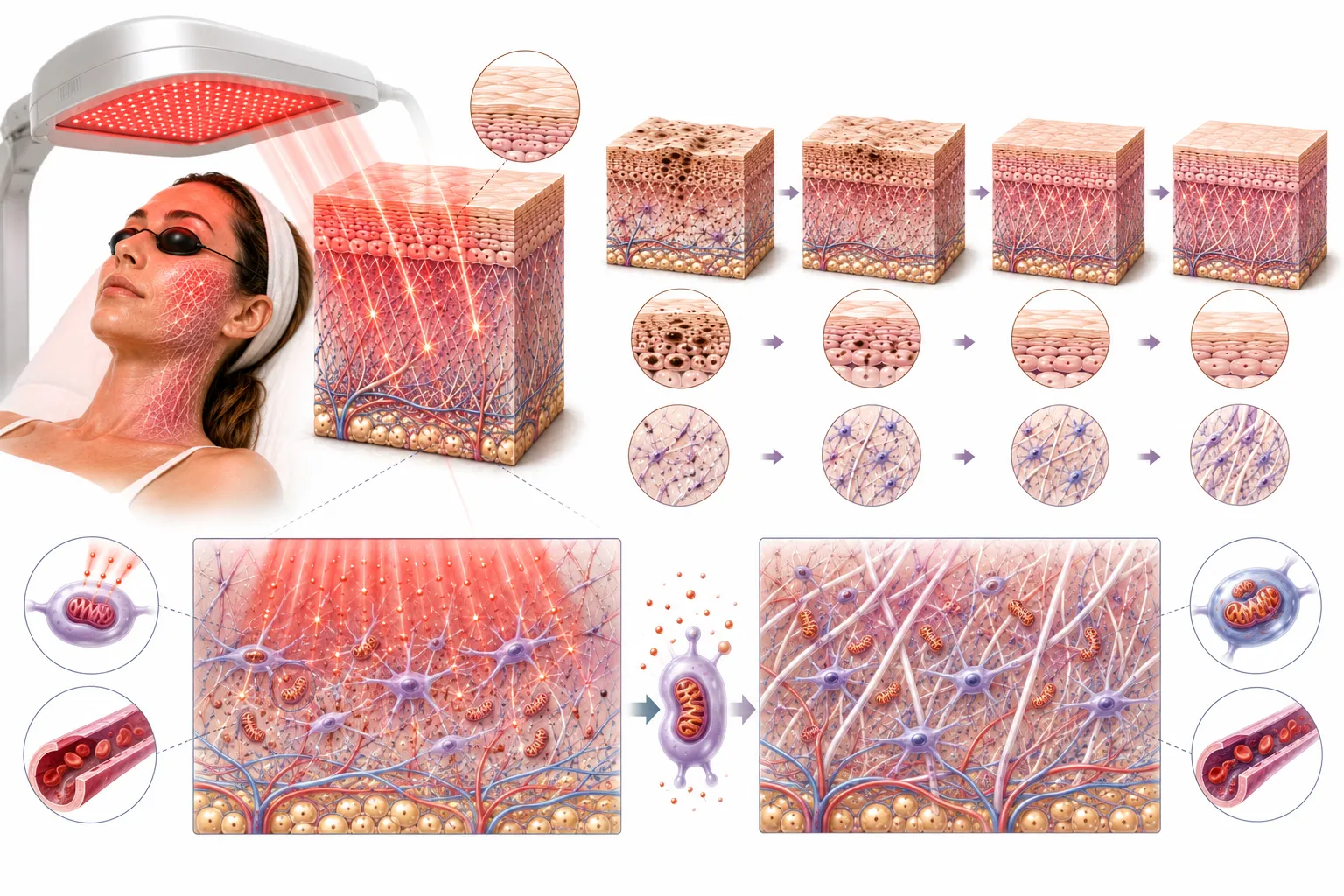
- Mitochondrial Absorption. Red light wavelengths are believed to be absorbed by mitochondria within skin cells.
- Collagen Link. Some research links increased cellular energy from red light to greater collagen production.
- Device Power Matters. At-home devices are generally less powerful than professional equipment, which may affect results.
- Gradual Effect. Any visible improvement tends to build slowly over weeks to months of consistent use.
Red light therapy works through a plausible cellular mechanism involving mitochondrial energy production.
Evidence quality varies, and at-home devices are generally less powerful than clinical equipment.
It does not replace sunscreen or proven repair ingredients for sun-damaged skin.
Science
The mechanism behind red light therapy
Red and near-infrared light at certain wavelengths are thought to be absorbed by chromophores within mitochondria, potentially increasing cellular energy production. This process, called photobiomodulation, is theorized to support several downstream effects relevant to sun-damaged skin, including collagen synthesis and reduced inflammatory signaling.
- Photobiomodulation
- The use of specific light wavelengths to influence cellular activity, without generating significant heat.
- Mitochondria
- Structures within cells responsible for producing energy, thought to be a key target of red light therapy.
Research Summary
What the research suggests
Suggests a modest, cumulative benefit for signs of photoaging.
At-home results may be more modest than those seen in clinical studies using professional-grade devices.
Benefits
What red light therapy may realistically offer
For sun-damaged skin specifically, the plausible benefits include:
- Mild support for collagen production over time
- Reduced appearance of inflammation and redness
- A gentle, non-invasive addition to an existing routine
- Minimal downtime or irritation risk
Clinical Guidance
How to approach red light therapy realistically
- Treat it as a supportive addition to an established skincare routine, not a replacement for proven ingredients like retinoids.
- Use consistently, several times weekly, since effects build gradually.
- Choose devices with published wavelength and power specifications where possible.
- Continue daily sunscreen use, since red light therapy does not prevent further UV damage.
Questions
Frequently asked questions
How long before red light therapy shows results?
Most reported improvements take several weeks to months of consistent use to become noticeable.
Is red light therapy safe for sun-damaged skin?
Generally yes, it's considered low-risk, though those with certain photosensitivity conditions should consult a doctor first.
Can red light therapy replace retinol or vitamin C?
No, it's best used alongside proven ingredients rather than as a replacement.
Are at-home red light devices as effective as in-office treatments?
Generally no; professional devices tend to be more powerful, which may produce more noticeable results.