Evidence
What the evidence shows
The connection through barrier function and inflammation is well-documented.
Barrier link
Well establishedInflammation role
Well documentedManagement approach
Supported
Use this section to decide
Does this advice apply to me?
Find the concern or goal closest to yours, then use the fit signal to decide how much weight to give this guide.If your goal is
Direct causeUsually relevant- Fit signal
- Often useful
No
If your goal is
Indirect connectionUse caution- Fit signal
- Limited evidence
Yes - inflammation
If your goal is
Key mechanismUsually relevant- Fit signal
- Often useful
Barrier compromise
If your goal is
Best approachUsually relevant- Fit signal
- Often useful
Gentle, balanced care
Research notes already in this guide
- The link between barrier function and acne is well-documented.
- Inflammation is recognized as a contributor to acne development.
- Sensitive skin treatment approaches are supported by dermatological practice.
- The management challenge is well-understood.
Explanation
How it works
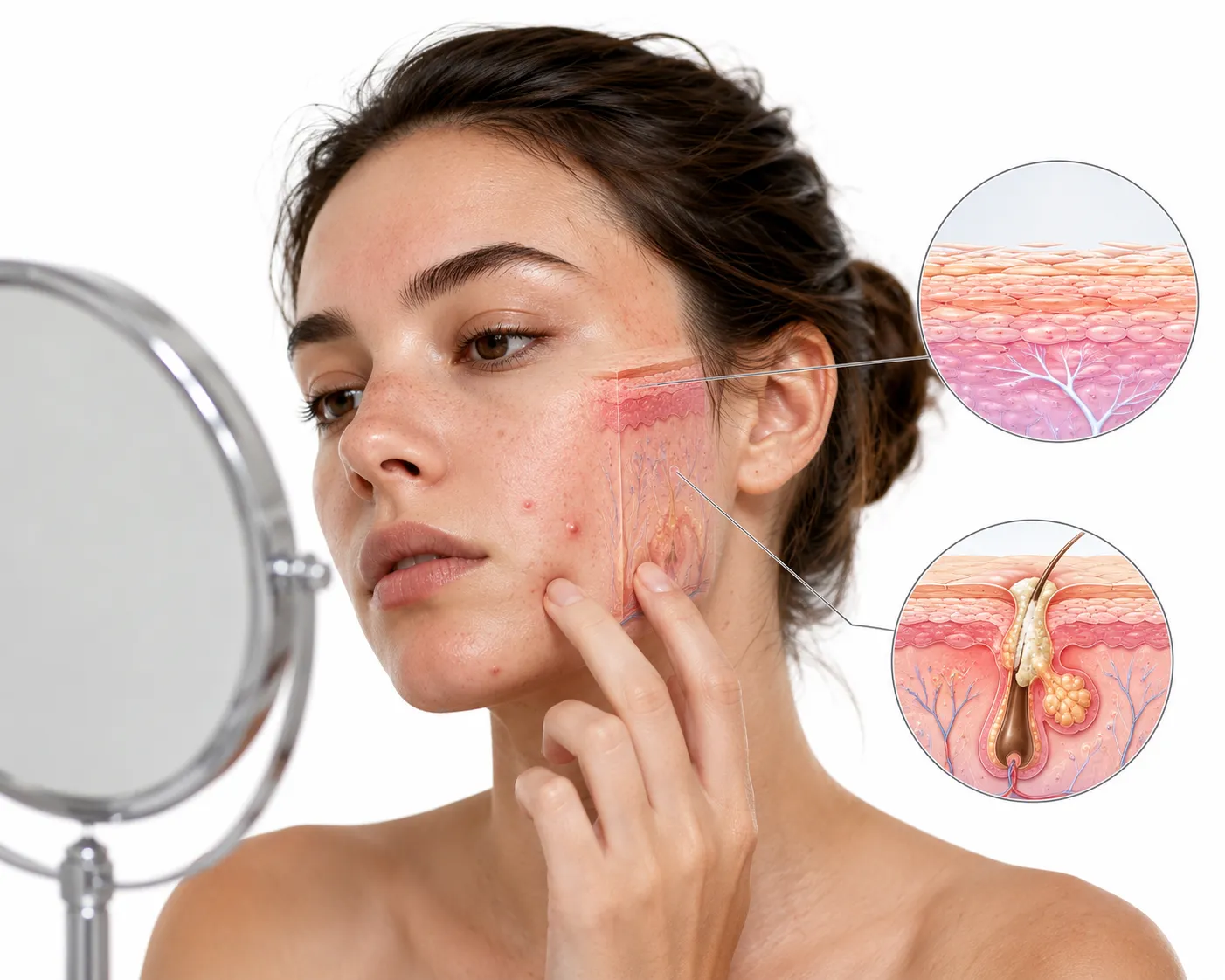
Barrier compromise
Sensitive skin has a compromised barrier that allows irritants to penetrate.
Inflammatory response
Irritants trigger inflammation in the skin.
Cell turnover disruption
Inflammation disrupts normal skin shedding.
Follicle blockage
Dead skin cells accumulate and block follicles.
Practical use
How to use it
Choose gentle, non-irritating acne treatments
Look for formulations specifically for sensitive skin.
Support your barrier
Use a ceramide-rich, non-comedogenic moisturizer.
Introduce treatments slowly
Start with one active ingredient and increase gradually.
Safety
Side effects and cautions
- Using harsh acne treatments on sensitive skin
Choose gentle, non-irritating acne treatments.
- Avoiding all active ingredients for fear of irritation
Some active ingredients can be used gently.
- Over-moisturizing and causing breakouts
Choose non-comedogenic moisturizers.
Fit
Who should be careful
- Expecting simple solutions
Worth noting
Small details that can change the answer
- Barrier Function. Sensitive skin has a compromised barrier that allows irritants to penetrate more easily.
- Inflammation Link. Inflammation from sensitive skin can disrupt skin cell turnover and lead to blocked follicles.
- Reactivity. Sensitive skin is more reactive to bacteria, making breakouts more likely.
- Treatment Challenge. Acne treatments can irritate sensitive skin, creating a management challenge.
Sensitive skin doesn't directly cause acne but can make you more prone.
The connection involves barrier compromise and inflammation.
Managing both requires a gentle, balanced approach.
Choose non-irritating acne treatments and support your barrier.
Patience is essential - both conditions respond to careful, consistent care.
Definition
How sensitive skin and acne are connected
The connection is indirect but real, involving barrier function and inflammation.
- Sensitive skin doesn't directly cause acne
- Compromised barrier allows irritants to penetrate
- Inflammation from sensitivity disrupts skin processes
- Dead skin cells accumulate, blocking follicles
- The connection is indirect but significant
Explanation
Common causes of breakouts in sensitive skin
Understanding these can help you avoid them.
Benefits
How to manage sensitive skin and acne together
A careful, balanced approach is key.
- Use gentle, non-irritating acne treatments
- Support the barrier with ceramide-rich moisturizers
- Introduce active ingredients slowly and one at a time
- Choose products specifically for sensitive, acne-prone skin
- Be patient - both conditions take time to improve
Questions
Frequently asked questions
Can sensitive skin be acne-prone?
Yes. Many people have both sensitive and acne-prone skin.
What acne treatments are safe for sensitive skin?
Gentle formulations of salicylic acid, benzoyl peroxide, and retinoids can be used cautiously.
Is my acne caused by my sensitivity?
Not directly, but sensitivity can make you more prone to breakouts.
How do I treat acne without irritating my sensitive skin?
Choose gentle formulations, introduce slowly, and support your barrier.
References
Sources
The notes below are drawn from the evidence already cited in this guide. They are not a complete bibliography.
- The link between barrier function and acne is well-documented.
- Inflammation is recognized as a contributor to acne development.
- Sensitive skin treatment approaches are supported by dermatological practice.
- The management challenge is well-understood.