Evidence
What the evidence shows
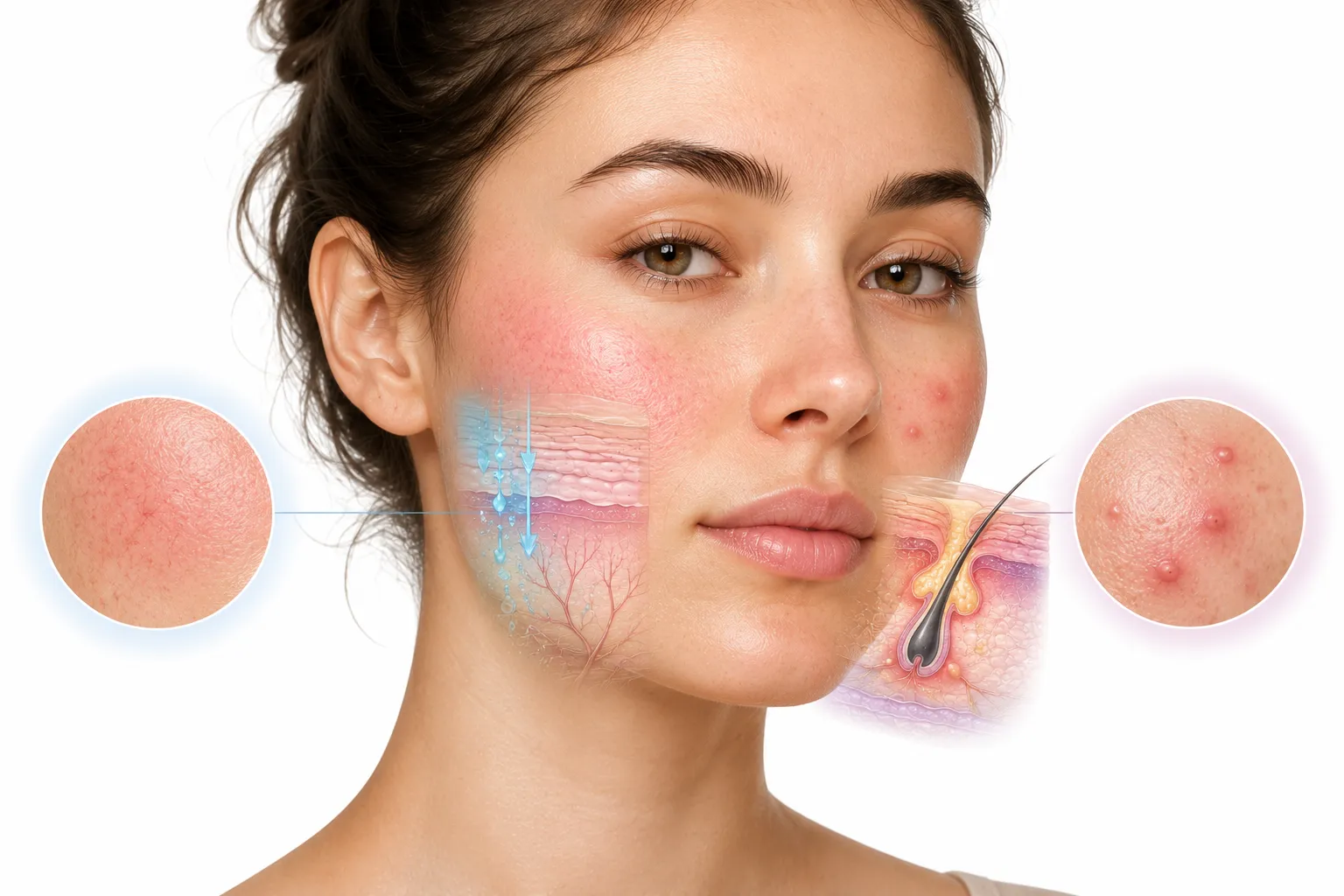
Sensitive skin and acne-prone skin are distinct conditions with different root causes, but they share a common thread: inflammation. Treating both requires addressing inflammation without irritating the skin.
My skin stings and reacts, but I don't break out
You have sensitive skin without acne - focus on barrier support.I break out regularly but my skin doesn't react to products
You have acne-prone skin without sensitivity - standard acne treatments may work.I break out and my skin is easily irritated
You have both conditions - choose gentle, non-comedogenic products.
Use this section to decide
Does this advice apply to me?
Find the concern or goal closest to yours, then use the fit signal to decide how much weight to give this guide.If your goal is
Sensitive skinUse caution- Fit signal
- Limited evidence
Reacts to irritants
If your goal is
Acne-prone skinUse caution- Fit signal
- Limited evidence
Prone to breakouts
If your goal is
OverlapUsually relevant- Fit signal
- Often useful
Common, not universal
If your goal is
Key to managing bothUsually relevant- Fit signal
- Often useful
Gentle, non-comedogenic products
Practical use
How to use it
Choose non-comedogenic, fragrance-free products
Look for products labeled "non-comedogenic" and "fragrance-free."
Use gentle acne treatments
Try azelaic acid (10%) or salicylic acid (0.5-2%) for acne without severe irritation.
Support the barrier
Use ceramides, niacinamide, or squalane to support the barrier while treating acne.
Safety
Side effects and cautions
- Using harsh acne treatments on sensitive skin
Choose gentle alternatives like azelaic acid or low-concentration salicylic acid.
- Avoiding moisturizer because of acne
Sensitive, acne-prone skin needs hydration to support the barrier. Choose oil-free, non-comedogenic moisturizers.
- Over-exfoliating to clear breakouts
Over-exfoliation damages the barrier and can make both conditions worse.
Fit
Who should be careful
- Those looking for a simple yes/no answer
Worth noting
Small details that can change the answer
- Overlap Rate. Up to 50% of people with sensitive skin also experience acne.
- Inflammation Link. Inflammation is a common driver of both sensitivity and acne.
- Treatment Challenge. Standard acne treatments can irritate sensitive skin, making management more complex.
- Barrier Role. A compromised barrier can lead to both sensitivity and increased breakouts.
Sensitive skin and acne-prone skin are not the same thing.
They often overlap, with up to 50% of sensitive skin individuals also experiencing acne.
Inflammation is the common link between the two conditions.
Treating both requires gentle, non-comedogenic products.
A compromised barrier can worsen both sensitivity and acne.
Definition
What are sensitive skin and acne-prone skin?
Sensitive skin is characterized by reactivity to irritants, often due to a compromised barrier. Acne-prone skin is characterized by a tendency to develop comedones and inflammatory breakouts, often due to excess sebum production and bacteria. They are distinct but overlapping conditions.
- Sensitive skin: reacts to irritants with stinging, burning, redness
- Acne-prone skin: prone to clogged pores and breakouts
- Overlap: up to 50% of sensitive skin individuals have acne
- Both involve inflammation as a key factor
Explanation
The relationship between sensitivity and acne
The relationship between sensitive skin and acne-prone skin is complex. Sensitive skin is often inflamed, and inflammation is a key driver of acne. Additionally, a compromised barrier can lead to bacterial overgrowth and increased breakouts. However, you can have sensitive skin without acne, and acne without sensitivity - the connection is inflammation, not causation.
Benefits
How to care for skin that is both sensitive and acne-prone
Caring for skin that is both sensitive and acne-prone requires a gentle, balanced approach.
- Use non-comedogenic products that won't clog pores
- Choose fragrance-free, gentle formulations
- Incorporate anti-inflammatory ingredients like niacinamide
- Avoid harsh acne treatments (high-concentration acids, benzoyl peroxide)
- Support the barrier with ceramides and squalane
Myth Reality
Common myths about sensitive and acne-prone skin
Sensitive skin can be clear and breakout-free.
Acne-prone skin can be dry, combination, or oily.
You can, but you need to choose gentle options like azelaic acid or salicylic acid at low concentrations.
Questions
Frequently asked questions
Can I have sensitive skin and never get acne?
Yes, sensitive skin can be clear and non-acne-prone.
Can acne treatments irritate sensitive skin?
Yes, many acne treatments are harsh and can exacerbate sensitivity.
What's the best active for sensitive, acne-prone skin?
Azelaic acid is often recommended as it treats acne and rosacea without severe irritation.
Should I use a moisturizer if I have acne?
Yes, but choose oil-free, non-comedogenic formulas to avoid clogging pores.