Evidence
What the evidence shows
Healing sun-damaged skin is a long-term process. The most important factor is consistent sun protection, which prevents new damage and allows the skin's repair mechanisms to work.
Retinoid studies
Retinoid studiesSunscreen research
Sunscreen researchIndividual variability
Individual variability
Use this section to decide
Does this advice apply to me?
Find the concern or goal closest to yours, then use the fit signal to decide how much weight to give this guide.If your goal is
Early ResultsUsually relevant- Fit signal
- Often useful
3-6 months
If your goal is
SignificantUse caution- Fit signal
- Limited evidence
6-12 months
If your goal is
Full ResultsUse caution- Fit signal
- Limited evidence
1-2 years
If your goal is
Key FactorUse caution- Fit signal
- Limited evidence
Consistency
Research notes already in this guide
- Studies show that retinoids can improve photoaging in 4 to 6 months.
- Clinical trials have demonstrated the long-term benefits of sunscreen.
- Research indicates that skin repair takes time and consistency.
Expected results
Results and timeframe
Healing sun-damaged skin is a slow process, often taking 1 to 2 years for full results.
Early improvement in texture can be seen in 3 to 6 months.
Deep wrinkles are the most stubborn and take the longest to improve.
Practical use
How to use it
Set realistic expectations
Healing sun-damaged skin takes time; be patient.
Be consistent
Use your sunscreen and treatments every day.
Track your progress
Take photos every few months to see the changes.
Safety
Side effects and cautions
- Quitting treatment too early
Healing takes time; consistency is key.
- Expecting results after one or two months
It can take months or years to see significant results.
- Not using sunscreen during treatment
Without sun protection, new damage will undo any repair.
Fit
Who should be careful
- Those expecting quick fixes or overnight results
Worth noting
Small details that can change the answer
- Cell Turnover. The epidermis turns over every 28 days in young adults, but this process slows with age.
- Collagen Production. Collagen production can be stimulated, but it takes time to build up the skin's structural framework.
- Pigment Fading. Pigmentation changes can take 6 to 12 months to fade with consistent treatment.
- Individual Variability. Some people heal faster than others due to genetics and age.
Pigmentation changes take longer, often 6 to 12 months.
Consistent sun protection is the most important factor in healing.
Definition
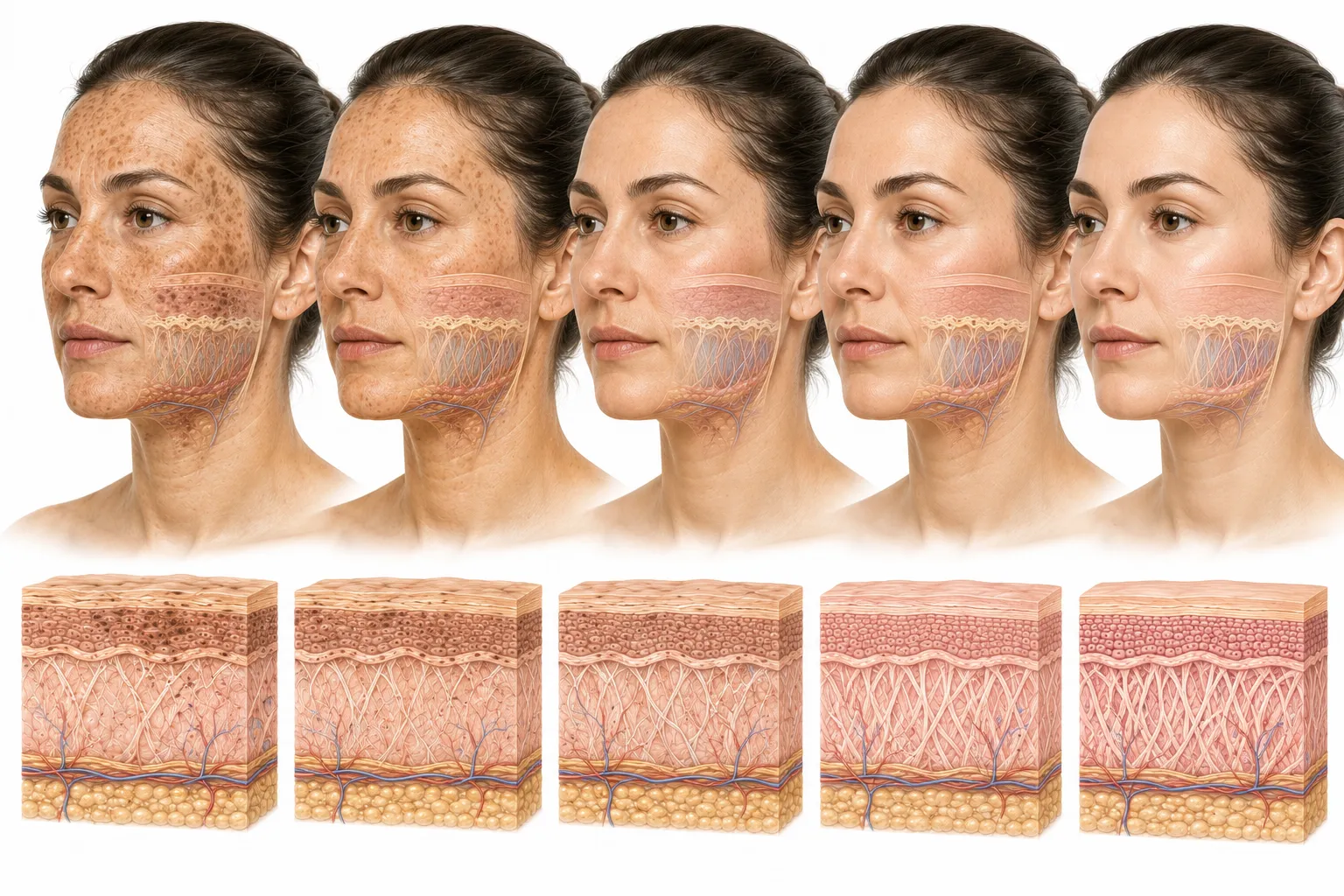
A timeline for healing sun-damaged skin
The timeline for healing sun-damaged skin is not a straight line. Different aspects of the damage improve at different rates. Understanding this can help you set realistic expectations and stay motivated.
- Months 0-3: Early improvement in skin texture and tone.
- Months 3-6: Pigmentation may start to fade.
- Months 6-12: Significant improvement in fine lines and wrinkles.
- Months 12-24: More advanced changes in deep wrinkles and skin elasticity.
Explanation
Factors that affect the healing timeline
The healing timeline is affected by several factors, including the severity of the damage, the treatment approach, the individual's skin type and age, and the consistency of the routine. Those who are younger and have less severe damage will likely see results faster.
Science
The biology of skin repair and timelines
The skin's repair mechanisms work on different timelines. The epidermis, the outer layer, turns over every 28 days, so some changes in texture and tone can be seen in a few months. The dermis, where collagen is produced, takes longer to regenerate, which explains why deep wrinkles take the longest to improve.
- Epidermal Turnover
- The process by which new skin cells are produced and old ones are shed.
- Dermal Remodeling
- The process by which the dermis is repaired and remodeled over time.
Questions
Frequently asked questions
How can I speed up the healing of sun-damaged skin?
Use prescription retinoids, vitamin C, and consider in-office treatments like laser therapy.
Will I ever see full healing of sun-damaged skin?
Full healing is unlikely, but significant improvement is possible.
Does age affect how long it takes to heal?
Yes. Younger skin repairs faster than older skin.
Is it worth trying to heal sun-damaged skin?
Yes. Even modest improvements can make a significant difference in skin health and appearance.
References
Sources
The notes below are drawn from the evidence already cited in this guide. They are not a complete bibliography.
- Studies show that retinoids can improve photoaging in 4 to 6 months.
- Clinical trials have demonstrated the long-term benefits of sunscreen.
- Research indicates that skin repair takes time and consistency.