Evidence
What the evidence shows
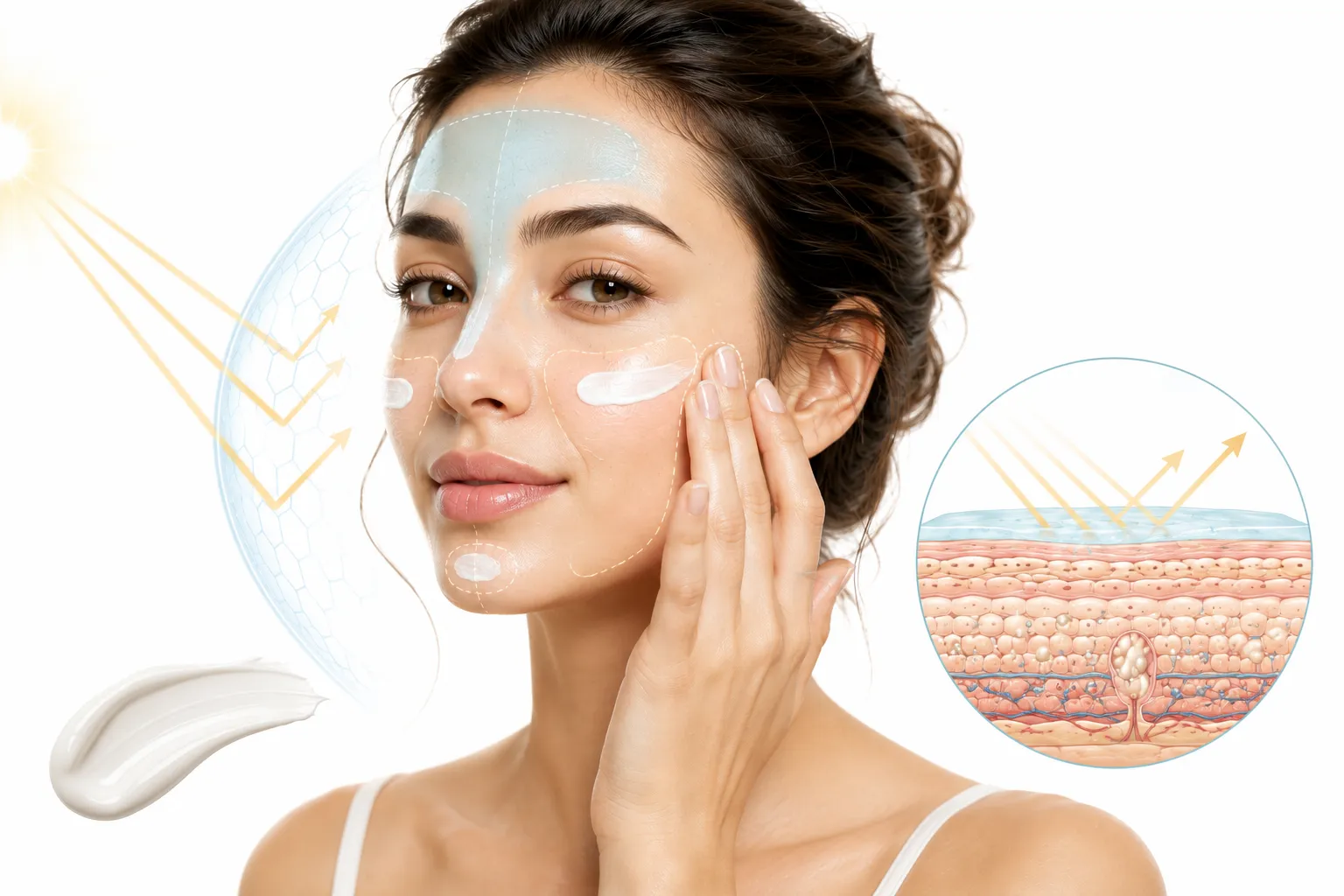
The key to sunscreen for combination skin is texture - lightweight, non-greasy formulas that feel comfortable on both oily and dry areas.
T-zone oily, cheeks dry?
Try a lightweight gel sunscreen with a semi-matte finish.Both zones sensitive?
Consider a mineral sunscreen with zinc oxide.Need a one-product solution?
Look for a hybrid sunscreen that balances both zones.
Use this section to decide
Does this advice apply to me?
Find the concern or goal closest to yours, then use the fit signal to decide how much weight to give this guide.If your goal is
SPF levelUsually relevant- Fit signal
- Often useful
30+ broad-spectrum
If your goal is
Best textureUsually relevant- Fit signal
- Often useful
Lightweight gel or fluid
If your goal is
Key labelsUsually relevant- Fit signal
- Often useful
Oil-free, non-comedogenic
If your goal is
Zonal optionUse caution- Fit signal
- Limited evidence
Different sunscreens for different zones
Practical use
How to use it
Look for lightweight, oil-free formulas
Gel or fluid sunscreens often work best for combination skin.
Test the texture
Apply to both your T-zone and cheeks to see how it feels on each.
Don't give up if the first one doesn't work
Finding the right sunscreen can take a few tries.
Safety
Side effects and cautions
- Choosing a sunscreen that works on one zone but not the other
You need a sunscreen that works for both your T-zone and cheeks.
- Skipping sunscreen because it breaks you out
The right sunscreen won't break you out - you just need to find the right formula.
- Using too little sunscreen
You need about 1/4 teaspoon for your face - most people use far less.
Fit
Who should be careful
- Those who want a one-size-fits-all sunscreen - combination skin may need a zonal approach
Worth noting
Small details that can change the answer
- Texture Priority. Lightweight gel or fluid formulas work best for combination skin.
- Oil-Free Rule. Oil-free sunscreens are less likely to clog T-zone pores.
- Mineral Option. Zinc oxide and titanium dioxide sunscreens are often well-tolerated.
- Zonal Approach. Some people use different sunscreens on different areas of the face.
The best sunscreen for combination skin is lightweight, oil-free, and has a matte or semi-matte finish.
Gel and fluid sunscreens are often more comfortable than heavy creams.
Mineral sunscreens with zinc oxide or titanium dioxide are a good option.
Don't be afraid to use different sunscreens on different areas of your face.
SPF 30+ broad-spectrum protection is essential for all skin types.
Product Comparison
Comparing sunscreen types for combination skin
Chemical sunscreen
Beginner friendlyBest for: Lightweight protection with minimal white castLightweight · Invisible · Good for T-zone
Consider: May irritate sensitive cheeksMineral sunscreen
Beginner friendlyBest for: Gentle protection with barrier benefitsGentle on skin · No irritation · Good for cheeks
Consider: Can be drying · May leave white castHybrid sunscreen
Beginner friendlyBest for: Balanced protection with good textureBalanced formula · Good for both zones
Consider: Can be harder to findShopping Guide
What to look for on the label
Protects against both UVA and UVB rays.
Reduces the risk of clogged pores in the T-zone.
Gel, fluid, or serum textures absorb well.
Reduces shine without drying out the cheeks.
Dos Donts
Dos and don'ts for combination skin sunscreen
Do
Prevents T-zone clogging
Ensures adequate protection
Maintains protection
Addresses different needs
Avoid
Clogs T-zone pores
Dries out the cheeks
UV rays penetrate clouds
Reduces protection significantly
Benefits
Why proper sunscreen matters for combination skin
Sun protection is particularly important for combination skin because UV exposure affects both zones differently and can make existing imbalances worse.
- Prevents the T-zone from becoming oilier from sun-induced inflammation
- Stops the cheeks from getting drier from UV-related barrier damage
- Prevents hyperpigmentation that can affect both zones
- Slows the visible aging that occurs regardless of skin type
Questions
Frequently asked questions
Can I use a moisturizer with SPF for combination skin?
Yes, but ensure it's lightweight and non-comedogenic to avoid T-zone clogging.
Should I use a physical or chemical sunscreen for combination skin?
Both can work - mineral sunscreens are often gentler on dry cheeks, while chemical sunscreens are lighter on the T-zone.
How much sunscreen should I use?
About 1/4 teaspoon for the face - most people use far less.
Can I skip sunscreen on the oily T-zone?
No - the T-zone needs protection just as much as the cheeks.