Evidence
What the evidence shows
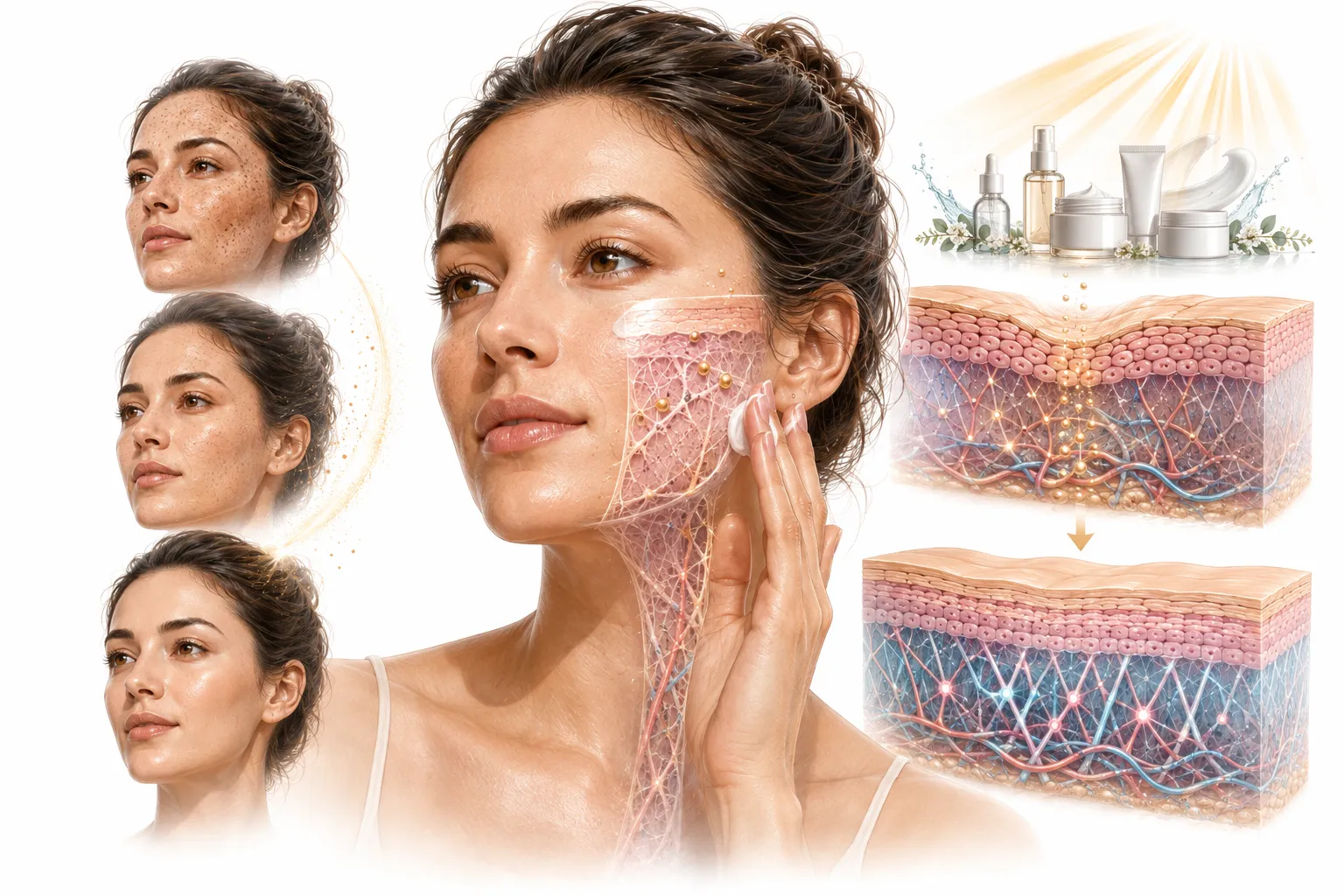
Facial sun damage is responsive to treatment, but it requires a multi-layered approach that combines daily protection with active repair.
Retinoids
RetinoidsVitamin C
Vitamin CChemical peels
Chemical peels
Use this section to decide
Does this advice apply to me?
Find the concern or goal closest to yours, then use the fit signal to decide how much weight to give this guide.If your goal is
CoreUsually relevant- Fit signal
- Often useful
Retinoids + Sunscreen
If your goal is
SupportUsually relevant- Fit signal
- Often useful
Vitamin C
If your goal is
AdvancedUse caution- Fit signal
- Limited evidence
Chemical peels
If your goal is
ImportantUse caution- Fit signal
- Limited evidence
Patience
Research notes already in this guide
- Numerous studies have shown the efficacy of retinoids for facial photoaging.
- Research supports the use of vitamin C for photoprotection and repair.
- Clinical trials have demonstrated the efficacy of chemical peels and laser therapy.
Explanation
How it works
Protection
Sunscreen prevents further UV damage to the face.
Stimulation
Retinoids stimulate collagen production in the dermis.
Protection from free radicals
Vitamin C neutralizes free radicals.
Exfoliation
Chemical peels remove the outer layer of damaged skin, revealing newer, healthier skin.
Practical use
How to use it
Develop a consistent morning and evening routine
Use vitamin C in the morning and retinoids in the evening.
Protect your skin every day
Apply sunscreen every morning, even on cloudy days.
Be patient
Results may take several months to become visible.
Safety
Side effects and cautions
- Using facial products that are too harsh
The face is sensitive, so products should be used cautiously.
- Skipping sunscreen after using repair products
Repair products make the skin more sensitive to the sun, so sunscreen is essential.
- Expecting immediate results
Repairing facial sun damage takes time.
Fit
Who should be careful
- Those with severe sun damage who may need in-office treatments
Worth noting
Small details that can change the answer
- Facial Skin. The skin on the face is thinner and more vascular than on other parts of the body.
- Retinoid Efficacy. Retinoids are highly effective for treating photoaging on the face.
- Chemical Peel Depth. Chemical peels for the face can be adjusted to different depths, depending on the extent of the damage.
- Facial Sensitivity. The face is more sensitive than other areas, so introduce new products gradually.
The face is the most common site for sun damage and requires a focused approach.
Sunscreen is the first and most important step.
Retinoids are the most effective topical treatment for facial photoaging.
Vitamin C provides additional protection and support.
In-office treatments can be effective for advanced damage.
Definition
A step-by-step approach to repairing facial sun damage
Repairing sun-damaged facial skin involves a step-by-step approach. Each step addresses a different aspect of photoaging, and together they create a comprehensive strategy.
- Step 1: Daily sun protection with SPF 30+.
- Step 2: Topical retinoid use in the evening.
- Step 3: Vitamin C serum in the morning.
- Step 4: Regular chemical exfoliation.
- Step 5: In-office treatments for advanced damage.
Science
How the skin on the face responds to treatment
The skin on the face is highly responsive to treatment because it has a high density of blood vessels and a high rate of cell turnover. Retinoids bind to retinoic acid receptors in the skin, stimulating collagen production and accelerating cell turnover. Vitamin C acts as an antioxidant, neutralizing free radicals. Chemical peels remove the outer layer of damaged skin, revealing healthier skin underneath.
- Retinoic Acid Receptors
- Proteins in the skin that bind to retinoids, triggering a cascade of cellular events.
- Keratinocyte
- The most common type of skin cell in the epidermis.
Questions
Frequently asked questions
Can I use the same products on my face as I do on my body?
Facial skin is more sensitive, so products formulated for the face are generally gentler.
How do I avoid irritation from retinoids?
Start with a low-strength retinoid and use it every other night.
Is it too late to repair facial sun damage?
No. Even advanced photoaging can be improved with the right approach.
How often should I get a chemical peel?
The frequency depends on the peel's strength and your skin's tolerance; consult with a dermatologist.
References
Sources
The notes below are drawn from the evidence already cited in this guide. They are not a complete bibliography.
- Numerous studies have shown the efficacy of retinoids for facial photoaging.
- Research supports the use of vitamin C for photoprotection and repair.
- Clinical trials have demonstrated the efficacy of chemical peels and laser therapy.