Evidence
What the evidence shows
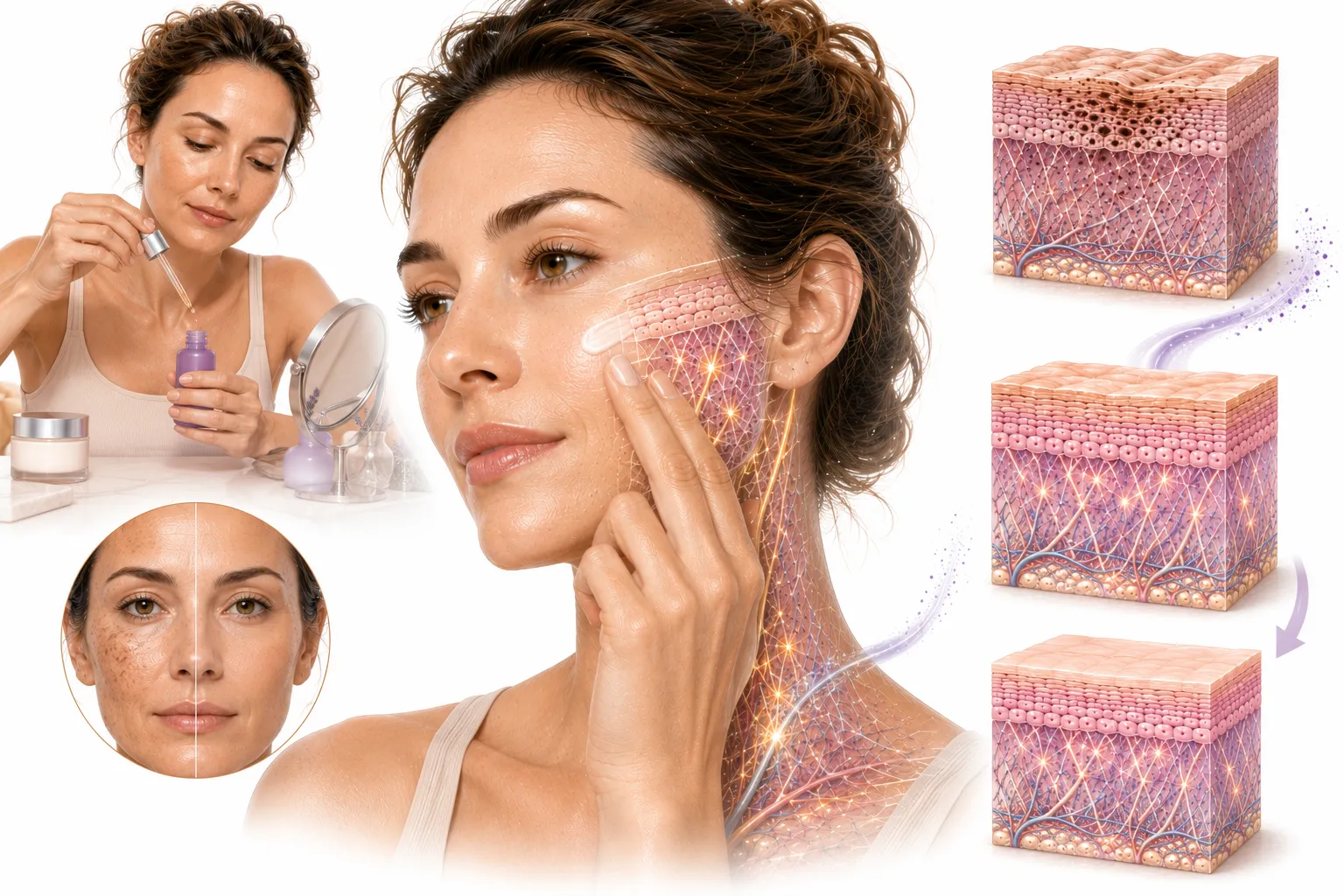
Retinol's real strength for sun damage isn't fast results, it's consistency - the collagen-building effect compounds over months in a way few other over-the-counter ingredients can match.
Use this section to decide
Does this advice apply to me?
Find the concern or goal closest to yours, then use the fit signal to decide how much weight to give this guide.If your goal is
Main benefitUsually relevant- Fit signal
- Often useful
Collagen, texture, fine lines
If your goal is
Best time to useUse caution- Fit signal
- Limited evidence
Night
If your goal is
Typical strengthUse caution- Fit signal
- Limited evidence
0.25-1%
If your goal is
Sun sensitivityDepends- Fit signal
- Possible fit
Increased
Research notes already in this guide
- Retinoids have one of the largest bodies of clinical research behind any anti-aging ingredient.
- Their collagen-stimulating effect on photoaged skin is well established.
- Retinol is widely recommended by dermatologists as a first-line treatment for signs of sun damage.
Explanation
How it works
Binds to skin cell receptors
Retinol converts to retinoic acid, which binds to receptors that regulate cell behavior.
Speeds up turnover
This encourages faster shedding of dull, damaged surface cells.
Stimulates collagen
It signals fibroblasts in the dermis to produce more collagen over time.
Gradual visible change
Texture, fine lines, and mild pigmentation improve as this process continues.
Expected results
Results and timeframe
Retinol is one of the best-studied ingredients for improving sun-damaged skin.
Texture improvements can appear within weeks, but collagen-related change takes months.
Practical use
How to use it
Start low and slow
Begin with a lower strength retinol a few nights a week.
Moisturize alongside it
Support the barrier with a gentle moisturizer to offset dryness.
Commit to daily SPF
Protect increasingly sensitive skin with broad-spectrum sunscreen each morning.
Safety
Side effects and cautions
- Using retinol every night from the start
Begin slowly, at 1 to 2 nights per week, to build tolerance and avoid irritation.
- Skipping sunscreen the next morning
Retinol increases sun sensitivity, making daily SPF essential while using it.
- Expecting results within a week or two
Collagen-related improvements typically take three to six months to become visible.
- Dryness or flaking
Common early on · Reduce frequency and moisturize well.
- Mild redness
Occasional · Ease into use gradually.
- Increased sun sensitivity
Common · Use sunscreen daily while on retinol.
Fit
Who should be careful
- Pregnant individuals
- Those wanting fast results
Worth noting
Small details that can change the answer
- Cell Turnover. Retinol speeds up the shedding and renewal of surface skin cells.
- Collagen Stimulation. It encourages the production of new collagen in the deeper layers of skin.
- Sun Sensitivity. Retinol increases photosensitivity, so it's typically used at night with daily SPF.
- Gradual Timeline. Meaningful improvement in texture and fine lines usually takes three to six months.
It works by speeding cell turnover and stimulating collagen production.
It increases sun sensitivity, making nightly use and daily SPF a standard pairing.
Gradual introduction helps minimize irritation while building tolerance.
Benefits
What retinol can realistically improve
For photoaged skin, retinol's benefits are among the best documented of any over-the-counter ingredient.
- Smoother texture from increased cell turnover
- Reduced appearance of fine lines over months of use
- Firmer-looking skin from increased collagen production
- Mild improvement in surface pigmentation
Beginner Guide
Easing into retinol without irritation
- 1Weeks 1-2 · 1-2 nights per week
Apply a pea-sized amount to dry skin.
- 2Weeks 3-4 · 2-3 nights per week
Increase gradually if skin tolerates it well.
- 3Week 5+ · Every other night to nightly
Adjust based on any dryness or sensitivity.
Questions
Frequently asked questions
How long does retinol take to improve sun damage?
Texture may improve within weeks, but collagen-related changes typically take three to six months.
Can retinol fade sun spots?
It can help mildly, though ingredients like vitamin C are often paired with it for pigment-specific concerns.
Is retinol the same as retinoid or tretinoin?
Retinol is a milder, over-the-counter retinoid; tretinoin is a stronger, prescription-only form.
Can I use retinol on sensitive, sun-damaged skin?
Yes, but it's best introduced gradually and paired with a supportive moisturizer to reduce irritation.
References
Sources
The notes below are drawn from the evidence already cited in this guide. They are not a complete bibliography.
- Retinoids have one of the largest bodies of clinical research behind any anti-aging ingredient.
- Their collagen-stimulating effect on photoaged skin is well established.
- Retinol is widely recommended by dermatologists as a first-line treatment for signs of sun damage.