Evidence
What the evidence shows
How well-established is the science?
Barrier function
Well-documented and foundationalLipid role
Consistent researchBarrier repair strategies
Effective and validated
Use this section to decide
Does this advice apply to me?
Find the concern or goal closest to yours, then use the fit signal to decide how much weight to give this guide.If your goal is
ThicknessUse caution- Fit signal
- Limited evidence
10-20 micrometers
If your goal is
Key componentsUsually relevant- Fit signal
- Often useful
Ceramides, cholesterol, fatty acids
If your goal is
FunctionsUsually relevant- Fit signal
- Often useful
Protection + hydration retention
If your goal is
Health priorityUse caution- Fit signal
- Limited evidence
Essential, not optional
Explanation
How it works
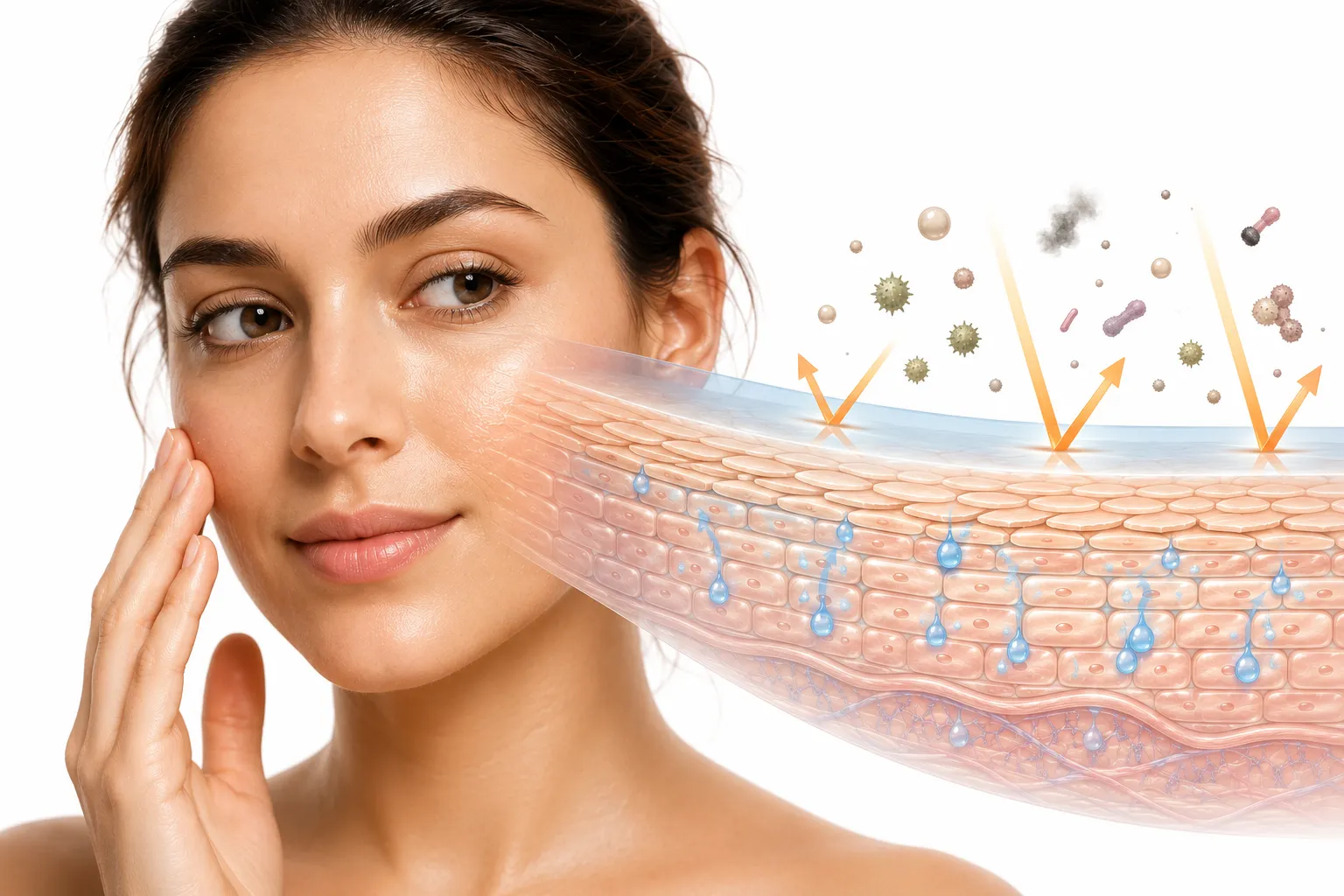
Protection and hydration are two sides of the same coin.
Intact barrier
Corneocytes and lipids form a tight protective layer.
Blocks irritants
External threats are kept out.
Retains water
Moisture is kept in, preventing dehydration.
Healthy skin
The skin looks and feels comfortable and resilient.
Practical use
How to use it
Use barrier-supporting skincare
Look for products with ceramides, cholesterol, and fatty acids.
Avoid barrier-damaging habits
Don't over-exfoliate, use harsh cleansers, or use hot water.
Protect the barrier from environmental stress
Use SPF daily, protect skin from extreme temperatures, and use a humidifier in dry conditions.
Safety
Side effects and cautions
- Treating the barrier as optional or unimportant
The barrier is the foundation of skin health. It's not optional.
- Focusing only on active ingredients
Without a healthy barrier, active ingredients can cause more harm than good.
- Using harsh products that damage the barrier
Barrier-supporting products should be the priority.
Fit
Who should be careful
- Ignoring barrier health
Worth noting
Small details that can change the answer
- Thickness. The skin barrier is only about 10-20 micrometers thick - thinner than a human hair.
- Lipid Composition. The barrier is about 50% ceramides, 25% cholesterol, and 25% fatty acids.
- TEWL. Trans-epidermal water loss measures how much water escapes through the barrier.
- Replacement Cycle. The barrier renews itself approximately every 14 days in younger skin, but this slows with age.
The skin barrier is the outermost layer of skin, composed of corneocytes and lipids.
It serves two essential functions: protection from external threats and retention of moisture.
A compromised barrier leads to dryness, sensitivity, and vulnerability to infections.
Most skin problems are worsened by a compromised barrier.
Barrier repair is the foundation of all effective skincare.
Definition
What is the skin barrier?
The skin barrier (stratum corneum) is the outermost layer of the epidermis. It's made up of corneocytes - dead skin cells that have been flattened and packed together - held in place by a lipid matrix of ceramides, cholesterol, and fatty acids. This structure is often compared to a brick wall, where corneocytes are the bricks and the lipid matrix is the mortar.
Explanation
Protection from the outside world
The barrier blocks the entry of bacteria, viruses, allergens, pollutants, and irritants. It's the first line of physical defense and plays a role in immune signaling. Without it, your body would be exposed to infections and irritants that could trigger allergic reactions, inflammation, and disease.
Explanation
Retaining hydration
The barrier prevents water from escaping through the skin. This is its other essential job. Without an intact barrier, water evaporates from the skin at an accelerated rate - a process called trans-epidermal water loss (TEWL). This leads to dryness, tightness, flaking, and a compromised skin surface.
Science
The barrier's role in skin health
A healthy barrier is the foundation of healthy skin. When it's intact, the skin looks hydrated, feels comfortable, and can tolerate environmental changes. When it's compromised, the skin becomes dry, sensitive, and prone to problems like acne, rosacea, and eczema.
- Trans-epidermal water loss (TEWL)
- The rate at which water evaporates from the skin's surface; higher TEWL indicates a compromised barrier.
- Lipid matrix
- The intercellular "mortar" that holds skin cells together and retains moisture.
Questions
Frequently asked questions
What happens when the skin barrier is damaged?
Your skin becomes dry, sensitive, and more vulnerable to infections and irritants.
How do I know if my barrier is healthy?
Healthy skin feels comfortable, looks hydrated, and doesn't react to products.
Can the skin barrier repair itself?
Yes, with proper care and removal of damaging factors.
Is the skin barrier the same for everyone?
No - genetics, age, and environmental factors affect barrier thickness and function.