Evidence
What the evidence shows
The biggest risk to normal skin is assuming it needs nothing - inconsistent care or sudden changes in routine can trigger the very problems normal skin typically avoids.
Use this section to decide
Does this advice apply to me?
Find the concern or goal closest to yours, then use the fit signal to decide how much weight to give this guide.If your goal is
DehydrationDepends- Fit signal
- Possible fit
Most common issue
If your goal is
SensitivityUse caution- Fit signal
- Limited evidence
Usually reaction-based
If your goal is
Barrier neglectUse caution- Fit signal
- Limited evidence
Gradual, preventable
If your goal is
Premature agingDo not rely on it- Fit signal
- Not established
With SPF, manageable
If your goal is
BreakoutsDo not rely on it- Fit signal
- Not established
Less common than in oily skin
Practical use
How to use it
Use a gentle, balanced cleanser
Avoid harsh sulfates and use lukewarm water to preserve the barrier.
Apply a lightweight, hydrating moisturizer
Choose a formula with humectants like glycerin and barrier-supporting ingredients.
Protect with SPF daily
Sunscreen is non-negotiable for maintaining healthy, even-toned skin.
Safety
Side effects and cautions
- Assuming normal skin needs no moisturizer
Even normal skin benefits from hydration and barrier support.
- Using harsh, stripping cleansers that disrupt balance
Gentle, sulfate-free cleansers preserve normal skin's healthy barrier.
- Skipping sunscreen because skin looks healthy
UV exposure causes cumulative damage even on skin that appears fine.
Fit
Who should be careful
- Ignoring regular skin maintenance
Helpful context
What else is worth knowing
Perfect for normal skin owners
If this sounds like you, read on.
Worth noting
Small details that can change the answer
- Dehydration Risk. Normal skin can become dehydrated when the barrier loses moisture to the environment faster than it can be replenished.
- Pore Size. Normal skin typically has refined pores that don't require intensive pore-clearing treatments.
- Sensitivity Threshold. Normal skin can react to harsh surfactants, fragrances, and over-exfoliation.
- Aging Pattern. Normal skin tends to show age-related changes later than dry or sensitive skin but can benefit from preventive care.
Normal skin is balanced but not immune to problems - dehydration, sensitivity, and barrier neglect are common concerns.
Dehydration is often missed because it affects water, not oil, levels in the skin.
Normal skin can become reactive when exposed to harsh products or over-exfoliation.
A consistent routine with gentle products is key to maintaining balance.
Sunscreen and hydration are just as important for normal skin as for any other type.
Definition
What "normal" actually means
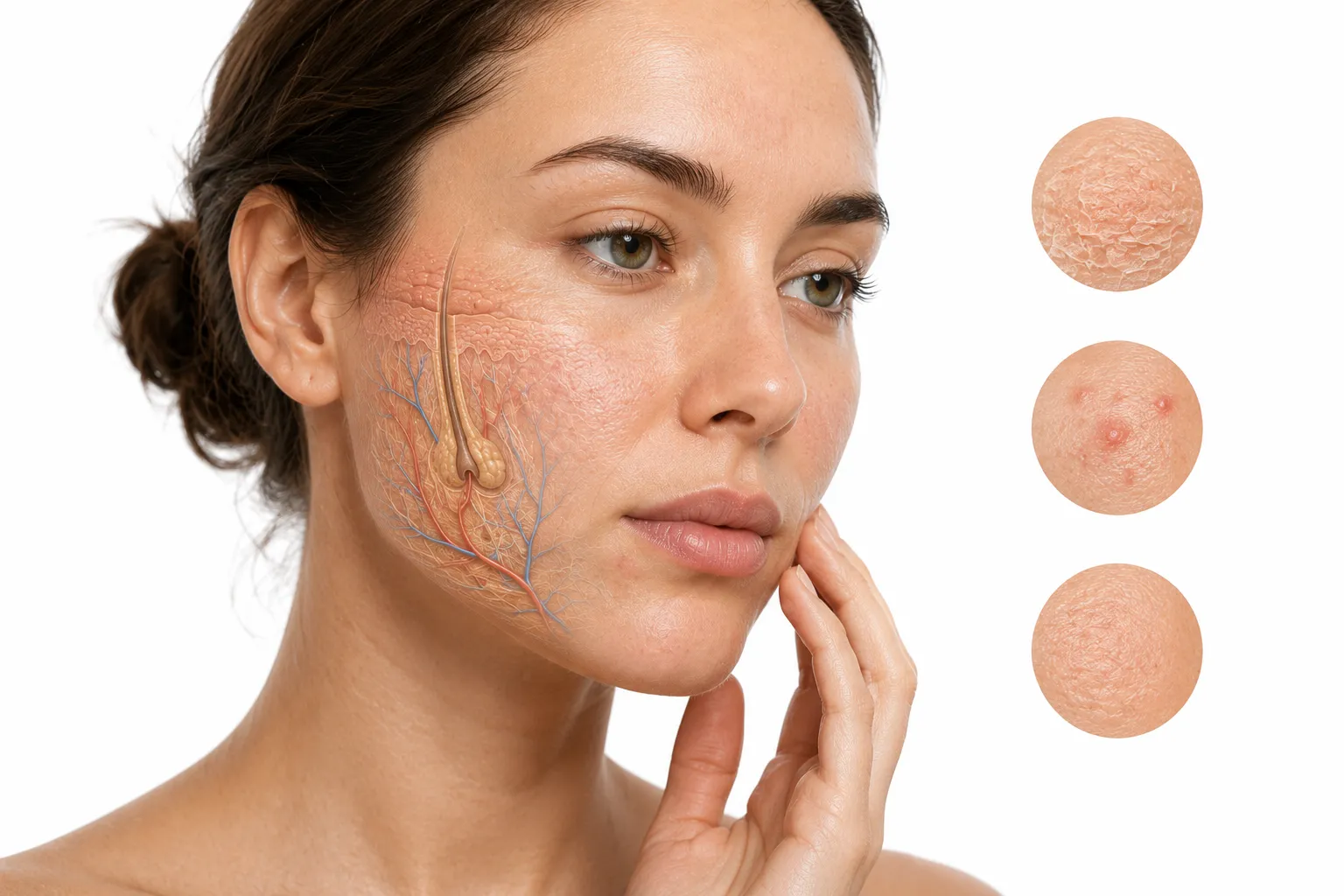
Normal skin is a clinical term, not a value judgment. It refers to skin that produces a moderate amount of sebum, retains moisture effectively, and has refined, medium-sized pores. It's sometimes called "eudermic" skin because it resembles healthy, well-functioning skin in its natural state. This balance doesn't mean perfect skin - it means skin that falls in the middle of the spectrum for sebum production and hydration without significant excess or deficiency in either direction.
Explanation
Common problem: dehydration
Dehydration is probably the most under-recognized problem for normal skin. It occurs when the skin lacks water, not oil - which is why it can happen even when sebum production seems fine. Environmental factors like air conditioning, heating, wind, and low humidity are common triggers. Dehydrated normal skin may feel tight after washing, look dull, or show fine lines that appear and disappear depending on hydration levels.
Explanation
Common problem: sensitivity and reactivity
Normal skin can become temporarily sensitive or reactive, especially when exposed to new active ingredients, harsh cleansers, or environmental stressors. This type of sensitivity is often dose-dependent - a little exfoliation is fine, but daily use can trigger redness or stinging. Sensitive episodes in normal skin tend to resolve once the trigger is removed, but they're a reminder that even balanced skin has limits.
Risks
Common problem: barrier neglect
Because normal skin doesn't demand attention through obvious signs of distress, it's easy to neglect barrier maintenance. Over time, this can lead to gradual thinning of the barrier, increased moisture loss, and earlier appearance of fine lines and dullness.
- Increased trans-epidermal water loss from barrier weakening
- Gradual loss of skin resilience and bounce
- Earlier appearance of fine lines from chronic dehydration
- Reduced ability to recover from environmental stressors
Science
How the balance is maintained
Normal skin maintains its balance through a complex interplay of sebum production, barrier function, and natural moisturizing factors. The stratum corneum (outermost layer) holds water like a sponge, while sebum provides a protective, water-repelling coating. When either component is disrupted - by over-washing, harsh products, or environmental extremes - the balance tips and problems begin.
- Natural moisturizing factors (NMF)
- A mixture of amino acids and other compounds that help the skin hold onto water.
- Trans-epidermal water loss (TEWL)
- The rate at which water evaporates from the skin's surface - higher TEWL means poorer barrier function.
Questions
Frequently asked questions
Can normal skin become oily or dry over time?
Yes, hormonal changes, aging, and climate can shift skin type over time.
Does normal skin get acne?
It can, but breakouts tend to be less frequent and less severe than in oily or acne-prone skin.
Is normal skin the same as healthy skin?
Not exactly - normal is a skin type, while healthy is a state of good condition regardless of type.
Should normal skin exfoliate?
Yes, but gently and moderately - 1-2 times per week is usually sufficient.