Evidence
What the evidence shows
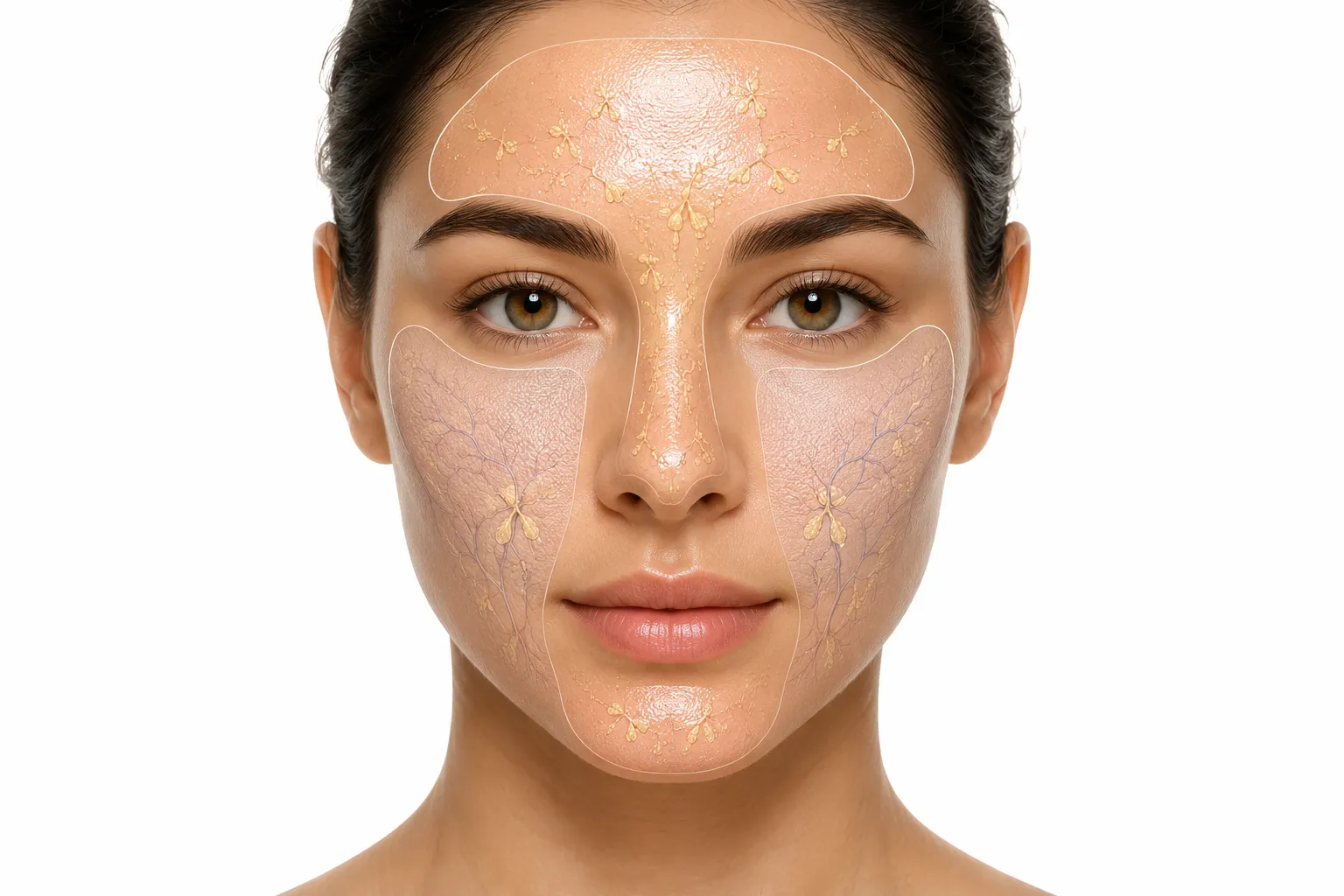
Combination skin isn't a compromise between oily and dry - it's a map of the face where different areas have different needs. The treatment isn't a single product but a strategy.
Use this section to decide
Does this advice apply to me?
Find the concern or goal closest to yours, then use the fit signal to decide how much weight to give this guide.If your goal is
T-zoneDepends- Fit signal
- Possible fit
Oily, visible pores
If your goal is
CheeksUse caution- Fit signal
- Limited evidence
Normal to dry
If your goal is
Key challengeUse caution- Fit signal
- Limited evidence
Balancing different needs
If your goal is
Best approachUsually relevant- Fit signal
- Often useful
Zone-specific care
Explanation
How it works
The distribution of sebaceous glands explains it all.
Gland distribution
More sebaceous glands in the T-zone than on the cheeks.
More oil in the T-zone
More glands produce more sebum in the central face.
Less oil on the cheeks
Fewer glands mean less sebum and a tendency toward dryness.
Combination pattern emerges
The face has two different needs in different zones.
Practical use
How to use it
Use a gentle, non-stripping cleanser
Clean the whole face without over-drying the cheeks.
Apply different products to different areas
Use mattifying or oil-controlling products on the T-zone, and richer moisturizers on the cheeks.
Adjust seasonally
Be prepared to modify your routine as your skin shifts with the seasons.
Safety
Side effects and cautions
- Treating the whole face as oily
This leads to over-drying the cheeks and other dry areas.
- Treating the whole face as dry
This can cause congestion and breakouts in the T-zone.
- Using a single product on the entire face
Different areas often need different levels of hydration and oil control.
Fit
Who should be careful
- Using a one-size-fits-all approach
Helpful context
What else is worth knowing
Perfect for combination skin owners
If this sounds like your skin, read on.
Worth noting
Small details that can change the answer
- T-zone Density. The T-zone has more sebaceous glands than other areas of the face.
- Gland Distribution. Sebaceous gland distribution is determined by genetics.
- Seasonal Variation. Combination skin can shift - becoming oilier in summer and drier in winter.
- Common Type. Combination skin is the most common skin type worldwide.
Combination skin means having different skin types in different areas of the face.
The T-zone is oily due to a higher concentration of sebaceous glands.
The cheeks and jawline are normal to dry.
The best approach is to treat different areas differently.
Combination skin can shift seasonally and with age.
Definition
What combination skin actually is
Combination skin is a skin type characterized by having two or more different skin types on the face. The most common presentation is an oily T-zone (forehead, nose, chin) and dry to normal cheeks. This occurs because the sebaceous glands are more concentrated in the T-zone, which is also where larger pores are typically found.
Science
The anatomy behind the pattern
Sebaceous glands are distributed unevenly across the face. The highest concentration is in the central part of the face - the T-zone. The forehead, nose, and chin have more glands per square centimeter than the cheeks and jawline. This is why the T-zone tends to be oilier even when the cheeks are not.
- T-zone
- The area of the face that includes the forehead, nose, and chin, where sebaceous glands are most concentrated.
- U-zone
- The cheeks and jawline area, where sebaceous glands are less concentrated.
Explanation
How combination skin differs from other types
Unlike oily skin, which is oily everywhere, or dry skin, which is dry everywhere, combination skin has a patchwork. Unlike normal skin, which is evenly balanced, combination skin has distinct zones. This is both the challenge and the defining characteristic of the type.
Risks
Common challenges of combination skin
Combination skin presents unique challenges because it's simultaneously prone to the problems of both oily and dry skin.
- Congestion and breakouts in the T-zone
- Dryness, flaking, and tightness on the cheeks
- Discomfort from using the same products on both areas
- Difficulty finding products that balance both needs
Questions
Frequently asked questions
Is combination skin the same as normal skin?
No - normal skin is balanced everywhere, while combination skin has distinct zones.
Can combination skin become purely oily or dry?
It can shift with age, climate, and hormones, but often remains a hybrid.
Should I use products for oily or dry skin?
Neither - look for products specifically designed for combination skin or customize your approach.
Does combination skin get acne?
It can, primarily in the T-zone where oil production is higher.