Evidence
What the evidence shows
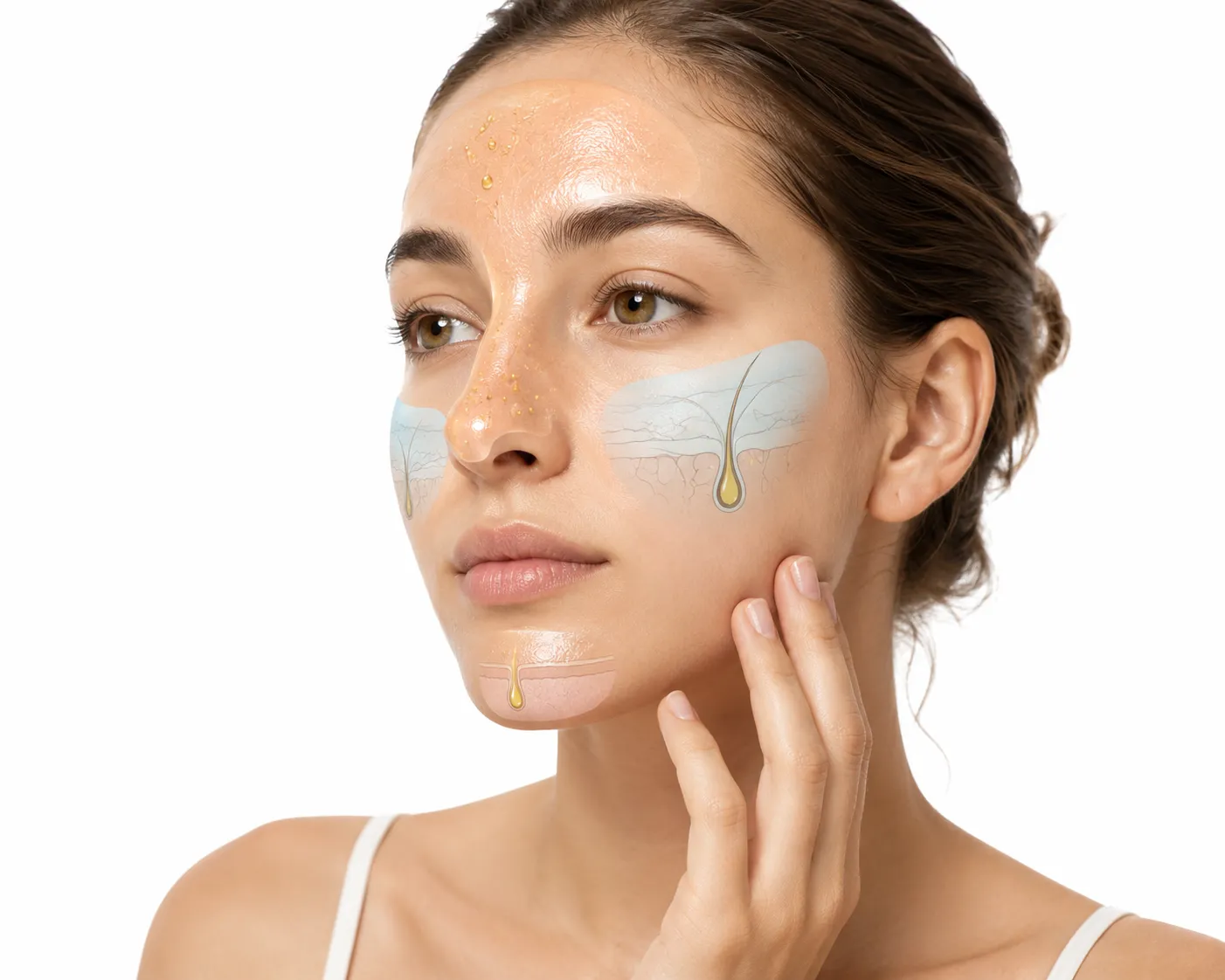
Combination skin type exists as its own category precisely because standard oily, dry, and normal classifications assume uniform behavior across the whole face, an assumption that doesn't hold for a large share of people.
T-zone shiny, cheeks tight?
Likely combination skin type.Shiny everywhere?
Likely oily skin type instead.
Use this section to decide
Does this advice apply to me?
Find the concern or goal closest to yours, then use the fit signal to decide how much weight to give this guide.If your goal is
Classification basisUse caution- Fit signal
- Limited evidence
Zone comparison
If your goal is
T-zoneDepends- Fit signal
- Possible fit
Usually oilier
If your goal is
CheeksUse caution- Fit signal
- Limited evidence
Usually drier or normal
If your goal is
StabilityUse caution- Fit signal
- Limited evidence
Can shift over time
Expected results
Results and timeframe
The specific pattern can shift over time with seasons, hormones, and age.
Practical use
How to use it
Cleanse and wait
Observe your bare skin a few hours after cleansing.
Compare zones directly
Check oil, texture, and pore visibility in the T-zone versus the cheeks.
Confirm over time
Repeat the observation across a few days to rule out one-off variation.
Safety
Side effects and cautions
- Classifying skin type based on the T-zone alone
Compare the T-zone and cheeks separately before concluding.
- Assuming combination skin type never changes
Reassess periodically, since the pattern can shift over time.
- Treating combination skin type the same as oily skin
Account for the drier cheek areas in product choices too.
Fit
Who should be careful
- A single quick glance without comparing zones
Worth noting
Small details that can change the answer
- Zone-Based Classification. Combination skin type is identified by comparing oil levels across different facial zones.
- Common Pattern. An oilier T-zone paired with drier or normal cheeks is the most frequently described pattern.
- Distinct From Uniform Types. It exists because oily, dry, and normal classifications assume the whole face behaves the same way.
- Can Shift. The specific pattern of a combination skin type can change with seasons and age.
Combination skin type is classified by comparing oil and texture patterns across different facial zones.
The most common pattern is an oilier T-zone alongside drier or normal cheeks.
This classification exists because oily, dry, and normal categories assume uniform behavior across the whole face.
Confirming it accurately requires zone-by-zone observation rather than a single overall impression.
Definition
How combination skin type is defined
Combination skin type is a classification describing skin that shows different oil and texture patterns across different areas of the face, most commonly a mix of oily and dry or normal characteristics.
- Defined by zone comparison, not one uniform trait
- Most common pattern: oily T-zone, drier cheeks
- A recognized category alongside oily, dry, and normal
Explanation
Why standard skin types don't always fit
Oily, dry, and normal classifications generally describe the face as a single, uniform surface. Combination skin type was introduced because many faces show a genuine split in behavior between zones, which those simpler categories don't capture.
Science
The basis for zone-based classification
Skin typing frameworks generally rely on observing sebum production, pore visibility, and texture across specific facial regions rather than a single overall impression.
- T-zone
- The forehead, nose, and chin area, where sebaceous gland density is typically highest.
- Skin typing
- The practice of classifying skin based on oil production, moisture retention, and reactivity.
Decision Helper
Confirming your classification
Shiny T-zone, tight or flaky cheeks
Likely combination skin typeShows the classic split pattern between zones.
Uniform shine across the whole face
Likely oily skin type insteadNo meaningful contrast between zones.
Uniform dryness or tightness everywhere
Likely dry skin type insteadNo oilier zone to indicate a mixed pattern.
Dos Donts
Confirming the classification accurately
Do
Gives the clearest read on natural oil levels.
Accounts for normal day-to-day variation.
Avoid
Can lead to misclassifying combination skin as fully oily.
The specific pattern can shift with seasons and age.
Questions
Frequently asked questions
How is combination skin type different from oily skin?
Oily skin shows uniform shine and oil production across the whole face, while combination skin shows a contrast between an oilier T-zone and drier or normal cheeks.
Can combination skin type change over time?
Yes, the specific balance between zones can shift with seasons, hormones, and age.
How do dermatologists confirm combination skin type?
By comparing oil production, pore visibility, and texture across different facial zones rather than judging the face as a whole.
Is combination skin type a common classification?
Yes, it's one of the most frequently identified skin types alongside oily, dry, and normal.