Evidence
What the evidence shows
The best moisturizer for sensitive skin isn't necessarily the one with the most ingredients - it's the one with the fewest unnecessary ones. Simplicity is a feature, not a bug.
Use this section to decide
Does this advice apply to me?
Find the concern or goal closest to yours, then use the fit signal to decide how much weight to give this guide.If your goal is
Best textureUsually relevant- Fit signal
- Often useful
Cream or gel-cream
If your goal is
Key ingredientsUse caution- Fit signal
- Limited evidence
Ceramides, squalane, glycerin
If your goal is
AvoidUse caution- Fit signal
- Limited evidence
Fragrance, essential oils, alcohol
If your goal is
ApplicationUse caution- Fit signal
- Limited evidence
Damp skin, within 3 minutes of washing
Practical use
How to use it
Start with a simple, fragrance-free formula
Look for a product with a short ingredient list and a ceramide or squalane base.
Apply to clean, damp skin
Wash gently with a fragrance-free cleanser and pat dry; apply moisturizer within three minutes.
Use a pea-sized amount and warm it between your hands
This avoids heavy application and distributes the product evenly before gentle patting into the skin.
Safety
Side effects and cautions
- Applying moisturizer to completely dry skin
Apply to damp skin within minutes of washing for much better hydration absorption.
- Using a moisturizer with "active" ingredients like retinol or vitamin C
Sensitive skin often can't tolerate actives; start with a basic barrier-repair moisturizer first.
- Choosing a gel moisturizer when skin is dehydrated
Gels are often not occlusive enough for dry or very sensitive skin; creams are often better.
Fit
Who should be careful
- Very acne-prone skin that needs non-comedogenic, water-based gel formulas
Helpful context
What else is worth knowing
What to look for in a sensitive-skin moisturizer
These ingredients support barrier repair without causing irritation.
Replenishes the "mortar" between skin cells
Mimics skin's natural oils, non-comedogenic
Attracts water to the skin
Holds up to 1000 times its weight in water
Worth noting
Small details that can change the answer
- Barrier Function. Sensitive skin often has lower ceramide levels, making it more prone to water loss and irritant penetration.
- Humectant Role. Humectants like glycerin draw water to the skin but work best when paired with occlusives to prevent evaporation.
- Fragrance Prevalence. Up to 85% of cosmetic products with fragrance contain at least one allergenic compound.
- Application Timing. Applying moisturizer within three minutes of washing locks in significantly more moisture.
Fragrance is the most common trigger in moisturizers for sensitive skin - always choose fragrance-free.
Look for barrier-repair ingredients like ceramides, squalane, and niacinamide.
Apply to damp skin to maximize hydration and reduce the amount needed.
The simplest formulation is often the best; avoid multi-ingredient "superfood" products.
Patch test every new moisturizer on your jawline or neck for 24 hours before committing.
Definition
What is a moisturizer?
A moisturizer is a skincare product designed to hydrate and support the skin's moisture barrier. It typically contains three types of ingredients: humectants, emollients, and occlusives. For sensitive skin, the goal is to hydrate while maintaining or repairing the barrier, not to add unnecessary active ingredients or fragrances.
- Available in lotions, creams, gels, and balms
- Combines humectants, emollients, and occlusives
- For sensitive skin, cream or gel-cream textures are often best
- Should be fragrance-free and formulated without common irritants
Science
Why sensitive skin needs a special moisturizer
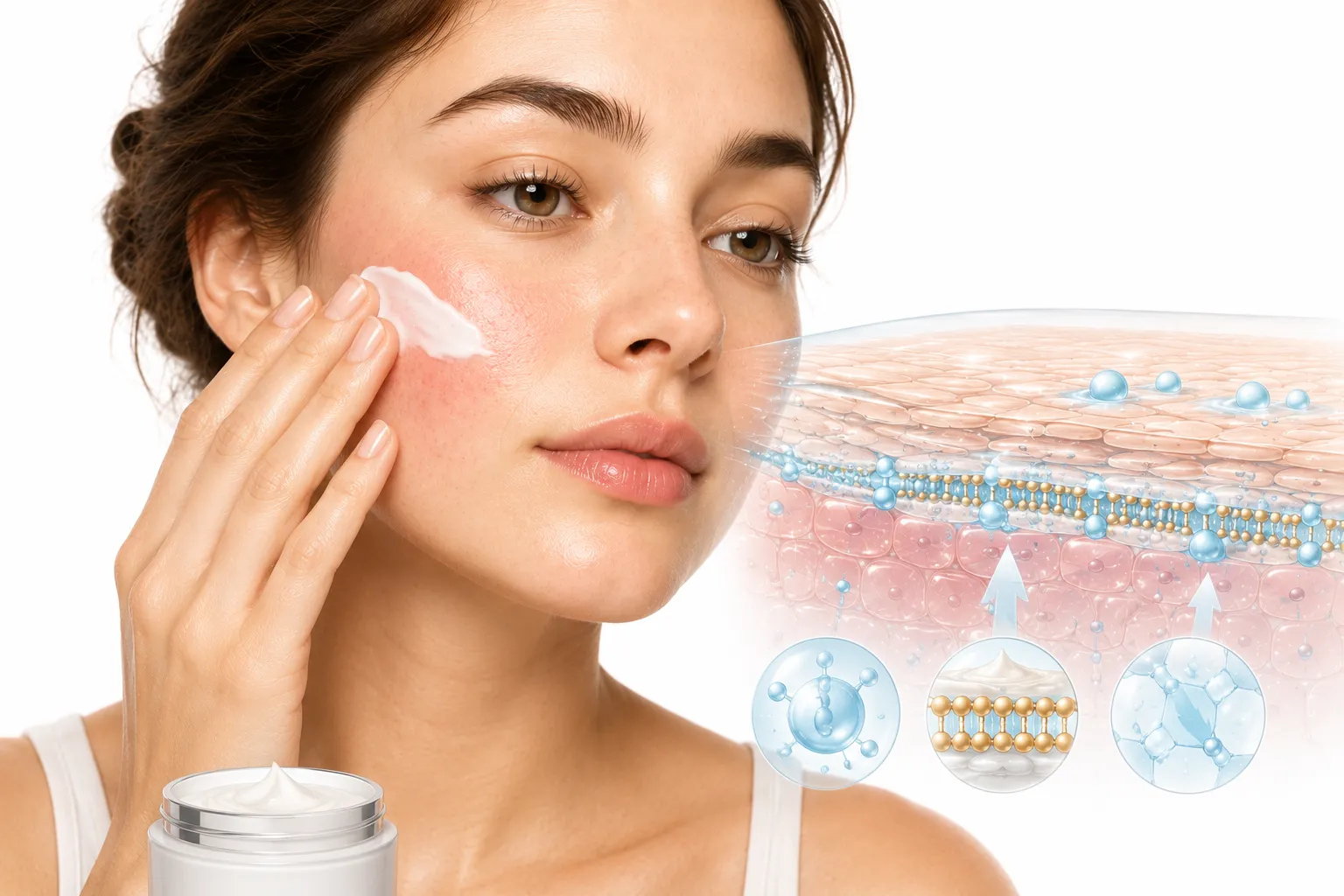
Sensitive skin has a compromised barrier that loses water more quickly and allows irritants to penetrate more easily. A regular moisturizer might contain ingredients that further irritate this barrier - fragrance is a classic example, as are certain preservatives and alcohols. The right sensitive-skin moisturizer supports barrier function while avoiding any potential triggers, making it a repair tool rather than just a basic hydration step.
- Trans-Epidermal Water Loss (TEWL)
- The rate at which water evaporates from the skin; elevated TEWL indicates a compromised barrier.
- Ceramides
- Lipids naturally found in the skin that form the mortar between skin cells, crucial for barrier integrity.
Benefits
What the right moisturizer does for sensitive skin
Beyond basic hydration, the right moisturizer actively repairs and protects the skin. Here's what you can expect.
- Reduces redness and calms reactive skin over time
- Strengthens the barrier, making skin less reactive overall
- Decreases the frequency and severity of irritation episodes
- Reduces the visible signs of fine dehydration lines
- Prepares the skin for other products like sunscreen and makeup
Avoid
Moisturizer ingredients to avoid
The most common cause of allergic contact dermatitis in skincare.
Strip the barrier and increase water loss.
Can clog pores and exacerbate acne in sensitive, breakout-prone individuals.
More ingredients = more potential allergens; keep it simple.
Questions
Frequently asked questions
Is it better to use a lotion, cream, or ointment for sensitive skin?
Creams are often the sweet spot - more hydrating than lotions but not as heavy as ointments. Choose cream if your skin is normal to dry, ointment if it's very dry.
Can sensitive skin use oil-based moisturizers?
Yes, but choose non-comedogenic oils like squalane or jojoba oil, which mimic the skin's natural lipids.
How often should I moisturize sensitive skin?
At least twice daily, morning and night, and immediately after any water exposure.
Should I use different moisturizers for day and night?
Not necessarily - a good basic moisturizer can work for both. Just add sunscreen in the morning.