Evidence
What the evidence shows
Sensitive skin reacts more to the tugging motion of dull or multi-blade razors than to the blade itself. A sharp, single-blade razor is counterintuitively the gentlest option.
I get razor bumps every time I shave
Switch to a single-blade safety razor and shave with the grain.I need a fast shave and don't get much irritation
A high-quality multi-blade razor might work for you, but keep pressure light.I have sensitive skin and want the closest possible shave
Two-pass shave: one with the grain and one lightly across the grain, never against.
Use this section to decide
Does this advice apply to me?
Find the concern or goal closest to yours, then use the fit signal to decide how much weight to give this guide.If your goal is
Best blade countUsually relevant- Fit signal
- Often useful
1 or 2
If your goal is
AvoidUse caution- Fit signal
- Limited evidence
5+ blades, heavy pressure
If your goal is
Key practiceUse caution- Fit signal
- Limited evidence
Shave with the grain
If your goal is
When to replaceUse caution- Fit signal
- Limited evidence
Every 5-7 uses
Practical use
How to use it
Prepare the skin
Shave after a warm shower or after applying a warm compress to soften the hair.
Use a shaving cream or gel for sensitive skin
Fragrance-free, moisturizing, and free of drying alcohols.
Shave with the grain and use light pressure
One or two passes maximum; replace the blade regularly.
Safety
Side effects and cautions
- Using too much pressure
Let the razor do the work; pressing down increases friction and risk of razor burn.
- Shaving against the direction of hair growth
Shaving against the grain gives a closer shave but increases irritation; go with the grain for sensitive skin.
- Using a razor too many times
Replace the blade after 5-7 uses or when it feels dull; a dull blade is an irritant.
Fit
Who should be careful
- Those who prefer the closest possible shave over comfort
Worth noting
Small details that can change the answer
- Razor Burn Cause. Razor burn is often caused by the friction of multiple passes over the same area, not the blade itself.
- Ingrown Hair Origin. Ingrown hairs occur when a hair cut below the skin surface grows back at an angle and curls into the skin.
- Blade Life. Blades dull after 5-7 shaves; a dull blade requires more pressure and causes more irritation.
- Pre-Shave Prep. Hair absorbs water and softens significantly in the first three minutes of exposure to warm water, making shaving easier.
Fewer blades are often better for sensitive skin; try a single or double-blade razor.
Sharp blades are essential; change them every 5-7 uses to avoid irritation.
Shave with the direction of hair growth to reduce the risk of ingrown hairs.
Use a gentle, fragrance-free shaving cream or gel.
Exfoliating gently before shaving can help prevent ingrown hairs.
Definition
What is a razor?
A razor is a tool with a sharp blade used to remove unwanted hair from the body. It can be manual or electric, but manual razors are the focus for sensitive skin. The simplest razors have a single blade in a frame; more complex ones have multiple blades and moving heads. For sensitive skin, simplicity often wins.
- Manual razors can be disposable or refillable
- Blade count ranges from one to six
- Pivoting heads help maintain the correct angle
- Lubricating strips can reduce friction and irritation
Explanation
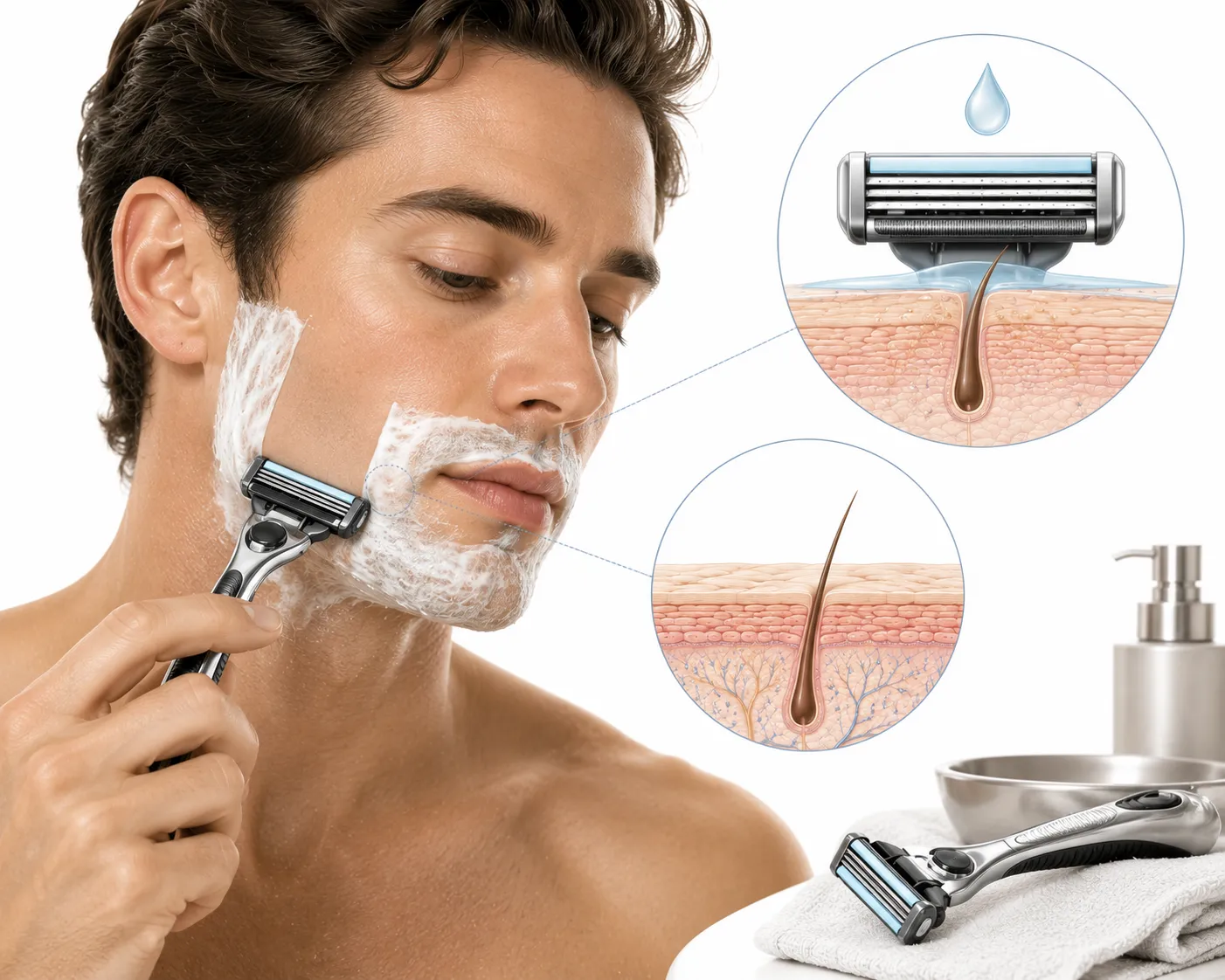
Why multi-blade razors irritate sensitive skin
Multi-blade razors work on the principle of a "hysteresis" effect: the first blade pulls the hair out of the follicle, the second or third cuts it below the skin level, and the remaining blades clean up any remaining stubble. This is great for a smooth feel but problematic for sensitive skin because the cut hair retracts into the follicle, leading to a higher risk of ingrown hairs and inflammation. The additional blades also create more friction on the skin's surface.
Benefits
What to look for in a sensitive-skin razor
The right razor for sensitive skin prioritizes sharpness and simplicity over bells and whistles. Here's what to look for.
- One or two blades to reduce tugging and friction
- A pivoting head that follows the contours of the body
- A simple lubricating strip (check ingredients if you're reactive)
- Replaceable blades that allow you to change frequently without buying a whole new razor
- A weight that feels comfortable and controllable in your hand
Risks
Razor features that can irritate sensitive skin
Some razor features are marketed as improvements but can actually worsen irritation for sensitive skin.
- Excessive blades: more blades mean more friction and more tugging
- Aggressive lubricating strips: some contain fragrance or menthol that can irritate
- Vibrating or "spa" features: unnecessary and can increase micro-abrasion
- Dull blades: the single biggest cause of shaving irritation
Questions
Frequently asked questions
Should I use a safety razor for sensitive skin?
Yes, many people with sensitive skin find single-blade safety razors reduce irritation significantly.
Is an electric razor better for sensitive skin?
Some electric razors (foil or rotary) can be gentler, but they are often less effective at providing a close shave. It depends on your skin's reaction.
How do I prevent razor bumps after shaving?
Use a gentle, alcohol-free aftershave or hydrating serum, and exfoliate regularly to prevent hairs from becoming ingrown.
Can sensitive skin use a five-blade razor?
It's not recommended. Five blades create more friction and increase the risk of razor burn and ingrown hairs.