Evidence
What the evidence shows
Retinol has strong scientific backing, but evidence specifically for sensitive skin formulations is growing.
Efficacy
Retinol is a proven anti-aging ingredientSafety
Low concentrations are well-tolerated with gradual introductionSensitive-skin evidence
Emerging evidence that lower concentrations are nearly as effective
Use this section to decide
Does this advice apply to me?
Find the concern or goal closest to yours, then use the fit signal to decide how much weight to give this guide.If your goal is
Best concentrationUsually relevant- Fit signal
- Often useful
0.1-0.25%
If your goal is
Best formatUse caution- Fit signal
- Limited evidence
Encapsulated or retinaldehyde
If your goal is
Start frequencyDepends- Fit signal
- Possible fit
Once weekly
If your goal is
Key pairingUse caution- Fit signal
- Limited evidence
Ceramide moisturizer
Expected results
Results and timeframe
Patience is critical; it takes 8-12 weeks to see results, and rushing causes irritation.
Practical use
How to use it
Start with a low concentration (0.1-0.25%)
Choose an encapsulated formula or a gentler derivative like retinaldehyde.
Apply once a week for the first two weeks
Then gradually increase to twice a week, then every other night, as tolerated.
"Buffer" by applying moisturizer first
Apply a thin layer of moisturizer to damp skin, let dry, then apply retinol, then follow with more moisturizer.
Safety
Side effects and cautions
- Using the highest concentration you can find
Start with the lowest concentration (0.1-0.25%) and work your way up.
- Applying retinol to damp skin
Damp skin enhances penetration and irritation; apply to completely dry skin.
- Skipping moisturizer
Moisturizer is not optional with retinol, especially for sensitive skin.
Fit
Who should be careful
- Those who want immediate, dramatic results and are prepared for intensive tolerization
Worth noting
Small details that can change the answer
- Conversion Process. Retinol requires two conversion steps to become active retinoic acid; retinaldehyde requires only one.
- Barrier Impact. Retinol can reduce ceramide production, which is why barrier-supporting moisturizers are essential.
- Clinical Evidence. Studies show that 0.25% retinol can be as effective for fine lines as 0.5% but with significantly less irritation.
- The "Retinol Uglies". A period of retinization (mild peeling, redness, and breakouts) is common but should be manageable if the introduction is gradual.
Sensitive skin can use retinol - just start with a low concentration (0.1-0.25%) and slow introduction.
Encapsulated formulas release retinol gradually, reducing irritation significantly.
Apply retinol to completely dry skin to avoid enhanced penetration and irritation.
Always use a barrier-supporting moisturizer to offset retinol's drying effects.
Definition
What is retinol?
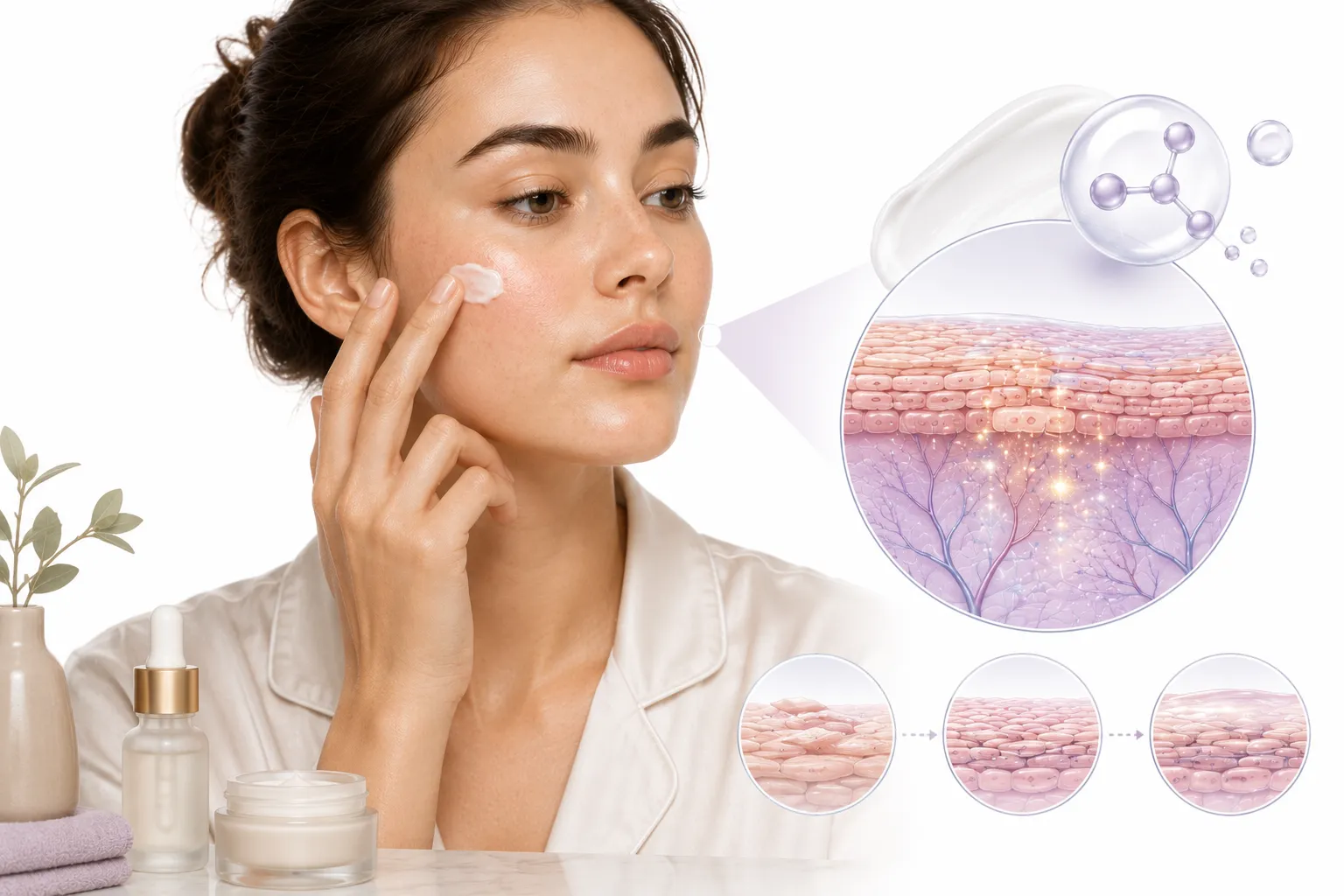
Retinol is a derivative of vitamin A, a category of compounds that are all converted into retinoic acid, the active ingredient that acts on skin cells. Retinol is the most common over-the-counter form, while tretinoin (a prescription retinoid) is already in the active form. For sensitive skin, the lower strength and slower conversion of over-the-counter retinol are advantages.
- Available in serums, creams, and oils
- Over-the-counter retinol is much gentler than prescription tretinoin
- Works by accelerating cell turnover and stimulating collagen
- For sensitive skin, encapsulated formulas are gentlest
Science
Why retinol irritates sensitive skin
Retinol irritates sensitive skin because it increases cell turnover at a rate the skin isn't prepared for. This rapid turnover means the skin sheds its protective layers faster than it can replenish them, leading to water loss, a temporary thinning of the barrier, and an inflammatory response. The irritation is essentially a form of contact dermatitis triggered by this accelerated process, not an allergic reaction to the retinol molecule itself.
- Retinization
- The adjustment period when skin adapts to retinoids, characterized by dryness, peeling, and temporary breakouts.
- Encapsulation
- A delivery system that slowly releases retinol into the skin over time, reducing the peak concentration and minimizing irritation.
Benefits
What the right retinol does for sensitive skin
With the right formulation and introduction, retinol can offer the same benefits to sensitive skin as it does to resilient skin.
- Reduces the appearance of fine lines and wrinkles
- Improves skin texture and smoothness
- Addresses pigmentation and uneven tone
- Stimulates collagen production over time
- Can be used safely with a gradual approach
Risks
Risks of using retinol incorrectly on sensitive skin
The risks are less about the retinol itself and more about how it's used. Here's what to avoid.
- Starting too high (0.5%+) before the skin is ready
- Using it daily from the start
- Pairing it with other harsh actives like acids or vitamin C
- Not using a moisturizer to support the barrier during retinization
Questions
Frequently asked questions
Can sensitive skin ever use tretinoin (prescription retinoic acid)?
Yes, but with caution. Some people with sensitive skin use low-strength tretinoin with a "skin cycling" or micro-dose approach, but you should consult a dermatologist.
Is bakuchiol a good retinol alternative for sensitive skin?
Bakuchiol is a plant-based compound with similar benefits but a completely different mechanism, and it's generally well-tolerated by sensitive skin.
Can I use retinol with niacinamide?
Yes - niacinamide can actually support the barrier and reduce retinization irritation. They are a common and effective combination.
How long does retinization last on sensitive skin?
2-4 weeks of mild peeling, redness, and breakouts is common, but it should be manageable. If it's severe or lasts longer, reduce frequency or concentration.