Evidence
What the evidence shows
The link between hormones and melasma is well established, though the specifics continue to be researched.
Pregnancy correlation
Melasma affects 15-50% of pregnant women, supporting a hormonal link.Contraceptive link
Oral contraceptives cause melasma in some users, confirming progesterone's involvement.Progesterone focus
Recent research suggests progesterone may be more significant than estrogen.
Use this section to decide
Does this advice apply to me?
Find the concern or goal closest to yours, then use the fit signal to decide how much weight to give this guide.If your goal is
Primary hormonesUsually relevant- Fit signal
- Often useful
Estrogen + progesterone
If your goal is
Key triggerDepends- Fit signal
- Possible fit
Hormonal + UV exposure
If your goal is
Most affectedUse caution- Fit signal
- Limited evidence
Women 20-50
If your goal is
Treatment priorityUsually relevant- Fit signal
- Often useful
Sun protection + dermatologist
Research notes already in this guide
- Melasma prevalence increases significantly during pregnancy when both estrogen and progesterone levels rise dramatically.
- Oral contraceptive users have reported melasma rates similar to pregnancy-related melasma.
- Hormone replacement therapy has been associated with melasma development in postmenopausal women.
- Progesterone-only contraceptives have been linked to melasma, suggesting progesterone alone can contribute.
- The condition affects individuals regardless of specific hormone ratios, suggesting it's the combined effect that matters.
Explanation
How it works
Hormonal shift occurs
Pregnancy, oral contraceptives, or hormone therapy alters circulating estrogen and/or progesterone levels.
Melanocytes respond
Hormones bind to receptors on melanocytes, triggering increased melanin production and distribution.
UV exposure amplifies
Sunlight activates melanocytes further, dramatically increasing the hormonal effect.
Melanin accumulates
Over time, excess melanin deposits in visible patches, creating the characteristic pigmentation.
Practical use
How to use it
See a dermatologist for diagnosis
Melasma can look like other skin conditions, and professional evaluation is important.
Use strict sun protection
SPF 50+ daily, hats, and seeking shade are essential since UV exposure amplifies hormone-related pigmentation.
Discuss medication options with your doctor
Various treatments exist, including topical agents, chemical peels, and sometimes laser therapies - but only under medical supervision.
Safety
Side effects and cautions
- Believing it's only estrogen that causes melasma
Both estrogen and progesterone are involved, and progesterone may be more significant in some cases.
- Expecting melasma to disappear immediately after hormone levels normalize
Melasma often persists for months or even years after hormones balance out.
- Assuming sun avoidance alone will prevent melasma
UV exposure amplifies hormonal effects, but hormones must change for melasma to develop.
Fit
Who should be careful
- Melasma from sun exposure alone
- Melasma in men without hormonal changes
Helpful context
What else is worth knowing
Who should know about hormone-related melasma?
Understanding the hormonal connection is essential for these groups.
Melasma often appears during pregnancy and requires a specialized approach to management.
Oral contraceptive usersConsider the possibility of melasma when starting birth control and use rigorous sun protection.
Women considering HRTDiscuss melasma risk with your healthcare provider when starting hormone replacement therapy.
Worth noting
Small details that can change the answer
- Not One Hormone. Both estrogen and progesterone contribute to melasma development - it's rarely just one hormone.
- Progesterone's Role. Some studies suggest progesterone may be the more significant trigger for melasma in certain individuals.
- UV Amplification. Hormonal changes alone rarely cause melasma without UV exposure activating melanocytes.
- Melanocyte Effect. Hormones can increase melanocyte number, size, and melanin production through multiple pathways.
Melasma is not caused by a single hormone - both estrogen and progesterone contribute significantly.
Progesterone may play a larger role in triggering melasma than previously recognized.
UV exposure is almost always required alongside hormonal changes for melasma to develop.
Melasma affects women disproportionately because of their hormonal cycles and reproductive events.
Treatment requires both hormonal considerations and rigorous sun protection.
Definition
What is melasma exactly?
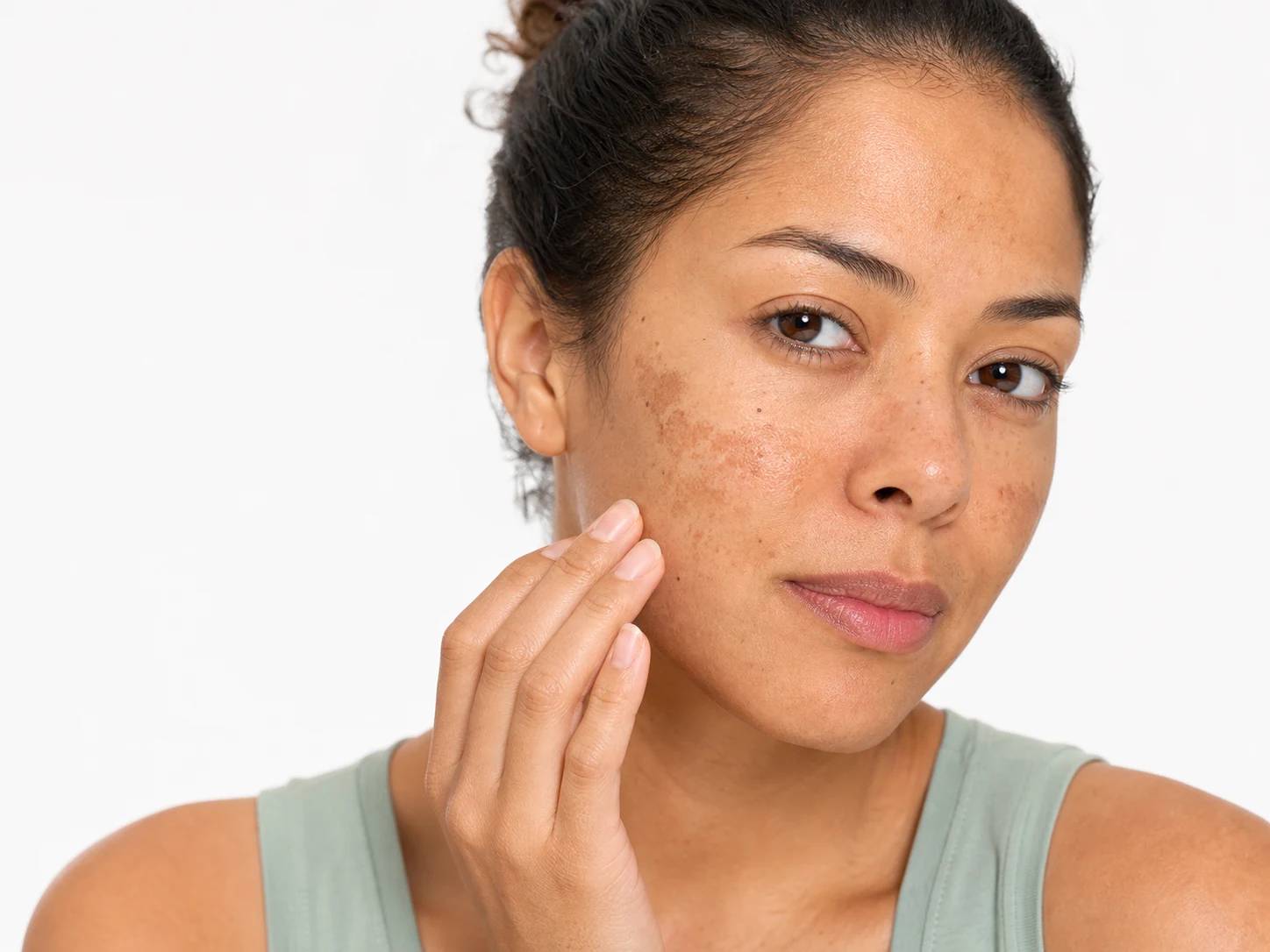
Melasma is an acquired skin condition involving hyperpigmentation, typically affecting sun-exposed facial areas. It's characterized by symmetrical brown or gray-brown patches that don't resolve with typical hyperpigmentation treatments alone because the condition is fundamentally driven by hormones and UV exposure, not just surface pigmentation.
- Symmetrical patches on cheeks, forehead, nose, and chin
- Primarily affects women, particularly those of childbearing age
- Not harmful medically but can significantly affect quality of life
- Often resistant to over-the-counter lightening treatments
Science
The hormonal mechanics of melasma
Melasma develops when melanocytes become hyperactive in response to hormonal signals. Estrogen and progesterone both influence melanocyte activity, but through somewhat different mechanisms. Estrogen appears to affect melanocyte density and can stimulate melanin production through estrogen receptor activation on melanocytes. Progesterone influences melanocyte function through its own receptors and may increase melanocyte size while also stimulating melanin production. Both hormones also likely affect other cells in the skin, such as keratinocytes, that can influence pigment production.
- Melanocyte
- A skin cell that produces the pigment melanin, which determines skin and hair color.
- Keratinocyte
- The primary cell type in the outermost layer of skin, which communicates with melanocytes about pigment production.
- Hormone receptor
- A protein on a cell's surface or inside the cell that binds to specific hormones and triggers cellular changes.
Questions
Frequently asked questions
Does estrogen always cause melasma?
No. While estrogen is a significant factor, many people with elevated estrogen never develop melasma. Genetics, UV exposure, and individual melanocyte sensitivity all play important roles.
Why do some men get melasma if hormones are the cause?
Men can develop melasma, though less frequently. It's often related to medication use, genetics, or hormonal imbalances that affect melanocyte function, though their hormones and hormone receptors function differently.
Can you have melasma without hormonal changes?
It's possible, though less common. Some people develop melasma due to sun exposure alone, certain medications, or a combination of genetic susceptibility and UV exposure.
Does progesterone cause more melasma than estrogen?
Some research suggests progesterone may be a more potent trigger for melasma, but results vary by study. The current consensus is that the combination matters more than either hormone alone.
References
Sources
The notes below are drawn from the evidence already cited in this guide. They are not a complete bibliography.
- Melasma prevalence increases significantly during pregnancy when both estrogen and progesterone levels rise dramatically.
- Oral contraceptive users have reported melasma rates similar to pregnancy-related melasma.
- Hormone replacement therapy has been associated with melasma development in postmenopausal women.
- Progesterone-only contraceptives have been linked to melasma, suggesting progesterone alone can contribute.
- The condition affects individuals regardless of specific hormone ratios, suggesting it's the combined effect that matters.