Evidence
What the evidence shows
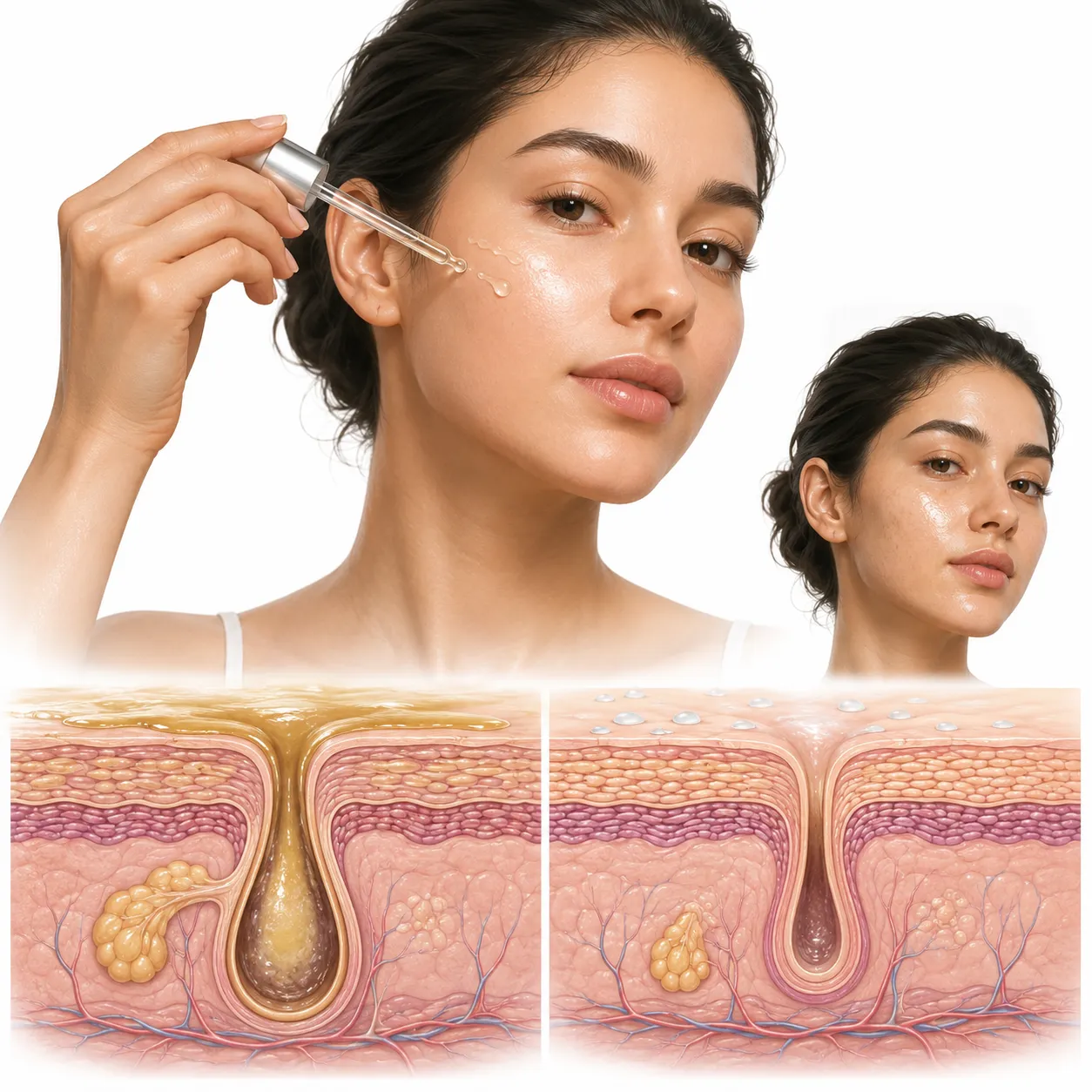
Niacinamide doesn't just reduce oil - it rebalances the skin. By supporting the barrier, it prevents the dehydration that triggers excess oil production.
Sebum regulation
Proven to reduce sebum productionBarrier support
Increases ceramide synthesisSafety
Well-tolerated with minimal side effects
Use this section to decide
Does this advice apply to me?
Find the concern or goal closest to yours, then use the fit signal to decide how much weight to give this guide.If your goal is
TypeUsually relevant- Fit signal
- Often useful
Vitamin B3 derivative
If your goal is
Best strengthUsually relevant- Fit signal
- Often useful
2-5%
If your goal is
Key benefitUse caution- Fit signal
- Limited evidence
Reduces sebum, supports barrier
If your goal is
EvidenceUsually relevant- Fit signal
- Often useful
Strong
Research notes already in this guide
- Multiple clinical studies show niacinamide reduces sebum production.
- The mechanism of 5-alpha-reductase inhibition is well-established.
- Niacinamide's barrier-supporting effects are well-documented.
Explanation
How it works
The pathway niacinamide takes to regulate oily skin.
Inhibits 5-alpha-reductase
Niacinamide reduces the activity of the enzyme that converts testosterone to DHT.
Reduces DHT levels
Lower DHT means less stimulation to the sebaceous glands.
Decreases sebum production
Sebaceous glands produce less sebum over time.
Strengthens the barrier
Increased ceramide production supports the barrier, reducing dehydration.
Expected results
Results and timeframe
Consistent use is key to seeing results.
Practical use
How to use it
Choose a niacinamide product
Serums or moisturizers with 2-5% niacinamide are ideal for oily skin.
Apply to clean, dry skin
Use after cleansing and before moisturizer.
Use consistently
Apply daily for 8-12 weeks to see full results.
Safety
Side effects and cautions
- Using too high a concentration
Start with 2-5% niacinamide; higher concentrations (10%+) can cause irritation.
- Using it inconsistently
Niacinamide works best with daily, consistent use.
- Combining with vitamin C incorrectly
Niacinamide and vitamin C can be used together, but apply vitamin C first and wait a few minutes for absorption.
Fit
Who should be careful
- Those with sensitivity to niacinamide (rare)
Worth noting
Small details that can change the answer
- Sebum Reduction. Clinical studies show niacinamide can reduce sebum production by up to 50% in some individuals.
- Barrier Support. Niacinamide increases ceramide synthesis in the skin by up to 30%.
- Anti-inflammatory. Niacinamide has well-documented anti-inflammatory properties, reducing redness and irritation.
- Concentration Range. Most studies use concentrations between 2% and 5%, with 5% being most common for sebum regulation.
Niacinamide reduces sebum production by inhibiting 5-alpha-reductase.
It also strengthens the barrier, preventing compensatory oil production.
The optimal concentration for oily skin is 2-5%.
Niacinamide is well-tolerated and works well with other ingredients.
Science
The biology of niacinamide
Niacinamide is a water-soluble vitamin that's a precursor to NAD+ and NADP+, coenzymes involved in hundreds of cellular processes. In the skin, it supports energy metabolism, DNA repair, and barrier function. Its ability to regulate sebum comes from its inhibition of 5-alpha-reductase, the enzyme that converts testosterone to DHT, a key driver of sebum production.
- 5-Alpha-Reductase
- An enzyme that converts testosterone to dihydrotestosterone (DHT), a key regulator of sebum production.
- Ceramides
- Lipid molecules that form the skin barrier; niacinamide increases ceramide synthesis.
Benefits
What niacinamide does for oily skin
Niacinamide offers a range of benefits that make it a standout ingredient for oily skin.
- Reduces visible oiliness and shine over time
- Reduces the appearance of enlarged pores
- Soothes redness and inflammation
- Supports the barrier, preventing reactive seborrhea
- Works well with other active ingredients
Questions
Frequently asked questions
Can niacinamide cause purging?
Niacinamide typically doesn't cause purging. If you experience breakouts, it may be an ingredient sensitivity.
Is niacinamide better than salicylic acid for oily skin?
They work differently - niacinamide regulates sebum, while salicylic acid exfoliates inside pores. They can be used together.
Can I use niacinamide with retinol?
Yes, they work well together. Niacinamide can even help reduce retinol irritation.
How long does niacinamide take to work on oily skin?
Most people see results in 4-8 weeks of consistent use.
References
Sources
The notes below are drawn from the evidence already cited in this guide. They are not a complete bibliography.
- Multiple clinical studies show niacinamide reduces sebum production.
- The mechanism of 5-alpha-reductase inhibition is well-established.
- Niacinamide's barrier-supporting effects are well-documented.