Evidence
What the evidence shows
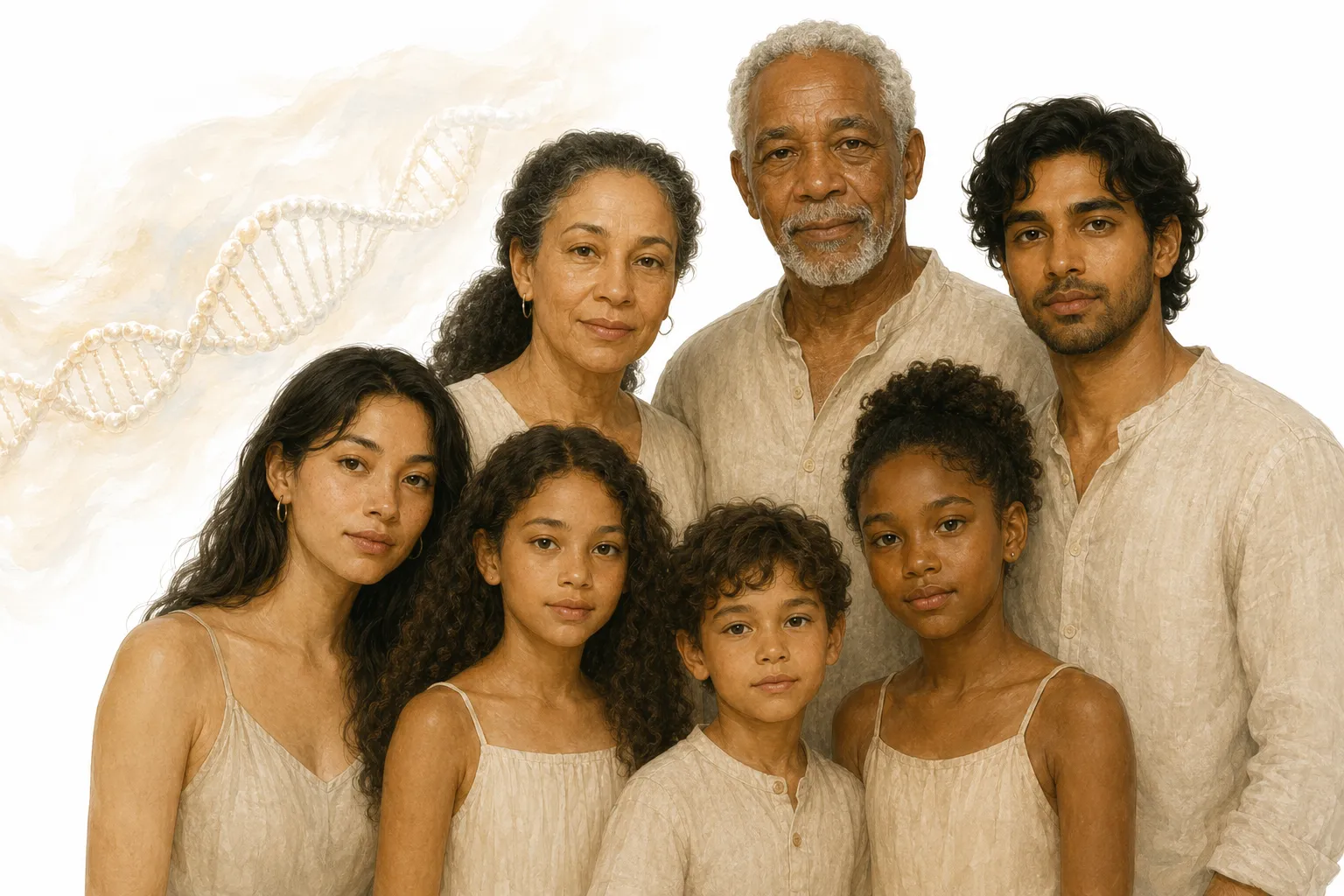
Skin color genetics is a story of fine-tuning, not switches: most of the relevant genes shift melanin production up or down by small amounts, and it's the combined total that determines visible shade.
Use this section to decide
Does this advice apply to me?
Find the concern or goal closest to yours, then use the fit signal to decide how much weight to give this guide.If your goal is
Inheritance typeUse caution- Fit signal
- Limited evidence
Polygenic
If your goal is
Key genes identifiedUsually relevant- Fit signal
- Often useful
Multiple
If your goal is
Melanocyte countUse caution- Fit signal
- Limited evidence
Similar across tones
If your goal is
Research statusUse caution- Fit signal
- Limited evidence
Active, evolving
Research notes already in this guide
- Genome-wide association studies have consistently linked specific gene variants to differences in skin pigmentation.
- The evolutionary link between UV exposure and regional skin tone variation is well established in population genetics.
- Ongoing research continues to refine understanding of how many genes contribute and by how much.
Practical use
How to use it
Understand your baseline tone is genetic
Your underlying skin tone is set by inherited genes and will not permanently change with products or sun exposure.
Separate tanning from genetics
Temporary tanning reflects increased melanin activity in response to UV, not a genetic shift.
Use this knowledge for sun-safety decisions
Understanding your genetic tendency toward burning or tanning can guide how much sun protection you need.
Safety
Side effects and cautions
- Assuming skin color follows simple single-gene inheritance
It is polygenic, involving many genes with small individual effects.
- Believing sun exposure changes your genetic baseline
Sun exposure can temporarily darken skin, but it does not alter the underlying genetic tone.
- Thinking melanocyte number differs by skin tone
Melanocyte density is similar across skin tones; activity and melanin type differ instead.
Fit
Who should be careful
- Predicting exact offspring skin tone, since inheritance is complex and not fully predictable
Helpful context
What else is worth knowing
How melanin production is regulated
Gene variants
Specific variants in genes like MC1R and SLC24A5 influence melanin output levels.
Melanin ratio
The balance of eumelanin to pheomelanin shapes whether tones lean brown or reddish.
Environmental interaction
UV exposure can temporarily increase melanin activity on top of the genetic baseline.
What the evidence suggests
Genome-wide studies have identified multiple genes with measurable effects on human skin pigmentation.
This supports the understanding of skin color as a polygenic, continuously variable trait.
Worth noting
Small details that can change the answer
- Melanocytes. All humans have a similar number of melanocytes regardless of skin tone; activity level differs, not cell count.
- Melanin types. Eumelanin produces brown-black tones, while pheomelanin produces red-yellow tones.
- Polygenic trait. Skin color involves the combined effect of dozens of genes rather than one dominant gene.
- Evolution. Regional skin tone variation is widely understood as an evolutionary adaptation to local UV intensity.
Skin color is a polygenic trait shaped by dozens of genes, not a single gene.
Melanocyte number is similar across skin tones; differences come from melanin type and activity.
Key genes like MC1R, SLC24A5, and OCA2 have measurable effects on pigmentation.
Regional skin tone variation is thought to reflect evolutionary adaptation to local UV exposure.
Sun exposure can darken skin temporarily but does not change your genetic baseline tone.
Explanation
Why skin color is a "polygenic" trait
Many genes, each with a small effect, combine to set skin tone.
Unlike traits controlled by a single gene, skin color results from the combined activity of many genes, each contributing a small effect to overall melanin production. This is why skin tone varies continuously across populations rather than falling into a small number of discrete categories.
Explanation
The role of key genes
A handful of genes have been studied closely for their outsized influence on skin pigmentation.
Common misconceptions
Myth
One gene determines skin color, similar to a simple dominant-recessive trait.
Reality
Skin color is polygenic, shaped by the combined effect of many genes.
Myth
Skin color genetics are fully understood.
Reality
Researchers have identified major contributing genes, but the full picture remains an active area of study.
Questions
Frequently asked questions
Is skin color determined by a single gene?
No, skin color is polygenic, meaning it results from the combined effect of many genes rather than one dominant gene.
Can skin color genetics change over a person's lifetime?
The genetic baseline stays fixed, though visible tone can shift temporarily due to sun exposure or hormonal changes.
Why do some populations have darker skin than others?
This is largely thought to reflect evolutionary adaptation to differing levels of regional UV exposure over many generations.
Do identical twins always have identical skin tone?
Since they share the same genetics, their baseline tone is typically very similar, though environmental sun exposure can create minor visible differences.
References
Sources
The notes below are drawn from the evidence already cited in this guide. They are not a complete bibliography.
- Genome-wide association studies have consistently linked specific gene variants to differences in skin pigmentation.
- The evolutionary link between UV exposure and regional skin tone variation is well established in population genetics.
- Ongoing research continues to refine understanding of how many genes contribute and by how much.