Evidence
What the evidence shows
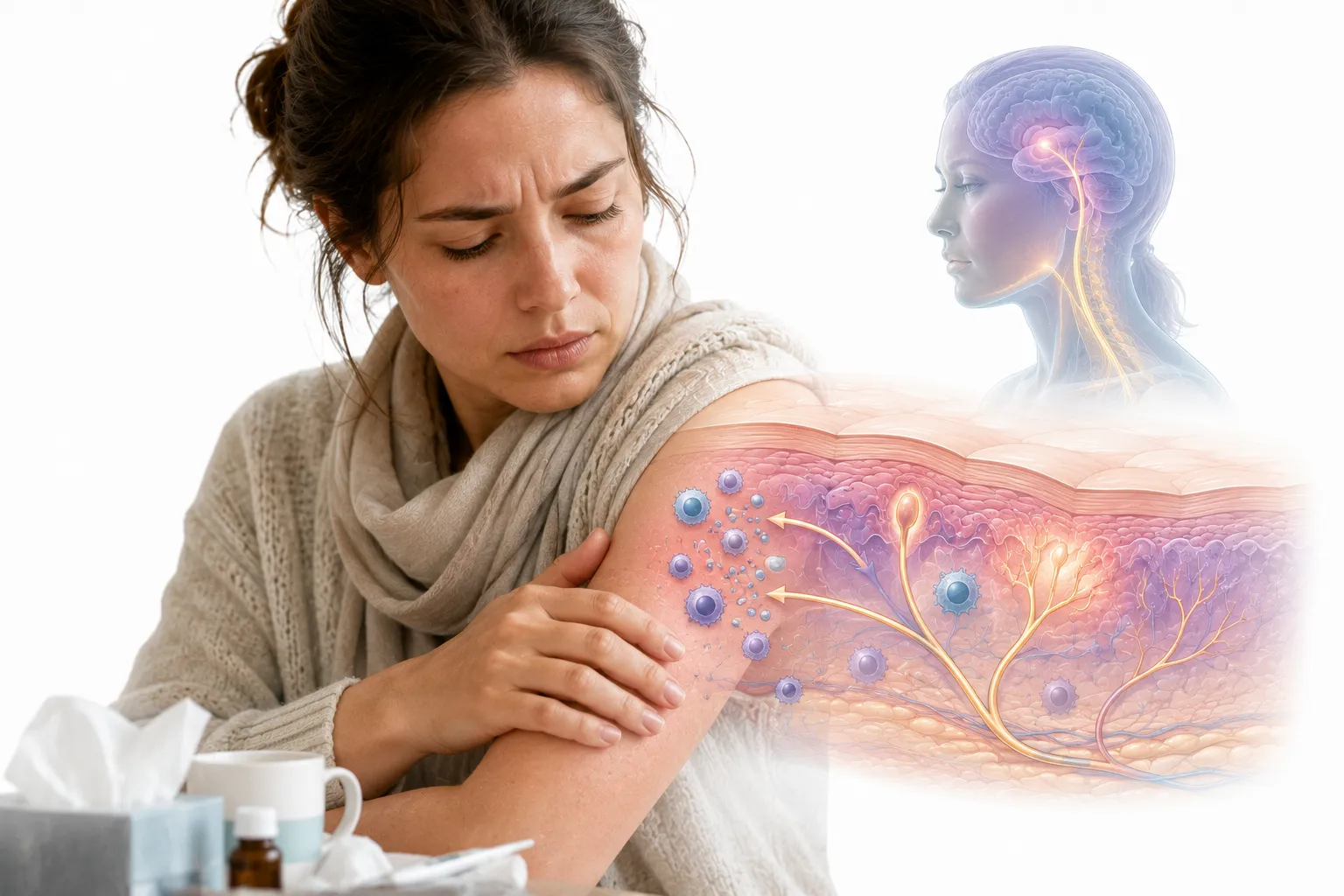
The same inflammatory response that's fighting your illness is also making your skin more reactive. It's a side effect of your body's defense system - not a sign that something is wrong with your skin itself.
Use this section to decide
Does this advice apply to me?
Find the concern or goal closest to yours, then use the fit signal to decide how much weight to give this guide.If your goal is
Primary CauseUse caution- Fit signal
- Limited evidence
Inflammatory cytokines
If your goal is
DurationUsually relevant- Fit signal
- Often useful
1-7 days
If your goal is
Key Self-CareUsually relevant- Fit signal
- Often useful
Simplify routine, hydrate
If your goal is
When to Seek HelpDepends- Fit signal
- Possible fit
Severe rash, blistering
Expected results
Results and timeframe
The sensitivity usually resolves on its own as the illness improves.
Practical use
How to use it
Simplify your skincare routine
Stick to a gentle cleanser and a rich moisturizer. Avoid exfoliating acids, retinoids, and vitamin C until you're fully recovered.
Stay hydrated
Drink plenty of water to support your skin from the inside out, especially if you have a fever.
Be gentle
Pat your skin dry rather than rubbing, and avoid touching your face more than necessary.
Safety
Side effects and cautions
- Continuing your full active-ingredient routine
Cut back to just a cleanser and moisturizer while you're sick - your skin needs a break.
- Using harsh cleansers or exfoliants
Switch to a gentle, hydrating cleanser and avoid all exfoliation until you feel better.
- Taking hot showers or baths
Hot water strips the skin of its natural oils and can make sensitivity worse. Use lukewarm water instead.
- Redness or flushing
Very common · Use calming, soothing products.
- Tightness and dryness
Very common · Apply moisturizer to damp skin.
- Stinging with products
Common · Simplify your routine to just the essentials.
- Increased breakouts
Common · Keep cleansing gentle and avoid picking.
Fit
Who should be careful
- People with chronic skin conditions who experience worsening - consult a doctor
Worth noting
Small details that can change the answer
- Cytokines. Inflammatory cytokines like IL-6 and TNF-alpha are released during illness and can directly affect skin nerve endings, increasing sensitivity.
- Barrier Function. Sickness reduces the skin's ability to produce lipids like ceramides, leading to a compromised barrier and increased water loss.
- Fever Impact. Even a slight fever can accelerate transepidermal water loss by up to 25%, making skin feel drier and more irritated.
- Stress Response. The physical and mental stress of being ill triggers cortisol release, which reduces the skin's natural defense mechanisms.
Skin sensitivity during illness is a normal physiological response - your immune system's inflammatory response affects the skin barrier.
Fever and dehydration also play a role, so staying hydrated is crucial.
The stress of being sick triggers cortisol release, which further compromises the barrier.
Simplify your skincare routine and avoid active ingredients.
Definition
What happens to your skin when you're sick
Understanding the inflammatory cascade.
When you're sick, your immune system goes into overdrive. This is a good thing - it's how you fight off the infection. But the same inflammatory response that's fighting the pathogen also affects your skin, making it more reactive and less able to hold onto moisture.
The main reasons your skin gets sensitive during illness
- Inflammatory cytokines released by the immune system directly affect skin nerve endings and barrier function
- Fever leading to fluid loss and dehydration, making the skin feel tight and dry
- Decreased lipid production, which is the skin's natural mortar
- Stress-induced cortisol release, which further impairs the barrier
- Medication side effects - some drugs can cause skin reactions or photosensitivity
How to care for sensitive skin during illness
The goal is to be as gentle as possible - don't demand too much from your skin while your body is already working hard.
- Stick to a minimal routine - cleanser, moisturizer, and sunscreen are enough
- Use lukewarm, not hot, water to avoid drying out your skin further
- Apply moisturizer to slightly damp skin - this is when it's most effective
- Avoid active ingredients like exfoliating acids or retinoids until you're fully recovered
- Consider a humidifier to add moisture to the air, especially if you have a fever
When to see a doctor about skin changes during illness
- Rash that spreads rapidly or is accompanied by a high fever
- Skin that becomes painful or swollen
- Signs of infection like pus, warmth, or red streaks
- Reaction to medication that causes blistering or peeling
Questions
Frequently asked questions
Why does my skin react to products when I'm sick?
Your skin barrier is compromised during illness, making it more permeable and more reactive to ingredients that it would normally tolerate.
Can being sick cause acne breakouts?
Yes, stress from illness can trigger hormonal changes that may lead to breakouts. This is often temporary and resolves as you recover.
How long does illness-related skin sensitivity last?
It typically lasts for the duration of the illness and improves as you recover. It may take a few days after you feel better for your skin to fully normalize.
Should I see a dermatologist about skin changes during illness?
If you develop a severe rash, blistering, or signs of infection, you should see a doctor. Otherwise, the sensitivity is usually temporary and harmless.