Evidence
What the evidence shows
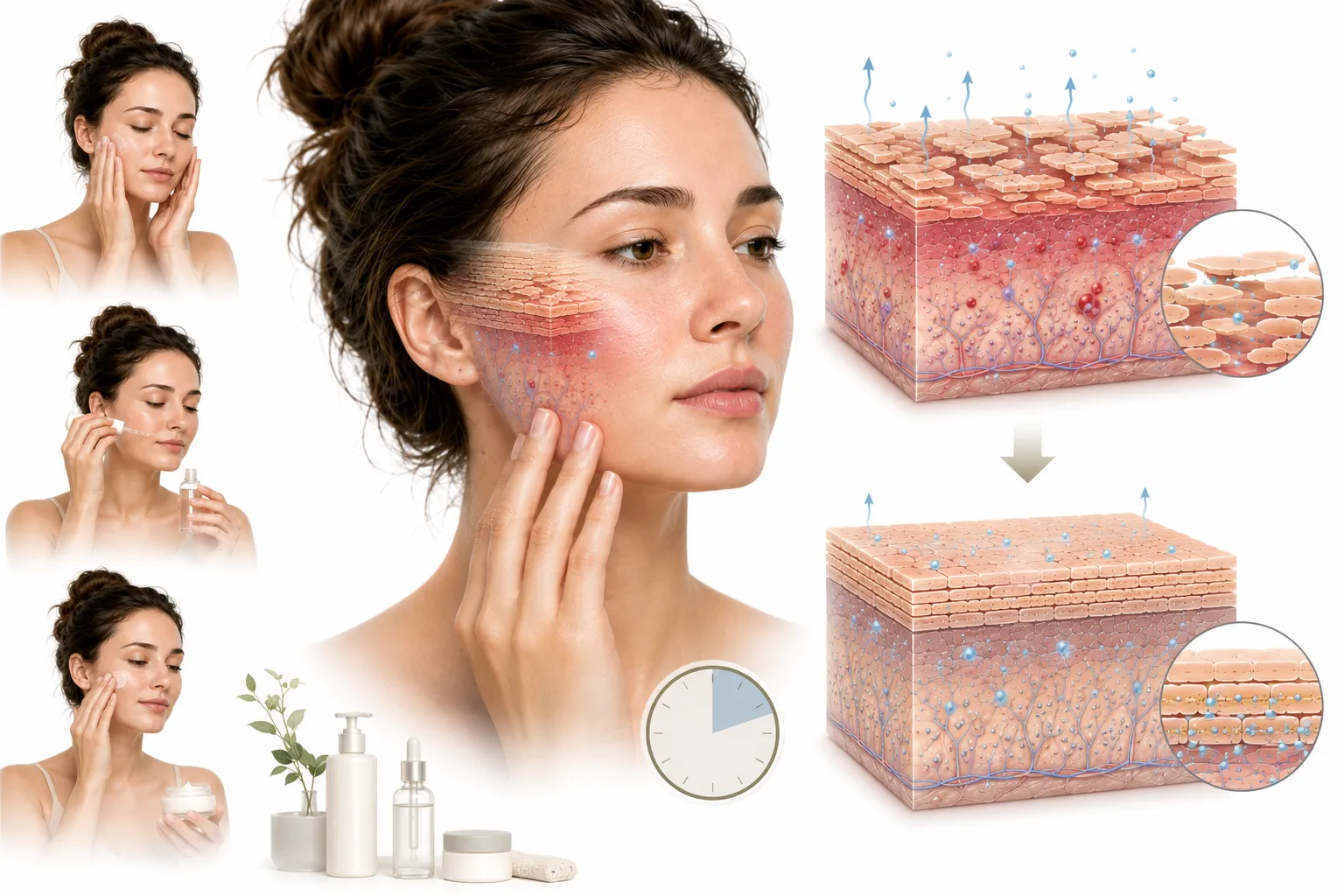
Skin barrier repair happens in layers. The surface responds quickly to intervention, but the deeper, lasting repair requires weeks of disciplined care.
Use this section to decide
Does this advice apply to me?
Find the concern or goal closest to yours, then use the fit signal to decide how much weight to give this guide.If your goal is
Surface improvementUsually relevant- Fit signal
- Often useful
3-5 days
If your goal is
Full structural repairUse caution- Fit signal
- Limited evidence
4-6 weeks
If your goal is
Stop usingDepends- Fit signal
- Possible fit
All acids, retinoids, exfoliants
If your goal is
Key repair ingredientsUsually relevant- Fit signal
- Often useful
Ceramides, niacinamide, squalane
Explanation
How it works
Surface hydration
Immediately after starting a repair routine, humectants and emollients improve skin feel and reduce tightness.
Lipid replenishment
Over days to weeks, topical lipids like ceramides integrate into the barrier, strengthening it.
Cellular turnover
New corneocytes are produced and migrate upward, creating a healthier barrier over 28 days.
Full functional restoration
After 4-6 weeks, the barrier regains its full ability to regulate water loss and block irritants.
Expected results
Results and timeframe
You can see surface improvements in 3 days, but full barrier repair takes 4-6 weeks.
Be patient. The barrier is self-healing, but it needs time and consistent care.
Practical use
How to use it
Simplify your routine
Strip back to just cleanser, moisturizer, and SPF (daytime). No actives, exfoliants, or acids.
Use barrier-supporting ingredients
Look for products with ceramides, niacinamide (at low concentrations), squalane, and panthenol.
Stay consistent
Apply morning and night without skipping. Your barrier needs consistent support.
Safety
Side effects and cautions
- Expecting overnight results
Surface improvement takes days; deep repair takes weeks.
- Using active ingredients while repairing
Stop all exfoliants, retinoids, and acids until the barrier recovers.
- Over-cleaning
Wash with lukewarm water and a gentle, non-foaming cleanser once or twice daily.
Fit
Who should be careful
- Anyone expecting a complete cure in 72 hours
Worth noting
Small details that can change the answer
- Barrier Structure. The stratum corneum is composed of 15-20 layers of corneocytes in a lipid matrix.
- Lipid Composition. The barrier is about 50% ceramides, 25% cholesterol, and 15% fatty acids by weight.
- Water Loss. A damaged barrier can lose up to 10 times more water than a healthy one.
- Repair Speed. The barrier turns over roughly every 28 days in healthy skin.
Stop all exfoliants, retinoids, and acids while repairing.
Use barrier-supporting ingredients like ceramides, niacinamide, and squalane.
Keep your routine simple - cleanse, moisturize, protect.
Science
Understanding the skin barrier structure
The skin barrier is not a flat layer but a complex, organized structure. The stratum corneum, or outermost layer, is composed of protein-rich corneocytes surrounded by intercellular lipids. This creates a semipermeable membrane that manages water flow and blocks external irritants.
- Corneocytes
- Flattened, dead skin cells that form the structural "bricks" of the barrier.
- Lipid matrix
- The "mortar" made of ceramides, cholesterol, and fatty acids that holds corneocytes together.
Results Timeline
What to expect when repairing your barrier
- 1Day 1-2
Reduced stinging and tightness; skin feels more comfortable.
- 2Day 3-5
Visible reduction in redness; skin texture begins to smooth.
- 3Week 1-2
Less sensitivity; products no longer sting; skin feels less dry.
- 4Week 4-6
Significant improvement in resilience; barrier function largely restored.
- 5Week 12+
Full structural restoration; skin handles actives and external stress more effectively.
Benefits
What a healthy barrier does for you
A functional skin barrier is the foundation of all good skincare.
- Prevents excessive water loss, keeping skin hydrated
- Blocks irritants, pollutants, and allergens from penetrating
- Reduces sensitivity and reactivity to products
- Helps maintain skin's natural pH balance
Questions
Frequently asked questions
Can I use retinol while repairing my skin barrier?
No, avoid retinoids and all other exfoliating or active ingredients until your barrier is fully recovered.
How do I know if my skin barrier is repaired?
Your skin will feel less tight and sensitive, products will stop stinging, and redness will diminish.
What damages the skin barrier most quickly?
Over-exfoliation, harsh cleansers, and extreme temperature changes are among the most common culprits.
Can I speed up repair beyond 3 days?
You can support faster surface recovery with barrier-specific products, but you can't compress the deeper structural repair timeline.