Evidence
What the evidence shows
Dark spots from sun damage often appear long after the UV exposure that caused them, which is why prevention is particularly important. The damage accumulates silently for years before becoming visible.
Use this section to decide
Does this advice apply to me?
Find the concern or goal closest to yours, then use the fit signal to decide how much weight to give this guide.If your goal is
SunscreenUsually relevant- Fit signal
- Often useful
Essential for prevention and treatment
If your goal is
Vitamin CDepends- Fit signal
- Possible fit
Good for antioxidant protection and brightening
If your goal is
RetinoidsDepends- Fit signal
- Possible fit
Effective for cell turnover and pigment fading
If your goal is
Laser treatmentsUsually relevant- Fit signal
- Often useful
Very effective but requires professional evaluation
Research notes already in this guide
- UV exposure is the primary cause of solar lentigines in Caucasian and Asian populations.
- Sun exposure is a known trigger for melasma, particularly in women.
- Sun protection is the most effective way to prevent hyperpigmentation from developing.
- Topical treatments can help fade dark spots but prevention is key.
Explanation
How it works
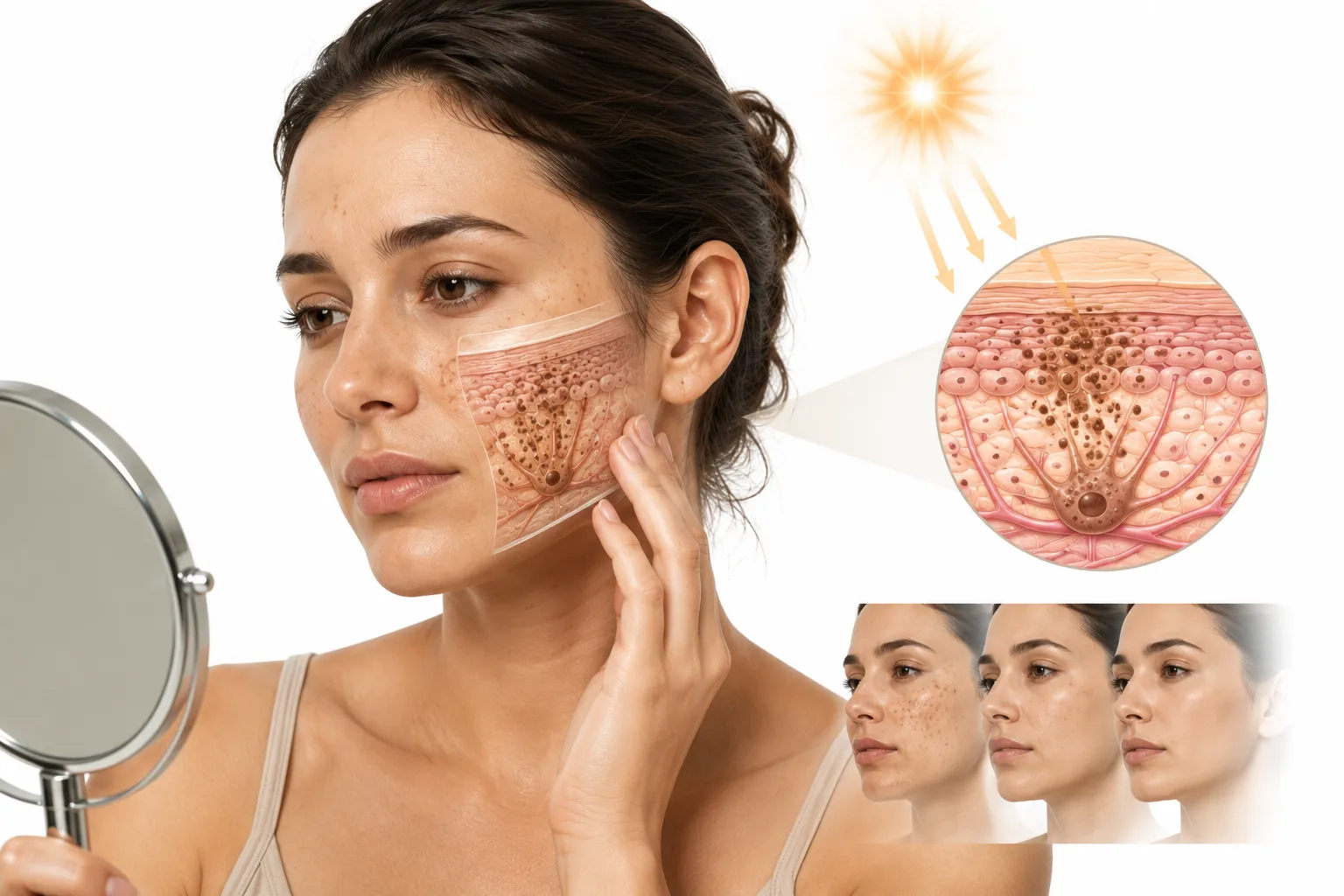
UV radiation reaches skin
UV rays penetrate the epidermis and reach melanocytes.
Melanocytes are activated
UV triggers melanin production through the tyrosinase enzyme.
Melanin distribution becomes uneven
Over time, melanocytes become dysregulated and produce pigment unevenly.
Dark spots form
The accumulated pigment appears as visible dark spots on the skin.
Expected results
Results and timeframe
UV exposure triggers melanin production that can become uneven over time.
Practical use
How to use it
Use sunscreen daily
Prevent new dark spots and prevent existing ones from darkening.
Incorporate brightening ingredients
Vitamin C, niacinamide, and retinoids can help fade dark spots.
Consult a dermatologist for stubborn spots
Professional treatments like lasers, chemical peels, and prescription lighteners may be effective.
Safety
Side effects and cautions
- Thinking dark spots are only a cosmetic issue
Dark spots can indicate deeper sun damage and increased skin cancer risk.
- Skipping sunscreen on dark spots
UV exposure worsens existing dark spots, so sunscreen is essential.
- Using aggressive lighteners without sun protection
Without sun protection, lightening treatments may be ineffective.
- Cosmetic concerns
Common · Use sunscreen and brightening ingredients
- Hard to treat once established
Common · Seek early treatment
- Potential for skin cancer
Rare · Have any changing spots evaluated
Fit
Who should be careful
- Seeking a simple solution for existing dark spots
Worth noting
Small details that can change the answer
- Solar Lentigines. Sun spots, also known as age spots, are flat brown patches caused by UV exposure.
- Melasma. A form of hyperpigmentation often triggered by sun exposure combined with hormonal changes.
- PIH. Post-inflammatory hyperpigmentation can be worsened or triggered by UV exposure.
- Time Lag. Dark spots often appear years after the sun exposure that caused them.
Sun damage is a primary cause of dark spots and hyperpigmentation.
Dark spots can appear years or decades after the sun exposure that caused them.
Prevention with sunscreen is the most effective strategy.
Treatment can help fade dark spots but requires consistency and patience.
Risks
Risk factors for sun-induced dark spots
Some people are more likely to develop dark spots from sun exposure than others.
- Having a skin type that tans easily or already has hyperpigmentation
- Frequent or intense sun exposure over a lifetime
- Hormonal changes that increase sun sensitivity
- A history of skin inflammation or injury
Myth Reality
Myths about sun damage and dark spots
They can occur at any age, depending on cumulative sun exposure.
While some fading is possible, dark spots often persist without treatment.
Cumulative UV exposure from daily activities also contributes to dark spots.
Questions
Frequently asked questions
Are sun spots and age spots the same thing?
Yes, they are terms for the same condition, solar lentigines, which are caused by UV exposure.
Can dark spots from sun damage become cancerous?
While most sun spots are benign, any changing or unusual spot should be evaluated by a dermatologist.
How long does it take for sun damage to cause dark spots?
Dark spots often appear after years of cumulative sun exposure.
Can dark spots from sun damage be prevented?
Yes, daily sunscreen use and sun protection are the most effective prevention strategies.
References
Sources
The notes below are drawn from the evidence already cited in this guide. They are not a complete bibliography.
- UV exposure is the primary cause of solar lentigines in Caucasian and Asian populations.
- Sun exposure is a known trigger for melasma, particularly in women.
- Sun protection is the most effective way to prevent hyperpigmentation from developing.
- Topical treatments can help fade dark spots but prevention is key.