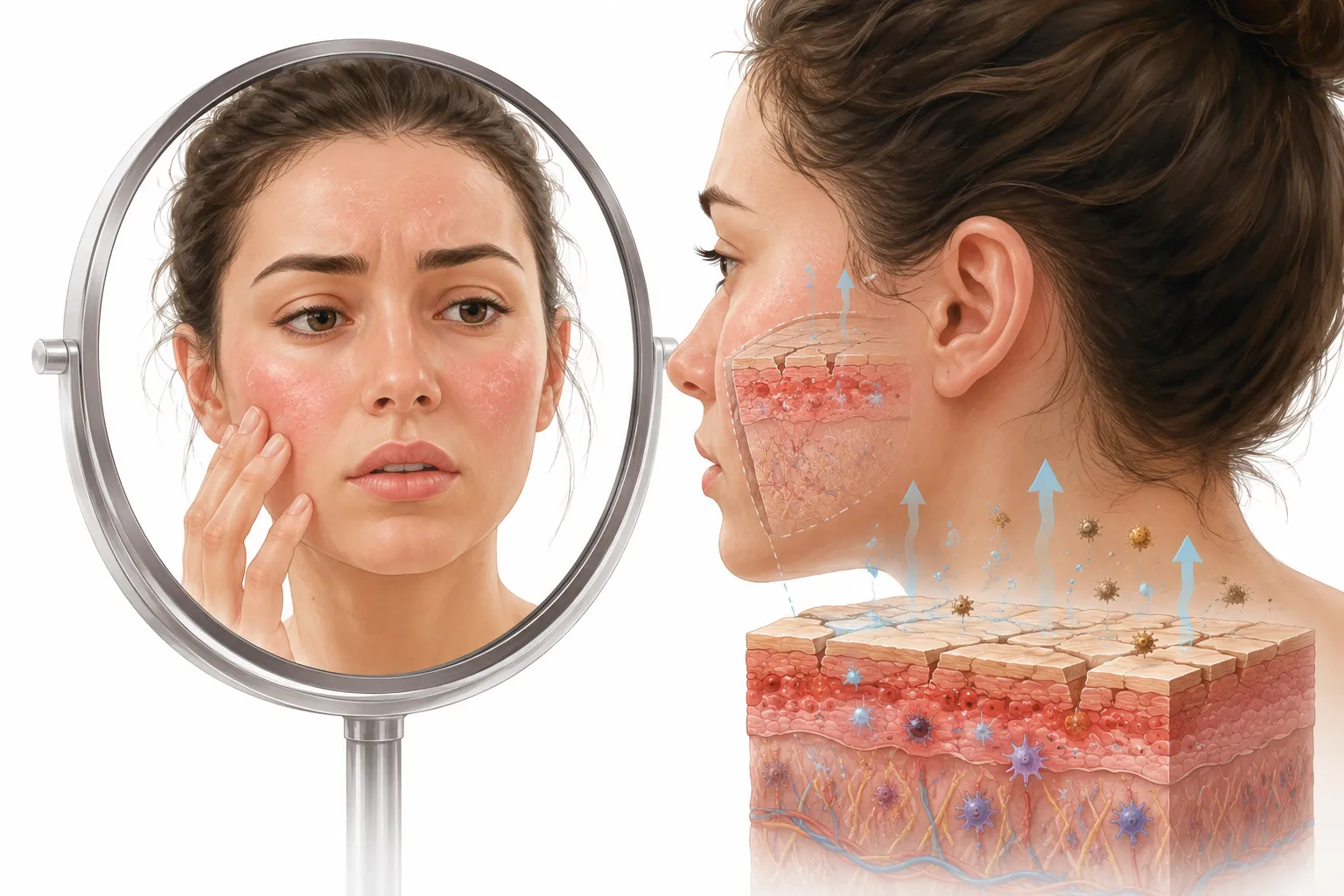
Evidence
What the evidence shows
A damaged barrier doesn't always look dramatic - it often feels dramatic. Stinging, burning, and tightness are just as telling as visible redness.
Does your skin sting or burn when you apply products?
This is a classic sign of barrier damage.Is your skin persistently dry and flaky?
Barrier damage prevents the skin from retaining moisture.Have you been using acids or exfoliating frequently?
Over-exfoliation is a common cause of barrier damage.
Use this section to decide
Does this advice apply to me?
Find the concern or goal closest to yours, then use the fit signal to decide how much weight to give this guide.If your goal is
Key signsDepends- Fit signal
- Possible fit
Dryness, redness, stinging
If your goal is
Common causeDepends- Fit signal
- Possible fit
Over-exfoliation, harsh products
If your goal is
Key actionUsually relevant- Fit signal
- Often useful
Simplify routine, stop exfoliation
If your goal is
Repair timeUse caution- Fit signal
- Limited evidence
2-8 weeks
Expected results
Results and timeframe
Barrier repair takes 2-8 weeks with consistent, gentle care.
Practical use
How to use it
Simplify your routine
Use only a gentle cleanser, a barrier-supporting moisturizer, and a mineral sunscreen.
Stop all exfoliation and active ingredients
Give your skin a break from acids, retinol, and vitamin C.
Be patient and consistent
Barrier repair typically takes 2-4 weeks for mild damage and 4-8 weeks for severe damage.
Safety
Side effects and cautions
- Continuing to exfoliate despite symptoms
Stop all exfoliation and focus on barrier repair.
- Using harsh cleansers on damaged skin
Switch to a gentle, fragrance-free cleanser.
- Expecting quick results
Barrier repair takes 2-8 weeks; be patient and consistent.
Fit
Who should be careful
- Those with diagnosed skin conditions who should consult a dermatologist
Worth noting
Small details that can change the answer
- Barrier Function. A healthy barrier prevents water loss and blocks irritants from entering the skin.
- Signs of Damage. Stinging with products you used to tolerate is a key sign of barrier damage.
- Common Causes. Over-exfoliation is one of the most common causes of barrier damage.
- Repair Time. Full barrier repair can take 4-8 weeks, depending on the severity of damage.
Signs of barrier damage include dryness, redness, stinging, and breakouts.
Over-exfoliation and harsh products are the most common causes.
Simplify your routine and stop all exfoliation and active ingredients.
If symptoms persist, consult a dermatologist.
Definition
What is the skin barrier?
The skin barrier, or stratum corneum, is the outermost layer of the skin. It's composed of dead skin cells (corneocytes) held together by a matrix of lipids - ceramides, cholesterol, and fatty acids. This barrier prevents water loss and keeps irritants out.
- Often described as a "brick and mortar" structure
- Lipids form the "mortar" that holds cells together
- Crucial for preventing water loss and irritant penetration
- Damage leads to dry, sensitive, and reactive skin
Signs of a damaged skin barrier
- Persistent dryness and flakiness even with moisturizer
- Stinging, burning, or itching with products you used to tolerate
- Redness and inflammation that doesn't seem to resolve
- Skin feels tight, rough, or sensitive to touch
- Breakouts or acne that seems to come out of nowhere
- Products don't absorb well or pill on the skin
- Skin looks dull, uneven, or prematurely aged
Risks
Common causes of barrier damage
These factors are the most common culprits behind barrier damage.
- Over-exfoliation: using acids or scrubs too often
- Harsh cleansers: sulfates (SLS, SLES), drying alcohols
- UV damage: unprotected sun exposure
- Environmental factors: wind, cold, low humidity
- Skin conditions: eczema, rosacea, contact dermatitis
- Using too many active ingredients (retinol, acids, vitamin C)
Dos Donts
How to repair a damaged barrier
Do
Use only a gentle cleanser, moisturizer, and sunscreen.
Acids, retinol, and vitamin C can worsen damage.
Ceramides, squalane, niacinamide, and fatty acids support repair.
Avoid
Exfoliation removes the barrier you're trying to rebuild.
Sulfates and drying alcohols strip the barrier further.
Hot water strips the barrier and increases water loss.
Questions
Frequently asked questions
Can barrier damage cause breakouts?
Yes, a compromised barrier can allow bacteria and irritants to penetrate, leading to breakouts.
Is barrier damage permanent?
No, it's usually repairable with the right care and patience.
Can I use oil on a damaged barrier?
Yes, non-comedogenic oils like squalane can support repair.
Should I see a dermatologist?
If you have severe symptoms or if your skin doesn't improve with home care, consult a dermatologist.