Evidence
What the evidence shows
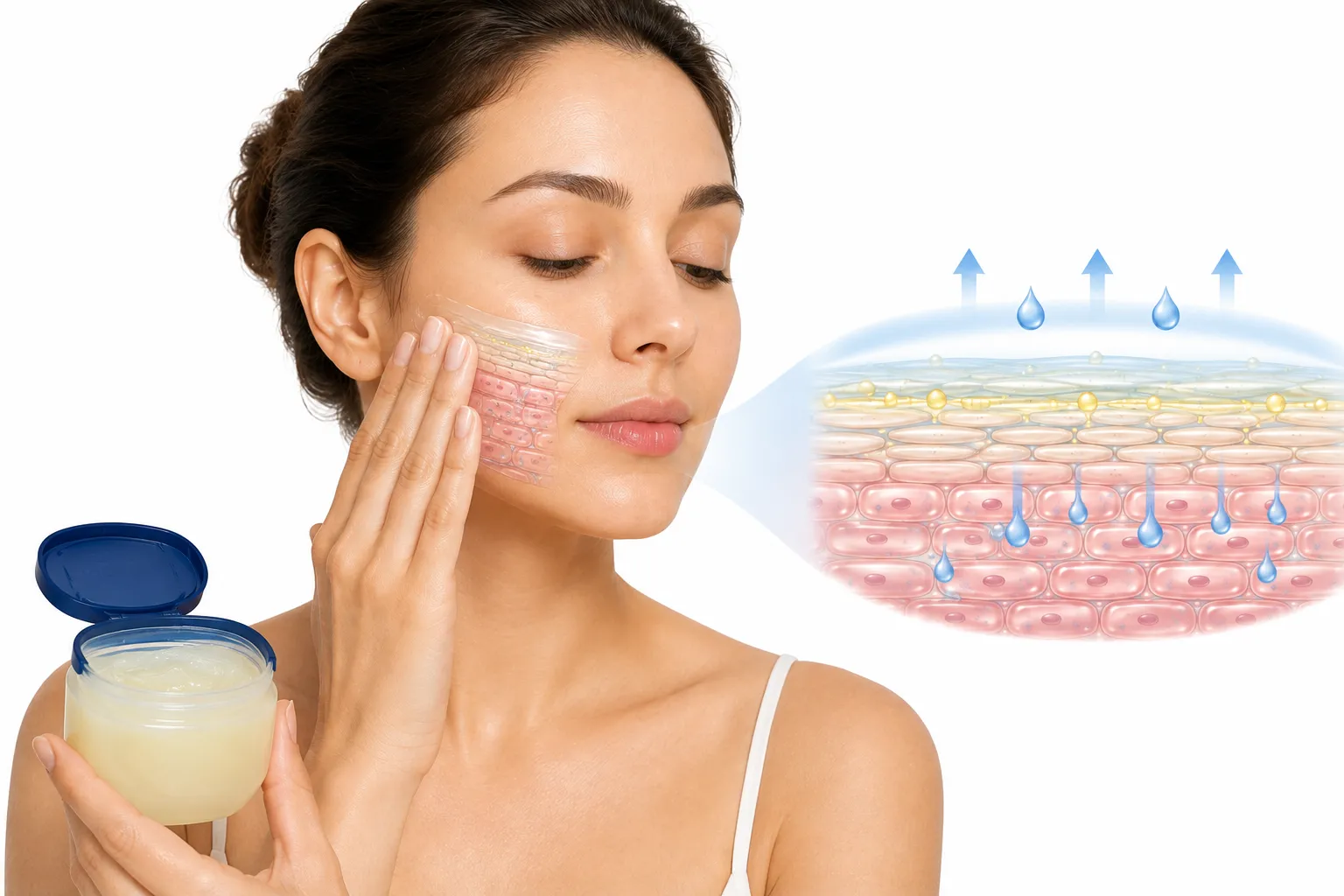
Vaseline doesn't rebuild your barrier - it creates a safe environment for your skin to rebuild itself. The actual repair is done by your skin's natural processes, not the petrolatum.
Use this section to decide
Does this advice apply to me?
Find the concern or goal closest to yours, then use the fit signal to decide how much weight to give this guide.If your goal is
Does it repair directly?Use caution- Fit signal
- Limited evidence
No
If your goal is
Does it support repair?Usually relevant- Fit signal
- Often useful
Yes
If your goal is
Key mechanismUse caution- Fit signal
- Limited evidence
Prevents water loss
If your goal is
Best used withUsually relevant- Fit signal
- Often useful
Hydrating products underneath
Explanation
How it works
Creating the optimal environment for natural repair.
Creates an occlusive seal
Vaseline forms a hydrophobic layer on the skin's surface.
Prevents water loss
Moisture is trapped in the skin, maintaining optimal hydration.
Protects from external factors
Irritants, allergens, and bacteria are blocked from entering.
Allows natural repair
With optimal hydration and protection, the skin can focus on rebuilding the barrier.
Practical use
How to use it
Apply your barrier-repair products first
Use a moisturizer with ceramides, niacinamide, or other barrier-supporting ingredients.
Seal with a thin layer of Vaseline
Apply a small amount to lock in the products and moisture underneath.
Allow time for repair
Use consistently and allow at least 2-4 weeks for noticeable improvement.
Safety
Side effects and cautions
- Using Vaseline alone and expecting barrier repair
Vaseline is a sealant; pair it with hydrating and barrier-building products.
- Applying Vaseline to dry skin
Apply to damp or hydrated skin for best results.
- Using Vaseline while continuing to damage the barrier
Stop using exfoliants and other barrier-damaging products first.
Fit
Who should be careful
- As a standalone barrier repair treatment
Worth noting
Small details that can change the answer
- Indirect Repair. Vaseline doesn't add barrier lipids; it creates conditions for the skin to repair itself.
- Water Loss Reduction. Petrolatum reduces transepidermal water loss by up to 99%.
- Repair Environment. Hydration is essential for enzyme function in barrier repair.
- Protection. Vaseline protects damaged skin from external irritants and bacteria.
Vaseline doesn't directly repair the barrier - it creates the conditions for repair.
It prevents water loss by up to 99%, maintaining hydration for repair processes.
It also protects damaged skin from external irritants and bacteria.
Use it on damp or hydrated skin, over other barrier-supporting products.
It's a supportive tool, not a complete repair solution on its own.
Science
The science of Vaseline and barrier repair
Barrier repair is a biological process that requires hydration to function. The enzymes responsible for lipid synthesis and the proteins involved in cell migration both require water. When skin is dehydrated, these processes slow down. Vaseline's primary contribution to barrier repair is maintaining hydration by preventing water loss, which keeps the repair environment optimized.
- Occlusive
- An ingredient that forms a physical barrier to prevent water loss from the skin.
- Transepidermal Water Loss (TEWL)
- The amount of water that evaporates through the skin; higher TEWL indicates a compromised barrier.
Benefits
Benefits of using Vaseline for barrier support
When used correctly, Vaseline can be an invaluable tool in barrier recovery.
- Prevents up to 99% of water loss from the skin
- Protects damaged skin from external irritants
- Creates optimal conditions for natural repair mechanisms
- Safe for sensitive skin and rarely causes reactions
- Inexpensive and widely available
Risks
Limitations of Vaseline for barrier repair
Vaseline isn't a complete barrier repair solution on its own.
- It doesn't add ceramides, cholesterol, or other barrier lipids
- It doesn't contain humectants to draw water into the skin
- Can feel greasy and uncomfortable for some people
- May not be suitable for acne-prone skin if used heavily
- Should be applied to damp or hydrated skin for best results
Ingredient Compatibility
Pairing Vaseline with other barrier-repair ingredients
Vaseline seals in ceramide-containing moisturizers for maximum benefit.
Apply ceramide moisturizer first, then Vaseline on top.Vaseline creates the ideal environment for niacinamide's barrier-supporting effects.
Use niacinamide serum or moisturizer under Vaseline.Vaseline locks in the water that hyaluronic acid draws into the skin.
Apply HA on damp skin, moisturize, then seal with Vaseline.Vaseline can increase retinoid penetration, which may cause irritation.
Use with caution and only after retinoid has fully absorbed.Questions
Frequently asked questions
Does Vaseline heal a damaged skin barrier?
It helps by preventing water loss and protecting the skin, but the actual healing is done by your skin's natural processes.
Should I use Vaseline on a compromised skin barrier?
Yes, but apply it after hydrating serums and moisturizers, not on its own.
Can Vaseline make barrier damage worse?
No, but if you don't apply it to hydrated skin, it won't be as effective.
What's better for barrier repair - Vaseline or a ceramide cream?
They work best together. Ceramides provide building blocks; Vaseline seals them in.