Evidence
What the evidence shows
The connection through barrier function is well-documented.
Barrier function
Well establishedHistamine response
Well understoodSusceptibility link
Recognized
Use this section to decide
Does this advice apply to me?
Find the concern or goal closest to yours, then use the fit signal to decide how much weight to give this guide.If your goal is
Direct causeUsually relevant- Fit signal
- Often useful
No
If your goal is
Indirect connectionUse caution- Fit signal
- Limited evidence
Yes - susceptibility
If your goal is
Key mechanismUsually relevant- Fit signal
- Often useful
Barrier compromise
If your goal is
Best approachUsually relevant- Fit signal
- Often useful
Barrier support + avoidance
Research notes already in this guide
- The role of barrier function in skin reactivity is well-documented.
- The mechanism of histamine release in sensitive skin is understood.
- The connection between sensitivity and hive susceptibility is recognized.
- Management approaches are supported by dermatological practice.
Explanation
How it works
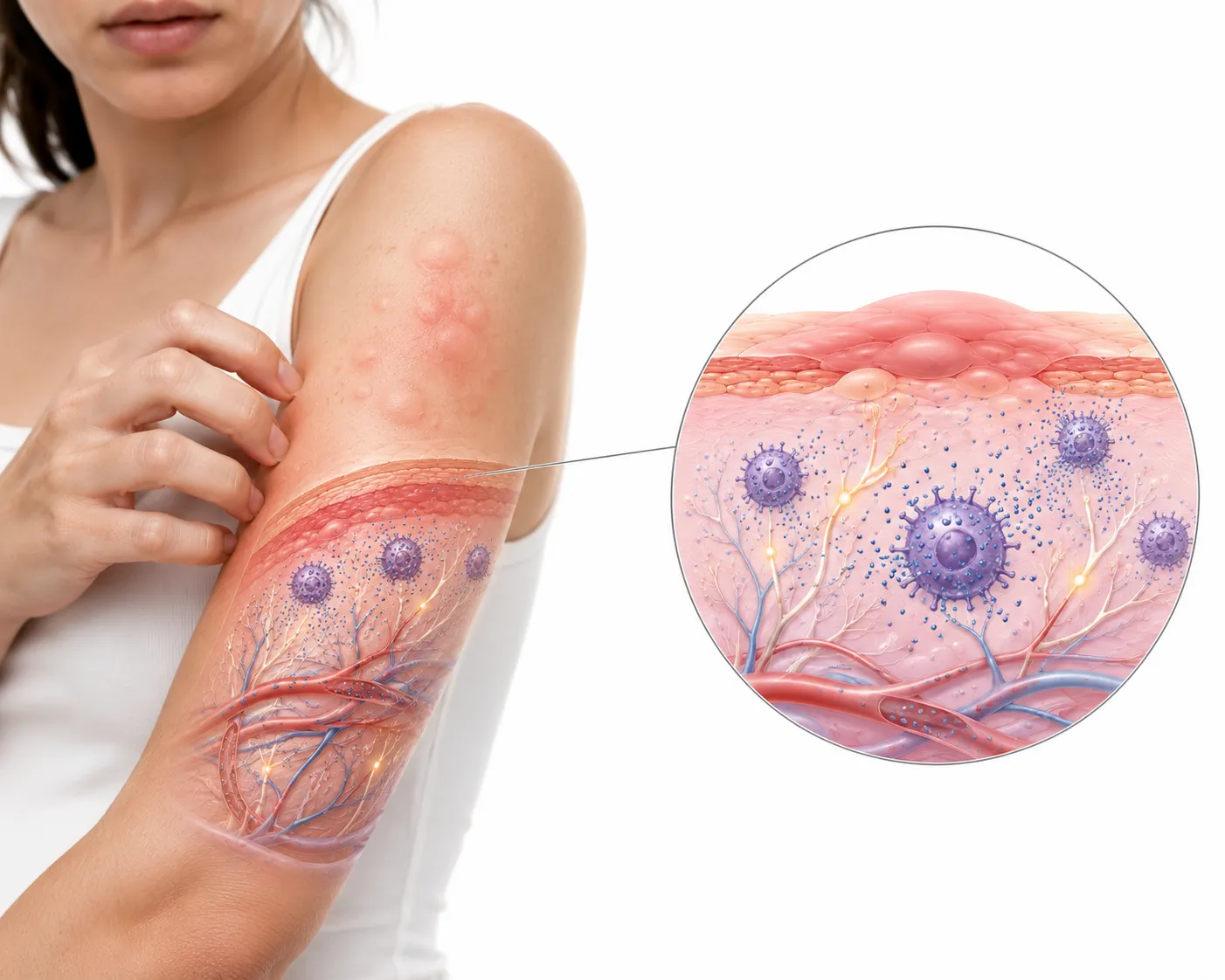
Barrier compromise
Sensitive skin has a compromised barrier.
Irritant penetration
Irritants and allergens penetrate the weakened barrier.
Histamine release
Mast cells release histamine in response.
Hive formation
Histamine causes itching and welts.
Practical use
How to use it
Support your skin barrier
Use a ceramide-rich moisturizer to strengthen your barrier.
Avoid scratching
Manage the itch with moisturizing, not scratching.
Identify and avoid triggers
Track what triggers your hives and avoid those triggers.
Safety
Side effects and cautions
- Assuming sensitive skin directly causes hives
Sensitive skin makes you more susceptible but doesn't directly cause hives.
- Scratching sensitive skin, which can trigger hives
Address the itch with moisturizing rather than scratching.
- Focusing only on treating hives without addressing sensitivity
Addressing underlying sensitivity can help prevent hives.
Fit
Who should be careful
- Expecting simple solutions
Worth noting
Small details that can change the answer
- Barrier Function. Sensitive skin has a compromised barrier that allows irritants to penetrate more easily.
- Histamine Response. Irritants can trigger histamine release from mast cells, causing hives.
- Physical Triggers. Sensitive skin is more reactive to friction and temperature changes.
- Susceptibility. Sensitive skin makes you more likely to develop hives, but doesn't cause them directly.
Sensitive skin doesn't directly cause hives but makes you more susceptible.
A compromised barrier allows irritants to penetrate and trigger histamine release.
Physical triggers like friction are more likely to cause hives on sensitive skin.
Supporting your skin barrier reduces susceptibility to hives.
Managing sensitivity is an important part of preventing hives.
Definition
How sensitive skin and hives are connected
The connection involves barrier function, reactivity, and histamine release.
- Sensitive skin doesn't directly cause hives
- Compromised barrier allows irritants to penetrate
- Irritants trigger histamine release from mast cells
- Histamine causes the welts and itching of hives
- Sensitive skin increases susceptibility
Explanation
Common triggers that affect sensitive skin
People with sensitive skin are more susceptible to these triggers.
Benefits
How to manage sensitive skin and hives
Supporting the barrier and avoiding triggers is key.
- Support barrier function with ceramide-rich moisturizers
- Avoid scratching - manage itching with moisturizing
- Identify and avoid personal triggers
- Use gentle, fragrance-free products
- Consider antihistamines for hive management
Questions
Frequently asked questions
Can sensitive skin alone cause hives?
No. Sensitive skin doesn't directly cause hives but makes you more susceptible to triggers.
Why does sensitive skin get hives more easily?
Sensitive skin has a compromised barrier that allows triggers to penetrate more easily.
Will moisturizing prevent hives?
Moisturizing can help prevent hives by supporting the barrier and reducing reactivity.
Are hives from sensitive skin dangerous?
Hives are usually harmless. If you experience difficulty breathing, seek immediate medical attention.
References
Sources
The notes below are drawn from the evidence already cited in this guide. They are not a complete bibliography.
- The role of barrier function in skin reactivity is well-documented.
- The mechanism of histamine release in sensitive skin is understood.
- The connection between sensitivity and hive susceptibility is recognized.
- Management approaches are supported by dermatological practice.