Evidence
What the evidence shows
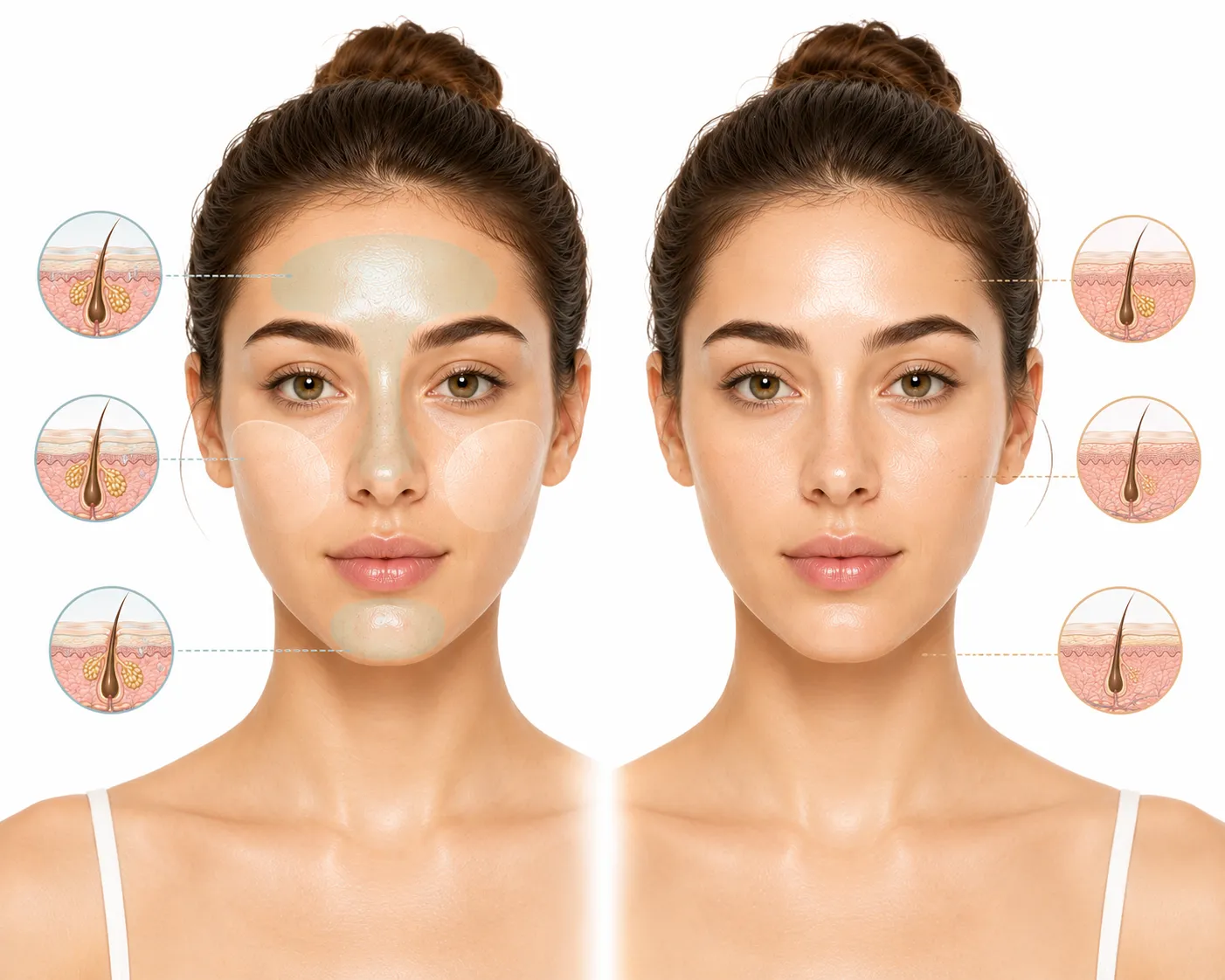
Normal skin and combination skin are fundamentally different in their consistency. Normal skin behaves the same everywhere; combination skin behaves differently in different zones.
Use this section to decide
Does this advice apply to me?
Find the concern or goal closest to yours, then use the fit signal to decide how much weight to give this guide.If your goal is
Normal skinUsually relevant- Fit signal
- Often useful
Consistent, balanced everywhere
If your goal is
Combination skinUse caution- Fit signal
- Limited evidence
Oily T-zone, dry/normal cheeks
If your goal is
Key differenceUse caution- Fit signal
- Limited evidence
Consistency across the face
If your goal is
TreatmentUsually relevant- Fit signal
- Often useful
Normal: uniform; Combination: zone-specific
Practical use
How to use it
Observe your skin's behavior
Notice whether your skin behaves the same across your whole face or differently in different zones.
Determine your skin type accurately
If your T-zone is significantly oilier than your cheeks, you have combination skin. If your whole face is consistent, you have normal skin.
Choose products for your skin type
Use a uniform routine for normal skin; use zone-specific care for combination skin.
Safety
Side effects and cautions
- Treating combination skin as normal skin
Combination skin needs a more nuanced approach.
- Using the same products on the whole face
Different zones need different care.
- Assuming normal skin is the same as combination skin
They are fundamentally different in oil production consistency.
Fit
Who should be careful
- Treating combination skin the same as normal skin
Worth noting
Small details that can change the answer
- Normal Skin. Balanced oil production across all areas of the face.
- Combination Skin. Significant difference between oily T-zone and drier cheeks.
- Key Distinction. The degree of difference in oil production across the face.
- Treatment Difference. Normal skin can use a uniform routine; combination skin needs zone-specific care.
Normal skin is balanced and consistent across the entire face.
Combination skin has an oily T-zone and normal or dry cheeks.
The key difference is consistency - normal skin is consistent, combination skin is not.
Combination skin requires zone-specific skincare; normal skin doesn't.
Accurate skin type identification is essential for choosing the right products.
Definition
What is normal skin?
Normal skin is characterized by balanced sebum production across the entire face. The skin is neither too oily nor too dry, with a good barrier function and comfortable feel. The T-zone may be slightly oilier than the cheeks, but the difference is minimal and the overall experience is consistent.
- Balanced oil production across the face
- Minimal difference between T-zone and cheeks
- Skin feels comfortable, not tight or greasy
- Good barrier function and resilience
- Fewer concerns with breakouts or sensitivity
Definition
What is combination skin?
Combination skin is characterized by a significant difference in oil production between the T-zone and the rest of the face. The T-zone (forehead, nose, chin) is oily, while the cheeks, eye area, and jawline are normal or dry. This creates two distinct skin conditions on the same face.
- Oily T-zone: Shine, blackheads, enlarged pores
- Normal/dry cheeks: May feel tight, rough, or flaky
- Significant difference between zones
- Requires zone-specific skincare
- May have different needs in different areas
Science
The biological difference between normal and combination skin
The difference between normal and combination skin lies in the uniformity of sebaceous gland activity. In normal skin, sebaceous glands across the face have similar levels of activity and sensitivity to hormones. In combination skin, the glands in the T-zone are more active and sensitive, while those on the cheeks are less active. This uneven distribution creates the "combination" effect and requires a different approach to skincare.
- Sebaceous Gland Uniformity
- The consistency of oil production across different areas of the face.
- Androgen Sensitivity
- The responsiveness of sebaceous glands to hormones that stimulate oil production.
Benefits
How to identify normal vs combination skin
The key is to observe your skin's behavior after cleansing and throughout the day.
- Normal skin: Your skin feels comfortable and looks balanced all day.
- Combination skin: Your T-zone gets oily during the day, while your cheeks feel fine or dry.
- Normal skin: Your skin responds consistently to products.
- Combination skin: Products may work differently on different areas of your face.
- Normal skin: You can use a uniform skincare routine.
- Combination skin: You need different products for different zones.
Dos Donts
Caring for normal vs combination skin
Do
Your skin responds well to a uniform approach.
Different areas have different needs.
Prepares the skin without stripping it.
Avoid
You'll neglect the oily T-zone or over-dry the cheeks.
Combination skin needs different products in different zones.
They may not address the specific needs of either zone.
Questions
Frequently asked questions
Can normal skin become combination skin?
Yes, hormonal changes, age, and environmental factors can shift skin type over time.
Is normal skin rare?
It's less common than combination skin, which affects up to 70% of people.
Can I use normal skin products if I have combination skin?
You can, but they may not adequately address your oily T-zone or dry cheeks.
How do I know if I have normal or combination skin?
If your skin feels consistent across your whole face, you have normal skin. If your T-zone is clearly oilier than your cheeks, you have combination skin.