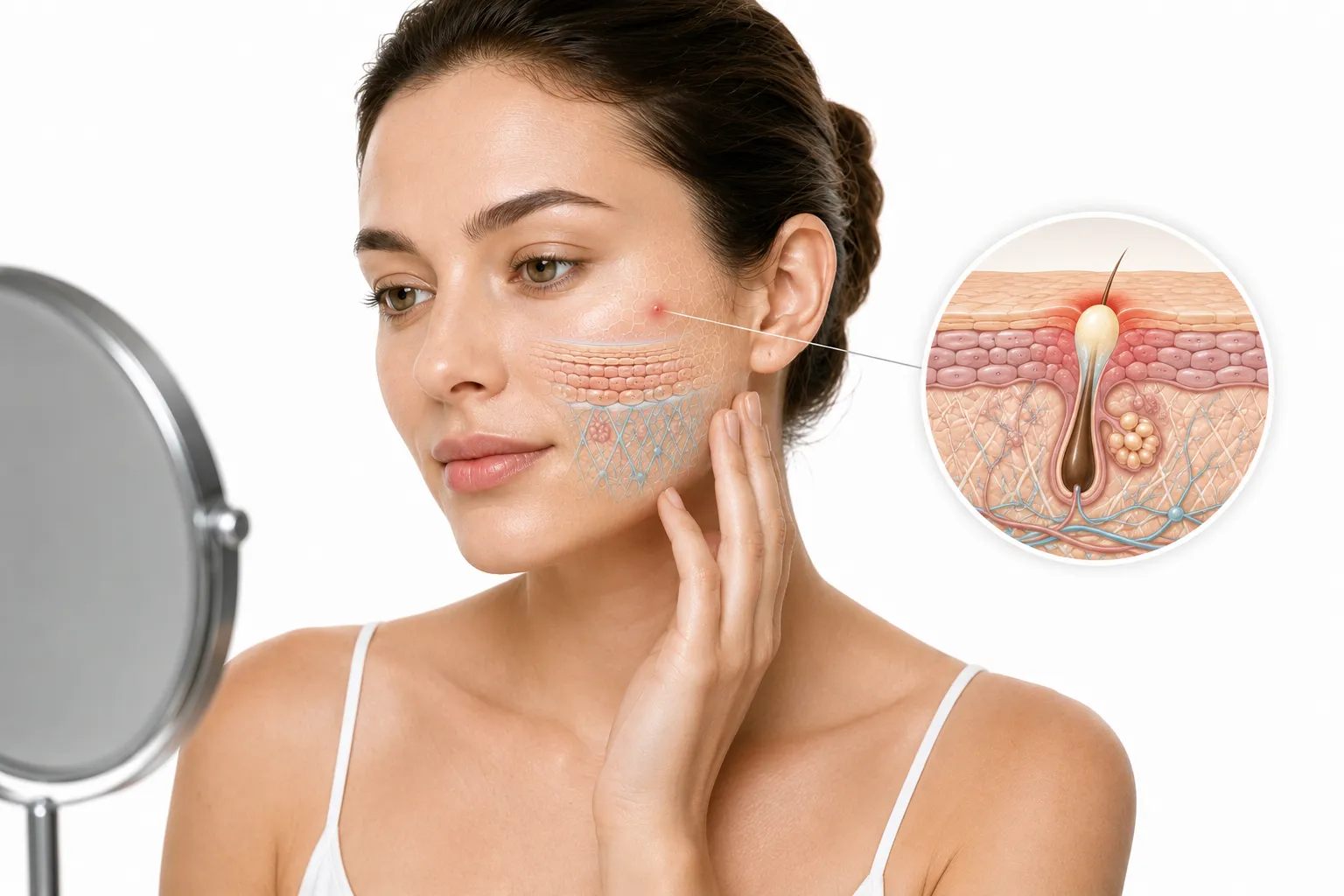
Evidence
What the evidence shows
Each feature of normal skin, oil level, moisture, pore size, and sensitivity, exists on a spectrum shared with other skin types; normal skin simply sits closer to the middle on most of them at once.
Use this section to decide
Does this advice apply to me?
Find the concern or goal closest to yours, then use the fit signal to decide how much weight to give this guide.If your goal is
Oil productionUsually relevant- Fit signal
- Often useful
Moderate
If your goal is
Moisture retentionUsually relevant- Fit signal
- Often useful
Good
If your goal is
Pore sizeUsually relevant- Fit signal
- Often useful
Small to medium
If your goal is
SensitivityUsually relevant- Fit signal
- Often useful
Low
Expected results
Results and timeframe
These features can shift over time due to age, hormones, or environment.
Practical use
How to use it
Assess each feature individually
Consider oil level, moisture, pore size, texture, and sensitivity separately.
Look for an overall balanced pattern
Normal skin typically shows moderate levels across most features at once.
Reassess periodically
Revisit your skin's features every so often, especially with age or season changes.
Safety
Side effects and cautions
- Assuming all five features must be perfectly present to count as normal skin
Some natural variation across features is still consistent with normal skin.
- Treating these features as permanent
Reassess periodically, since features like oil production can shift with age.
- Overlooking sensitivity as a feature
Low reactivity to products is just as defining as oil or moisture levels.
Fit
Who should be careful
- Skin with clearly extreme oil, dryness, or sensitivity
Helpful context
What else is worth knowing
The five core features
Prevents both shine and dryness.
Skin stays comfortable without tightness.
Not very visible.
Minimal roughness or flaking.
Tolerates a wide range of products.
Worth noting
Small details that can change the answer
- Oil. Normal skin produces sebum at a moderate rate, avoiding both excess shine and persistent dryness.
- Moisture. Good natural moisture retention helps normal skin avoid the tightness or flaking associated with dry skin.
- Pores. Pore size in normal skin tends to be small to medium and not especially visible.
- Sensitivity. Lower baseline sensitivity allows normal skin to tolerate a wider range of skincare products.
Normal skin is defined by five main features: oil production, moisture retention, pore size, texture, and sensitivity.
Each feature sits closer to the middle of its spectrum compared to other skin types.
The combination of features matters more than any single trait alone.
Some natural variation across features is still consistent with normal skin.
Definition
The five core features of normal skin
A structural breakdown.
Normal skin is typically defined by a combination of moderate oil production, good moisture retention, small to medium pores, even tone and texture, and low sensitivity. No single feature defines the type on its own; it's the combination that matters.
How each feature typically presents
- Oil production - enough to prevent dryness, not so much as to cause visible shine
- Moisture retention - skin feels comfortable without frequent tightness
- Pore size - small to medium, not very visible
- Texture and tone - smooth and relatively even
- Sensitivity - generally low, tolerating a wide range of products
Normal skin features vs other skin types
| Factor | Feature | Normal Skin | Contrast |
|---|---|---|---|
| Oil production | Moderate | Oily skin: high, dry skin: low | |
| Moisture retention | Good | Dry skin: poor | |
| Sensitivity | Low | Sensitive skin: high |
Explanation
Why these features can shift over time
Normal skin isn't a fixed set of specs.
Because these features are influenced by hormones, age, and environment, they aren't guaranteed to stay the same throughout life. Oil production, in particular, often naturally declines with age, which can gradually shift normal skin toward a drier profile.
Questions
Frequently asked questions
What are the main features that define normal skin?
Moderate oil production, good moisture retention, small to medium pores, even texture, and low sensitivity.
Do all these features need to be present for skin to count as normal?
Not perfectly; some natural variation across features is still consistent with normal skin.
Can these features change as I age?
Yes, oil production in particular tends to decline with age, which can shift skin toward a drier profile.
Is sensitivity really a defining feature of normal skin?
Yes, low reactivity to products and environmental factors is one of its more practical, easy-to-notice features.