Evidence
What the evidence shows
Normal skin's biggest advantage is that it doesn't need correction, but its biggest risk is that this leads to complacency or over-complication. Maintaining the routine is more important than having the perfect routine.
Use this section to decide
Does this advice apply to me?
Find the concern or goal closest to yours, then use the fit signal to decide how much weight to give this guide.If your goal is
MorningUsually relevant- Fit signal
- Often useful
Cleanse, moisturize, sunscreen
If your goal is
EveningUsually relevant- Fit signal
- Often useful
Cleanse, moisturize
If your goal is
Key principleUse caution- Fit signal
- Limited evidence
Consistency over complexity
If your goal is
Optional activesUse caution- Fit signal
- Limited evidence
Vitamin C, retinol, AHA/BHA
Practical use
How to use it
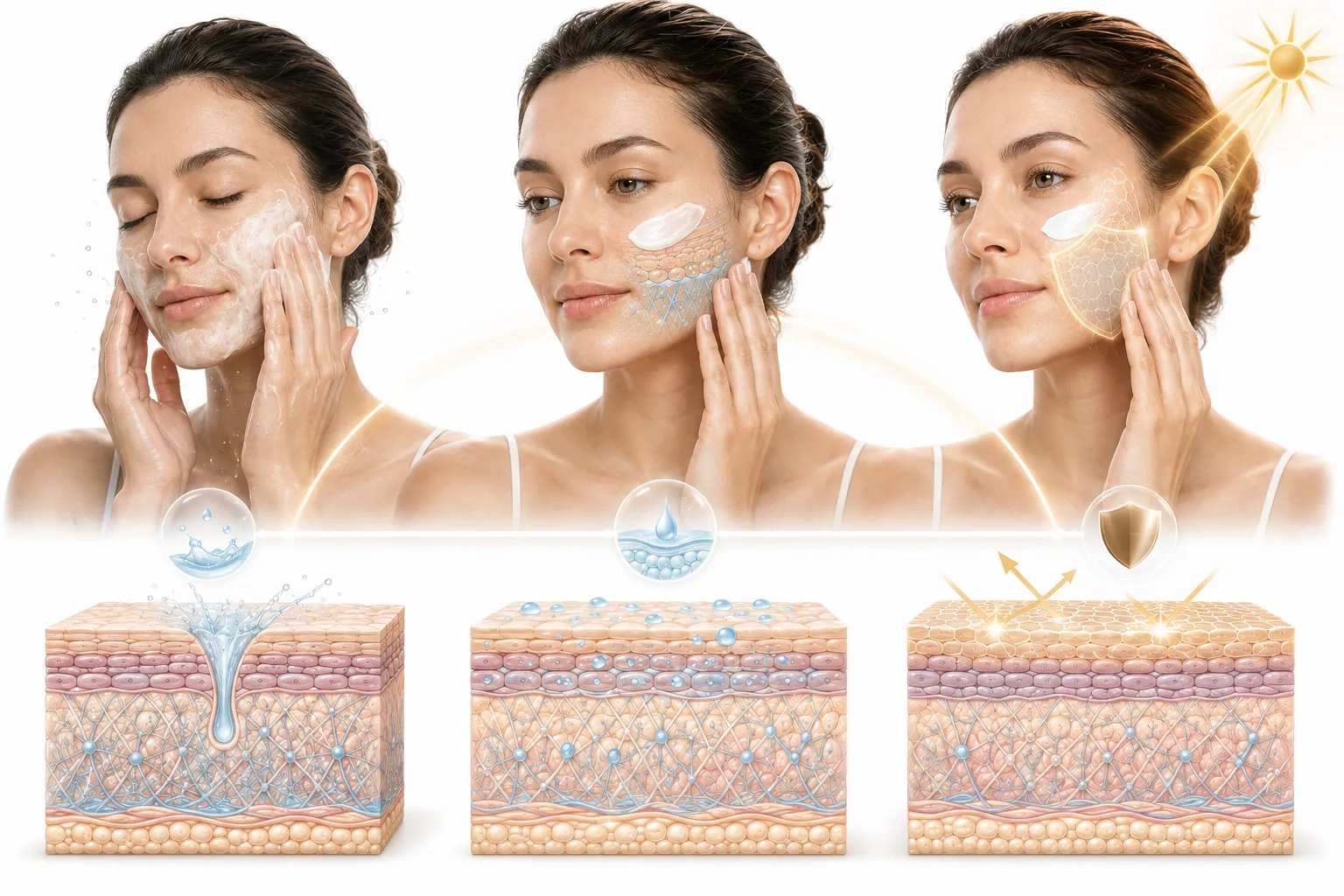
Build the core three-step routine
Cleanse, moisturize, and apply sunscreen every morning. Cleanse and moisturize every evening.
Add optional actives slowly
Start with one active (like vitamin C or retinol) and use it for 4-6 weeks before adding anything else.
Maintain consistency
The best routine is the one you stick to. Normal skin responds best to predictable, gentle care.
Safety
Side effects and cautions
- Assuming normal skin needs no moisturizer
Even normal skin needs a lightweight moisturizer to maintain hydration and barrier health.
- Using too many active ingredients at once
Normal skin can easily be overwhelmed; introduce actives one at a time.
- Skipping sunscreen because skin is "normal"
Sunscreen is essential for all skin types and is the primary tool for preventing premature aging.
Fit
Who should be careful
- Those with specific, complex skin concerns requiring a more targeted routine
Helpful context
What else is worth knowing
Which routine fits you?
Choose based on your age and goals.
Worth noting
Small details that can change the answer
- Skin Type Prevalence. Normal skin is less common than combination or oily skin, making it a relative minority.
- Aging Factor. Normal skin still ages, and it's not immune to environmental damage or the decline in collagen production.
- Sunscreen Criticality. Sunscreen is the single most important anti-aging step, regardless of skin type, and it's non-negotiable for normal skin as well.
- Hydration Need. Even normal skin loses hydration throughout the day and requires consistent moisturization.
Normal skin needs a consistent routine: cleanser, moisturizer, sunscreen.
Active ingredients are optional for normal skin - use them based on your goals, not out of habit.
Sunscreen is non-negotiable; it's your primary defense against premature aging.
Consistency is more important than the number of steps. A simple routine you follow daily beats an elaborate one you use sporadically.
Listen to your skin - if it feels tight or oily, adjust your routine accordingly. Normal skin can change with season and age.
Definition
What is a skincare routine?
A skincare routine is a structured sequence of products applied to the face to maintain or improve skin health. It typically involves cleansing, moisturizing, and protecting, with optional additional steps like exfoliating or treating specific concerns. For normal skin, the routine should be simple and focused on maintenance.
- Typically divided into morning and evening steps
- The core three-step is cleanse, moisturize, protect
- Can include optional active ingredients
- Consistency is more important than complexity
Explanation
Why normal skin needs a routine at all
Normal skin is often mistaken for skin that "takes care of itself," but it doesn't. Every skin type benefits from a consistent routine. Cleansing removes environmental pollutants and makeup, moisturizing prevents water loss, and sunscreen protects against UV damage. Without this routine, normal skin can become dry, dehydrated, or prematurely aged.
Routine Flow
The essential routine for normal skin
- 1Gentle water-based cleanser
Wash with lukewarm water, using gentle circular motions for 30-60 seconds. Pat dry.
- 2Lightweight moisturizer
Apply to slightly damp skin to lock in hydration.
- 3Sunscreen SPF 30+
Apply generously to all exposed skin.
Decision Helper
Optional add-ons based on your goals
I want to add antioxidant protection
Add a vitamin C serum after cleansing in the morning.Vitamin C neutralizes free radicals from UV exposure and pollution.
I want to reduce signs of aging or texture
Add a gentle retinol to your evening routine, starting with once a week.Retinol stimulates cell turnover and collagen production.
I want to smooth skin texture
Add a gentle AHA or BHA exfoliant once a week in the evening.Acids gently dissolve the bonds that hold dead skin cells together.
Questions
Frequently asked questions
Can normal skin use oily-skin or dry-skin products?
It can, but you'll likely need to adjust for texture. Oily-skin products may be too drying, and dry-skin products may be too heavy.
How often should I exfoliate normal skin?
Once or twice a week is sufficient. Over-exfoliation can compromise the barrier.
Does normal skin need a face mask?
Not necessarily, but a hydrating or clarifying mask once a week can be a nice occasional extra.
Is it okay to skip cleanser in the morning?
Yes, if you have normal skin that isn't particularly oily, you can just splash with water in the morning and skip cleanser.