Evidence
What the evidence shows
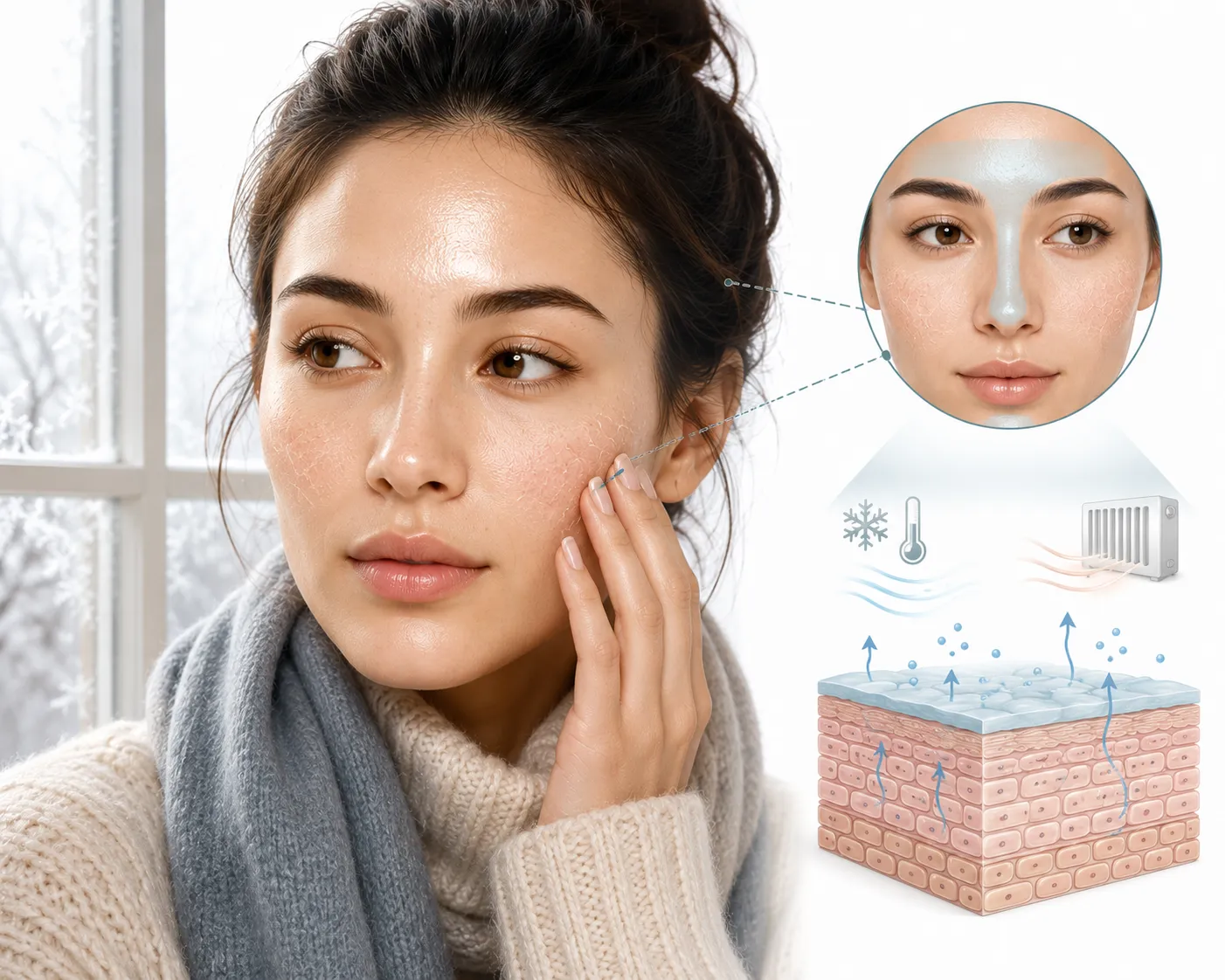
Winter affects all skin types, but combination skin experiences it as a divided response - the cheeks dry out while the T-zone remains oily.
Cheeks feel tight and dry?
Apply a richer moisturizer to the cheeks.T-zone still oily?
Continue using lightweight products on the T-zone.Both zones feeling dry?
Increase overall hydration and use a humidifier.
Use this section to decide
Does this advice apply to me?
Find the concern or goal closest to yours, then use the fit signal to decide how much weight to give this guide.If your goal is
Most affected areasDepends- Fit signal
- Possible fit
Cheeks
If your goal is
WhyUse caution- Fit signal
- Limited evidence
Cold air + indoor heating = reduced humidity
If your goal is
Best approachUsually relevant- Fit signal
- Often useful
Richer on cheeks, lightweight on T-zone
If your goal is
Key toolUsually relevant- Fit signal
- Often useful
Humidifier
Explanation
How it works
Humidity drops
Cold air and indoor heating reduce moisture in the environment.
Water loss accelerates
Water evaporates from the skin more quickly.
Cheeks dry out
Fewer oil glands mean less protection on the cheeks.
T-zone may still produce oil
Higher oil production provides some winter protection.
Practical use
How to use it
Adjust your routine for winter
Use richer products on the cheeks and moisturize the T-zone more consistently.
Use a humidifier indoors
Replenishes moisture in the air and helps prevent skin dryness.
Protect skin from cold weather
Cover your face when going outside in extreme cold.
Safety
Side effects and cautions
- Using the same routine in winter as in summer
Skin needs more hydration and barrier support in winter.
- Ignoring dry cheeks while focusing on the T-zone
Both zones need attention - just different products.
- Skipping moisturizer on the T-zone in winter
The T-zone still needs hydration in winter.
Fit
Who should be careful
- Those who use the same routine all year - seasonal changes are needed
Worth noting
Small details that can change the answer
- Cheek Sensitivity. Cheeks are more affected by winter dryness due to fewer oil glands.
- T-Zone Resilience. The T-zone is less affected but still needs adjustment.
- Humidity Drop. Indoor heating can reduce humidity to desert levels.
- Seasonal Adjustment. Skincare routines should change with the seasons.
Combination skin gets drier in winter, especially on the cheeks.
Cold air and indoor heating reduce humidity, accelerating moisture loss.
The T-zone is less affected but still needs adjustment.
Use richer moisturizers on the cheeks and lightweight products on the T-zone.
Seasonal routine adjustments are essential for balanced skin.
Science
Why winter affects combination skin differently
Winter affects the skin primarily through reduced humidity. Cold air holds less moisture than warm air, and indoor heating further dries the air. This causes water to evaporate from the skin more quickly. The cheeks, which have fewer sebaceous glands, lose moisture faster than the T-zone. The T-zone's oil production provides some protection, but even it can become dehydrated in winter.
- Humidity
- The amount of water vapor in the air.
- TEWL
- Transepidermal water loss - the rate at which water evaporates from the skin.
Routine Flow
A winter routine for combination skin
- 1Gentle, non-stripping cleanser
Use a hydrating cleanser that doesn't strip the skin.
- 2T-zone: Lightweight toner or serum
Use a balancing product on the T-zone.
- 3Cheeks: Richer serum or oil
Apply a richer, hydrating product to the cheeks.
- 4T-zone: Lightweight moisturizer
Use an oil-free gel moisturizer on the T-zone.
- 5Cheeks: Richer moisturizer
Apply a thicker, barrier-supporting cream to the cheeks.
Dos Donts
Dos and don'ts for winter combination skin
Do
Addresses increased winter dryness
Traps water in the skin
Replenishes moisture in the air
Skin needs change with the seasons
UV exposure still occurs
Avoid
Skin needs different support in winter
Can worsen winter dryness
Even the T-zone needs moisture in winter
Can damage the barrier in dry conditions
Questions
Frequently asked questions
Why do my cheeks get so dry in winter but my nose stays oily?
Cheeks have fewer oil glands than the T-zone, so they're more vulnerable to winter dryness.
Should I use different products on different zones in winter?
Yes - a zonal approach works well for combination skin in winter.
Can I use a humidifier to help with winter dryness?
Yes - it's one of the most effective ways to combat winter dryness.
Should I stop exfoliating in winter?
Reduce exfoliation frequency, but don't stop entirely unless your skin is very irritated.