Evidence
What the evidence shows
The skin barrier can't be repaired with a single product or overnight. It requires consistent, gentle care over weeks, as the body needs time to rebuild its lipid structure.
Use this section to decide
Does this advice apply to me?
Find the concern or goal closest to yours, then use the fit signal to decide how much weight to give this guide.If your goal is
Mild damageUse caution- Fit signal
- Limited evidence
2-4 weeks
If your goal is
Severe damageDepends- Fit signal
- Possible fit
4-8 weeks
If your goal is
Key to repairUsually relevant- Fit signal
- Often useful
Consistency and gentle care
If your goal is
Avoid during repairUse caution- Fit signal
- Limited evidence
Actives and exfoliation
Expected results
Results and timeframe
Mild barrier damage takes 2-4 weeks to repair.
Severe damage can take 4-8 weeks or more.
The first week of repair is crucial for reducing inflammation.
Practical use
How to use it
Simplify your routine
Use only a gentle cleanser and a barrier-supporting moisturizer.
Apply a barrier repair cream with ceramides
Use a cream with a mixture of ceramides, cholesterol, and fatty acids.
Be patient and consistent
Healing takes 2-4 weeks for mild damage and 4-8 weeks for severe damage.
Safety
Side effects and cautions
- Continuing to use active ingredients
Stop all acids, retinol, and vitamin C until the barrier is fully repaired.
- Exfoliating to remove flakiness
Flakiness is a sign of barrier damage; exfoliating makes it worse.
- Expecting quick results
Barrier repair takes time; be patient and consistent.
Fit
Who should be careful
- Those expecting quick, overnight results
Worth noting
Small details that can change the answer
- Lipid Synthesis. The skin produces ceramides, cholesterol, and fatty acids in a specific ratio needed for a functional barrier.
- Turnover Cycle. The barrier turnover cycle is approximately 28 days, which is why full repair takes at least 4 weeks.
- Inflammation Impact. Inflammation significantly slows the repair process, as the body's resources are diverted.
- Topical Support. Topical ceramides can support but not replace the body's own lipid synthesis.
Stopping all active ingredients and exfoliation is essential.
Consistency and patience are the keys to successful barrier repair.
Definition
What is the skin barrier?
The skin barrier, or stratum corneum, is the outermost layer of the skin. It's composed of dead skin cells (corneocytes) held together by a matrix of lipids - ceramides, cholesterol, and fatty acids. This barrier prevents water loss and keeps irritants out.
- Often described as a "brick and mortar" structure
- Lipids form the "mortar" that holds cells together
- Crucial for preventing water loss and irritant penetration
- Damage leads to dry, sensitive, and reactive skin
Science
The biology of barrier repair
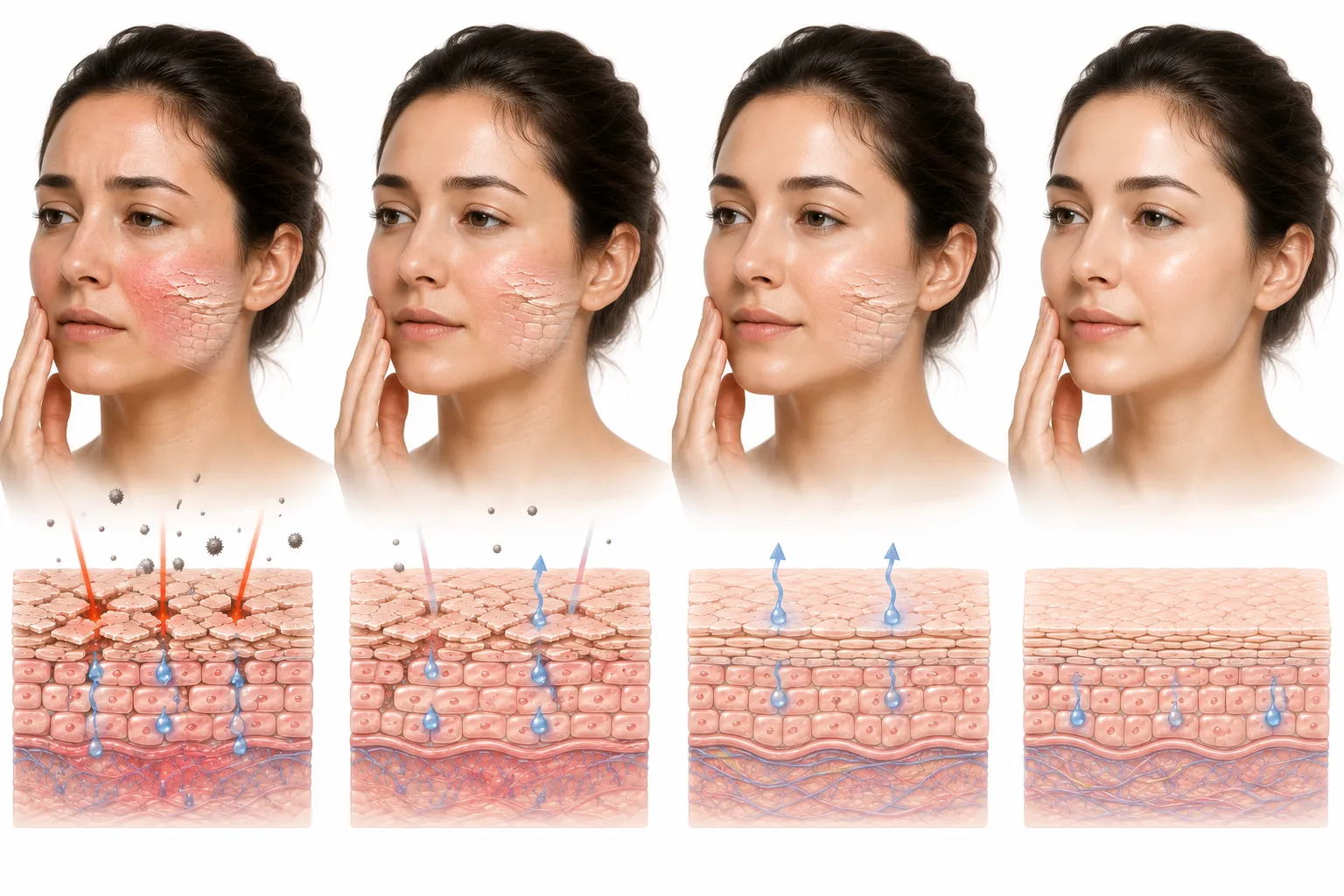
When the barrier is damaged, the skin responds by increasing lipid synthesis. This process is triggered by inflammation and involves the production of ceramides, cholesterol, and fatty acids in the right ratios. However, this synthesis is slow, taking several weeks to restore normal barrier function. The process also requires a balanced environment: reducing inflammation, avoiding further damage, and providing the right nutrients.
- Lamellar Bilayers
- Multiple lipid layers that form the main water barrier, arranged like pages of a book, requiring proper lipid ratios to function.
- Ceramide
- A type of lipid that's a key component of the skin barrier; ceramide levels decline with age and barrier damage.
Results Timeline
What to expect and when
- 1Days 1-3
Reduced irritation and inflammation; skin feels less angry.
- 2Week 1
Decreased sensitivity; less tightness and flaking.
- 32-4 weeks
Significant improvement in texture; visible glow returning; less reactive.
- 44-8 weeks
Full barrier repair; skin feels resilient and well-hydrated.
Dos Donts
How to support barrier repair
Do
Avoids further barrier disruption.
Supports the repair process with the right lipids.
UV damage slows barrier repair.
Avoid
Active ingredients can further damage the barrier.
Exfoliation removes the barrier you're trying to rebuild.
Hot water strips the barrier.
Questions
Frequently asked questions
Can the skin barrier repair itself without products?
Yes, but products with ceramides can support and speed up the process.
Is it safe to use oils on a damaged barrier?
Yes, non-comedogenic oils like squalane can support barrier repair.
Can I use niacinamide during barrier repair?
Yes, niacinamide can support barrier repair and reduce inflammation.
Does barrier repair time vary by age?
Yes, older skin may take longer to repair due to slower lipid synthesis.