Evidence
What the evidence shows
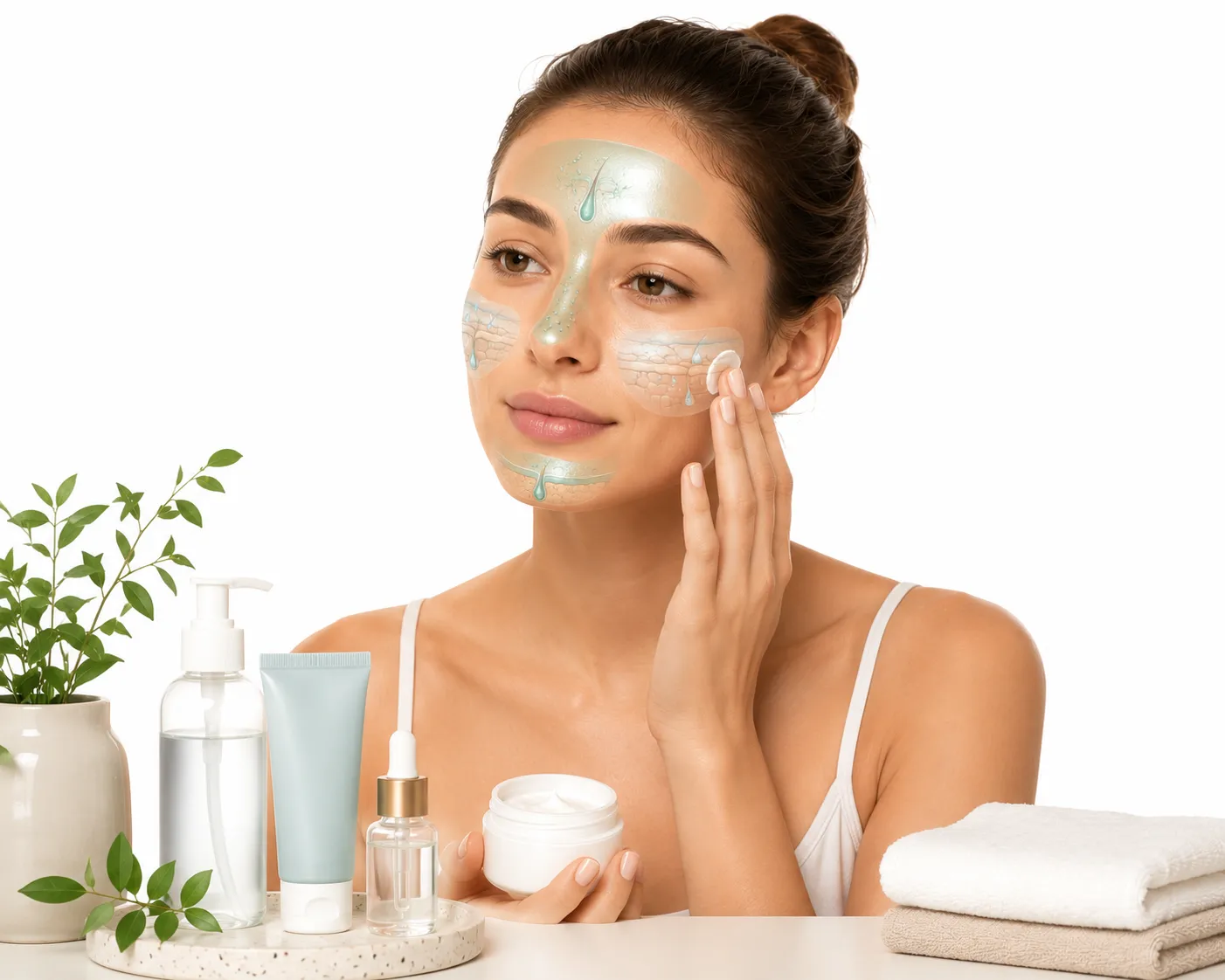
The biggest mistake with combination skin is treating it as a single skin type. The best results come from a zonal approach - different products for different areas of your face.
T-zone oily, cheeks dry?
Use lightweight products on the T-zone and richer on the cheeks.Combination with sensitivity?
Choose fragrance-free, gentle products throughout.Need to exfoliate?
Exfoliate the T-zone more frequently than the cheeks.
Use this section to decide
Does this advice apply to me?
Find the concern or goal closest to yours, then use the fit signal to decide how much weight to give this guide.If your goal is
Core approachUsually relevant- Fit signal
- Often useful
Zonal, not uniform
If your goal is
Oily zonesUse caution- Fit signal
- Limited evidence
T-zone needs lightweight care
If your goal is
Dry zonesUse caution- Fit signal
- Limited evidence
Cheeks need richer hydration
If your goal is
Key goalUsually relevant- Fit signal
- Often useful
Balance, not conformity
Practical use
How to use it
Identify your zones
Map out which parts of your face are oily and which are dry.
Build a zonal routine
Use different products on different areas of your face as needed.
Adjust based on response
Pay attention to how each zone responds and refine your approach.
Safety
Side effects and cautions
- Using the same moisturizer all over
Your T-zone and cheeks have different needs - treat them differently.
- Over-cleansing to "fix" the oiliness
This dries out the cheeks while making the T-zone produce even more oil as compensation.
- Skipping moisturizer on the T-zone
Even oily skin needs hydration to maintain barrier health.
Fit
Who should be careful
- Those who want a one-size-fits-all solution - combination skin needs a tailored approach
Worth noting
Small details that can change the answer
- Zonal Approach. Combination skin is best managed by using different products on different areas of the face.
- T-Zone Oil. The T-zone has more sebaceous glands and higher oil production.
- Cheek Dryness. Cheeks have fewer oil glands and can become dehydrated easily.
- Goal of Balance. The aim is not to change either zone's nature but to balance them both.
Combination skin requires a zonal approach - different products for different areas.
The T-zone and cheeks have different needs that should be addressed separately.
Gentle cleansing is essential to avoid over-drying some areas while stripping others.
Balance is the goal, not making either zone conform to the other's nature.
The best routine evolves based on how each zone responds to products.
Routine Flow
A balanced daily routine for combination skin
- 1Gentle, non-stripping cleanser
Use a gel or cream cleanser that cleanses without over-drying. Apply to the T-zone with a focus on oilier areas.
- 2Toner or essence
Use a hydrating toner that balances the skin's pH without adding oil.
- 3Serum (optional)
Choose a lightweight serum that addresses both oil and hydration needs.
- 4Moisturizer (zonal approach)
Use a lightweight gel moisturizer on the T-zone and a richer cream on the cheeks.
- 5Sunscreen
Use a lightweight, oil-free sunscreen that doesn't clog pores.
Dos Donts
Dos and don'ts for combination skin
Do
T-zone needs lightweight; cheeks need richer hydration
Avoids stripping either zone
Reduces irritation and improves absorption
Targets oil without drying cheeks
Avoid
Can clog T-zone pores
Will over-dry cheeks
Even oily skin needs hydration
Each zone has different needs
Beginner Guide
A simple starter routine for combination skin
- 1Week 1-2 · Daily, morning and evening
Focus on gentle cleansing and a lightweight moisturizer on all areas. Avoid treatments.
- 2Week 3-4 · Daily, with zonal approach
Begin using different moisturizers on T-zone and cheeks. Add gentle exfoliation 1-2 times per week.
- 3Week 5+ · Ongoing
Refine the routine based on how each zone responds. Add targeted serums where needed.
Skin Type Suitability
How combination skin responds to different products
T-zone responds well to lightweight, oil-free products
Cheeks need richer moisturization with barrier support
Some combination skin types also experience sensitivity
Questions
Frequently asked questions
Can combination skin become normal skin?
Skin type is often fixed, but combination skin can be well-balanced with the right care.
Should I use separate cleansers on different areas?
Sometimes - a gel cleanser on the T-zone and cream on the cheeks can work well.
Can I use a single moisturizer on combination skin?
Yes, if it's lightweight enough for the T-zone and rich enough for the cheeks - but it's often easier to use two.
Does diet affect combination skin?
Diet can influence skin - a balanced diet with plenty of water supports overall skin health.