Evidence
What the evidence shows
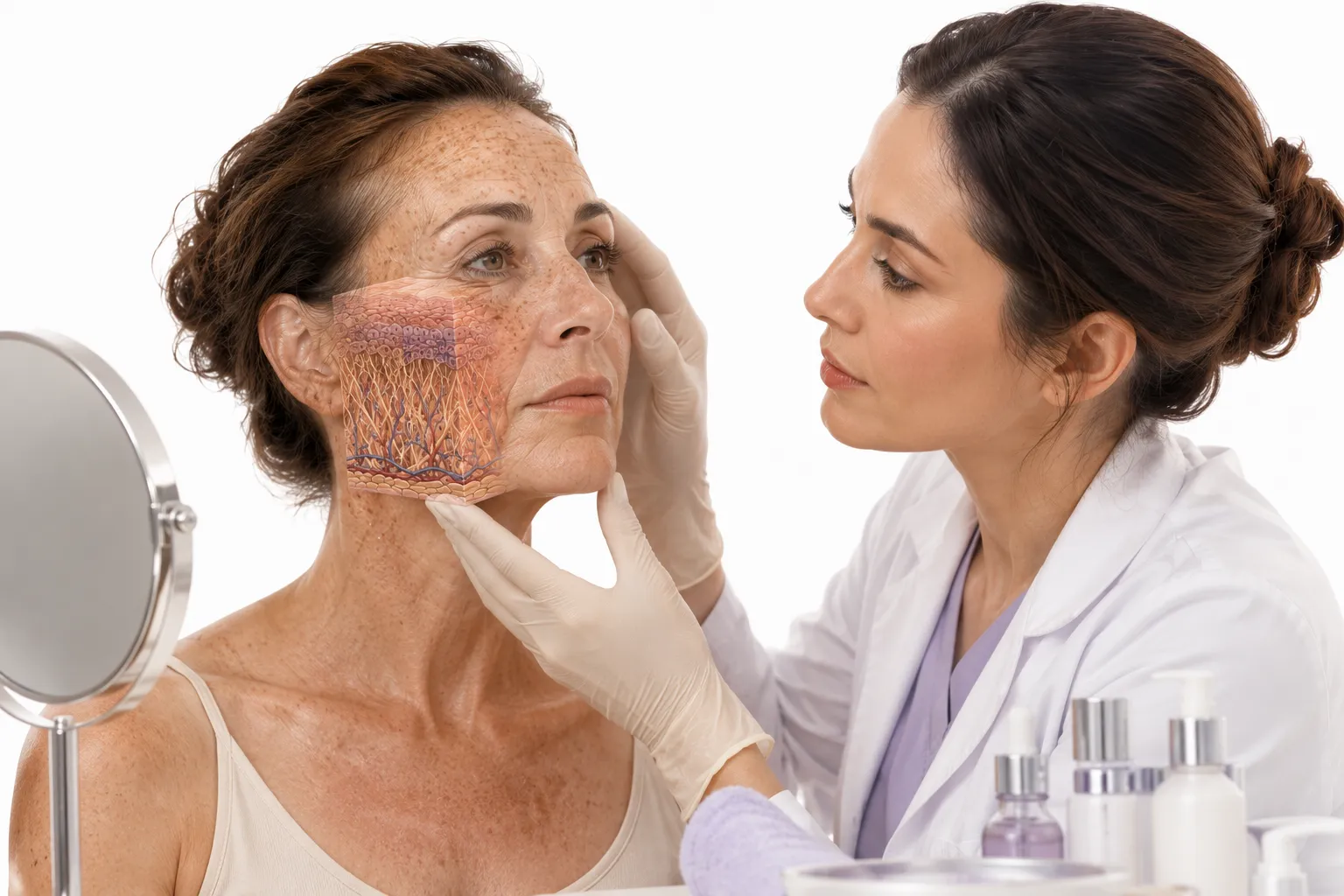
Severe sun-damaged skin requires professional intervention. The best approach combines prescription treatments with in-office procedures, all while maintaining strict sun protection.
Use this section to decide
Does this advice apply to me?
Find the concern or goal closest to yours, then use the fit signal to decide how much weight to give this guide.If your goal is
ConsultUsually relevant- Fit signal
- Often useful
Dermatologist
If your goal is
TreatmentUse caution- Fit signal
- Limited evidence
Laser, peels
If your goal is
ImportantUse caution- Fit signal
- Limited evidence
Sun protection
If your goal is
PatienceUse caution- Fit signal
- Limited evidence
Months to years
Research notes already in this guide
- Studies show that tretinoin is effective for treating photoaging.
- Research has demonstrated the efficacy of laser therapy.
- Clinical trials have shown the benefits of deep chemical peels.
Expected results
Results and timeframe
The process takes time and requires strict sun protection.
Managing expectations is important; improvement, not perfection, is the goal.
Practical use
How to use it
See a dermatologist
A dermatologist can assess the damage and recommend a treatment plan.
Follow the treatment plan
Use all prescribed treatments as directed.
Protect your skin
Apply sunscreen every day and avoid direct sun exposure.
Safety
Side effects and cautions
- Trying to treat severe damage with OTC products alone
Severe damage requires professional-strength treatments and supervision.
- Not protecting the skin during healing
Healing skin is more vulnerable to the sun, so protection is essential.
- Expecting dramatic results after one treatment
Healing severe sun damage is a process that takes time.
- Redness and swelling
Common · Follow your dermatologist's aftercare instructions.
- Scarring
Rare · Choose an experienced dermatologist to minimize risk.
- Pigmentation changes
Possible · Avoid sun exposure during healing.
Fit
Who should be careful
- Those who are not ready to commit to a prolonged treatment plan
Worth noting
Small details that can change the answer
- Actinic Keratosis. A common pre-cancerous lesion in severely sun-damaged skin.
- Tretinoin. A prescription retinoid that is more potent than over-the-counter retinol.
- Laser Resurfacing. Laser therapy can stimulate collagen production and improve skin texture.
- Chemical Peel Depth. Deep chemical peels can treat advanced photoaging.
Severe sun-damaged skin requires professional treatment.
A dermatologist can assess the damage and create a plan.
Treatment may include prescription retinoids, laser therapy, and chemical peels.
Definition
A professional approach to severe sun damage
Healing severe sun-damaged skin requires a professional, multi-pronged approach. It is not a do-it-yourself project. The treatments are more potent and the risks are higher, so they must be overseen by a dermatologist.
- Prescription retinoids like tretinoin or tazarotene.
- In-office laser treatments for resurfacing and collagen stimulation.
- Chemical peels with higher concentrations of acids.
- Microneedling to stimulate collagen production.
- Strict sun protection, always.
Risks
What to watch for with severe sun damage
Severe sun-damaged skin is not just a cosmetic issue; it comes with serious health risks. The most significant of these is the increased risk of skin cancer, including squamous cell carcinoma and melanoma. Actinic keratoses are a common precursor to skin cancer.
- Increased risk of squamous cell carcinoma and melanoma
- Actinic keratoses, which are pre-cancerous lesions
- Painful or bleeding lesions
- Moles that change or are asymmetrical
Science
How advanced treatments work on the skin
Laser treatments use concentrated light energy to remove the outer layer of skin and stimulate collagen production in the dermis. Chemical peels use acid solutions to exfoliate the skin and promote new skin growth. Microneedling creates controlled micro-injuries that trigger the skin's repair mechanisms.
- Ablative Laser
- A type of laser that removes the outer layer of skin.
- Non-Ablative Laser
- A type of laser that heats the dermis without removing the epidermis.
Questions
Frequently asked questions
Can severe sun-damaged skin be healed completely?
Complete healing is unlikely, but significant improvement is possible.
How much does professional treatment cost?
Costs vary widely depending on the treatments used and the location.
Is laser therapy painful?
It can be uncomfortable, but numbing cream is usually applied to the skin.
How long does it take to see results?
Improvement may take several months, with full results visible after a year or more.
References
Sources
The notes below are drawn from the evidence already cited in this guide. They are not a complete bibliography.
- Studies show that tretinoin is effective for treating photoaging.
- Research has demonstrated the efficacy of laser therapy.
- Clinical trials have shown the benefits of deep chemical peels.