Evidence
What the evidence shows
Combination skin doesn't mean your skin is "complicated" or "difficult" - it just means you need to adapt your routine to the different zones of your face.
Can I use one product on my entire face?
No - different zones have different needs.Is combination skin a problem?
No - it's a normal skin type.Should I use products for oily or dry skin?
Both, but in different areas.Can I fix combination skin?
It's not something to fix - it's something to manage.
Use this section to decide
Does this advice apply to me?
Find the concern or goal closest to yours, then use the fit signal to decide how much weight to give this guide.If your goal is
MeaningUse caution- Fit signal
- Limited evidence
Mixed oil production
If your goal is
PatternUse caution- Fit signal
- Limited evidence
Oily T-zone, dry cheeks
If your goal is
ImplicationUsually relevant- Fit signal
- Often useful
Zonal care needed
If your goal is
Key PointUsually relevant- Fit signal
- Often useful
It's normal, not problematic
Practical use
How to use it
Accept your skin type
Combination skin is normal and common. It's not a problem to be fixed.
Identify your zones
Know exactly which areas are oily and which are dry.
Adapt your routine
Choose products and application methods that address both zones.
Safety
Side effects and cautions
- Interpreting "combination" as "difficult"
It's not difficult - it just requires a more thoughtful approach.
- Treating combination skin with a single product
You need to address the different zones separately.
- Assuming combination skin is a temporary condition
For many people, it's a lifelong skin type.
Fit
Who should be careful
- People looking for a "one-size-fits-all" solution
Worth noting
Small details that can change the answer
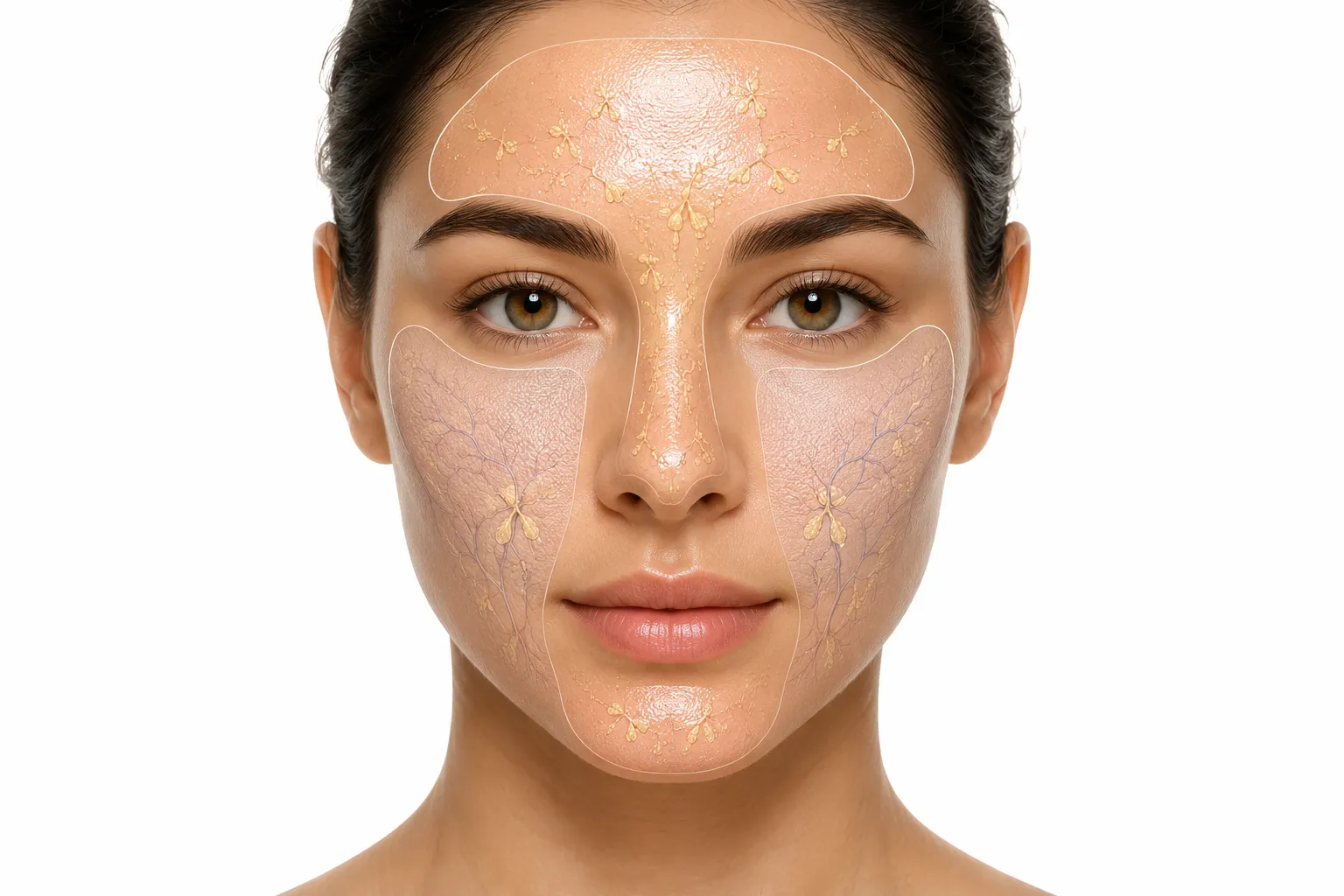
- Sebaceous Gland Density. The T-zone has significantly more sebaceous glands than the cheeks, which is why it behaves differently.
- Pore Size. Pores in the T-zone are larger and more visible because they're producing more oil.
- Skin Thickness. The T-zone skin is thicker than cheek skin, which also affects its behavior.
- Barrier Function. The cheeks have a thinner barrier, making them more prone to dryness and sensitivity.
Combination skin means different areas of your face have different characteristics.
The T-zone is oily, and the cheeks are normal or dry.
It's a normal skin type, not a problem to be fixed.
It requires a zonal approach to skincare.
Understanding what combination skin means helps you choose the right products.
Definition
The meaning of combination skin
What the term signifies.
Combination skin means that your face has both oily and dry characteristics in different areas. This is a normal, common skin type that reflects the uneven distribution of sebaceous glands across the face.
Explanation
What combination skin doesn't mean
Combination skin doesn't mean your skin is "problematic" or "difficult." It's a neutral descriptor. It doesn't mean you're doing anything wrong - it's just how your skin is built.
What the distribution of oil production means for you
- You can't treat your entire face the same way - different areas need different products
- Your skin may change with seasons, requiring adjustments
- You may need to use different products in different areas
- You'll need to be thoughtful about product application
What combination skin means for your routine
Understanding that you have combination skin has practical implications. Here's what it means for your skincare.
- You can't use a one-size-fits-all product - you need a zonal approach
- Your routine may be more complex than someone with a single skin type
- You may need to use different moisturizers on different areas
- You should apply products strategically, focusing on area-specific needs
Questions
Frequently asked questions
Is combination skin a medical condition?
No, it's a skin type - a normal variation in skin anatomy.
Does combination skin mean I have two different skin types?
No, it's one skin type with different characteristics in different areas.
Can combination skin become oily or dry everywhere?
It can change over time, but for many people, it remains combination.
Is combination skin more common in certain age groups?
It's common across all ages but can change with hormonal shifts.