Evidence
What the evidence shows
The pattern of combination skin is well-documented.
Is your T-zone shiny within 2-3 hours of washing?
Yes, but your cheeks aren'tAre your pores larger on your nose and forehead?
Yes, visibly largerDo different products work differently on different areas?
Yes, dramatically
Use this section to decide
Does this advice apply to me?
Find the concern or goal closest to yours, then use the fit signal to decide how much weight to give this guide.If your goal is
T-zoneUsually relevant- Fit signal
- Often useful
Oily
If your goal is
CheeksUsually relevant- Fit signal
- Often useful
Normal to dry
If your goal is
Key signUsually relevant- Fit signal
- Often useful
Different zones, different needs
If your goal is
Best testUse caution- Fit signal
- Limited evidence
Bare-face test
Research notes already in this guide
- The pattern of sebaceous gland distribution is well-established in dermatology.
- Clinical observations confirm the T-zone/cheek dichotomy in combination skin.
- These identification signs are consistent with dermatological definitions.
- Individual variation means the pattern may present differently in some people.
Practical use
How to use it
Confirm with a bare-face test
Wash your face with a gentle cleanser, wait one hour without applying products, and observe where oil appears.
Document your patterns
Note where you see shine, where you feel tightness, and where you break out. Look for the T-zone pattern.
Start zone-based skincare
Apply different products or amounts to different areas based on their needs.
Safety
Side effects and cautions
- Assuming you have oily skin because your T-zone is shiny
If only your T-zone is oily and your cheeks are comfortable or dry, you have combination skin, not oily skin.
- Using the same products all over your face
Combination skin benefits from zone-based application. Use different products or amounts on different areas.
- Skipping moisturizer because your T-zone is oily
Your cheeks still need moisture. Apply moisturizer everywhere, but use a lighter formula or less product on your T-zone.
Fit
Who should be careful
- Diagnosing skin conditions
Worth noting
Small details that can change the answer
- Sebaceous Gland Distribution. The T-zone has about twice as many sebaceous glands per square centimeter as the cheeks.
- Prevalence. About 80% of people have some degree of combination skin, making it the most common skin type.
- Seasonal Changes. Combination skin can become more pronounced in winter, with drier cheeks and a still-oily T-zone.
- Age Effects. Combination skin often shifts toward more uniform dryness with age, though the T-zone may remain the oiliest area.
Combination skin is characterized by an oily T-zone and normal to dry cheeks.
It's the most common skin type, affecting about 80% of people to some degree.
Key signs include different oil levels across your face, enlarged T-zone pores, and different product performance.
The bare-face test is the most reliable way to confirm combination skin.
Managing combination skin requires a zone-based approach to skincare.
Definition
What exactly is combination skin?
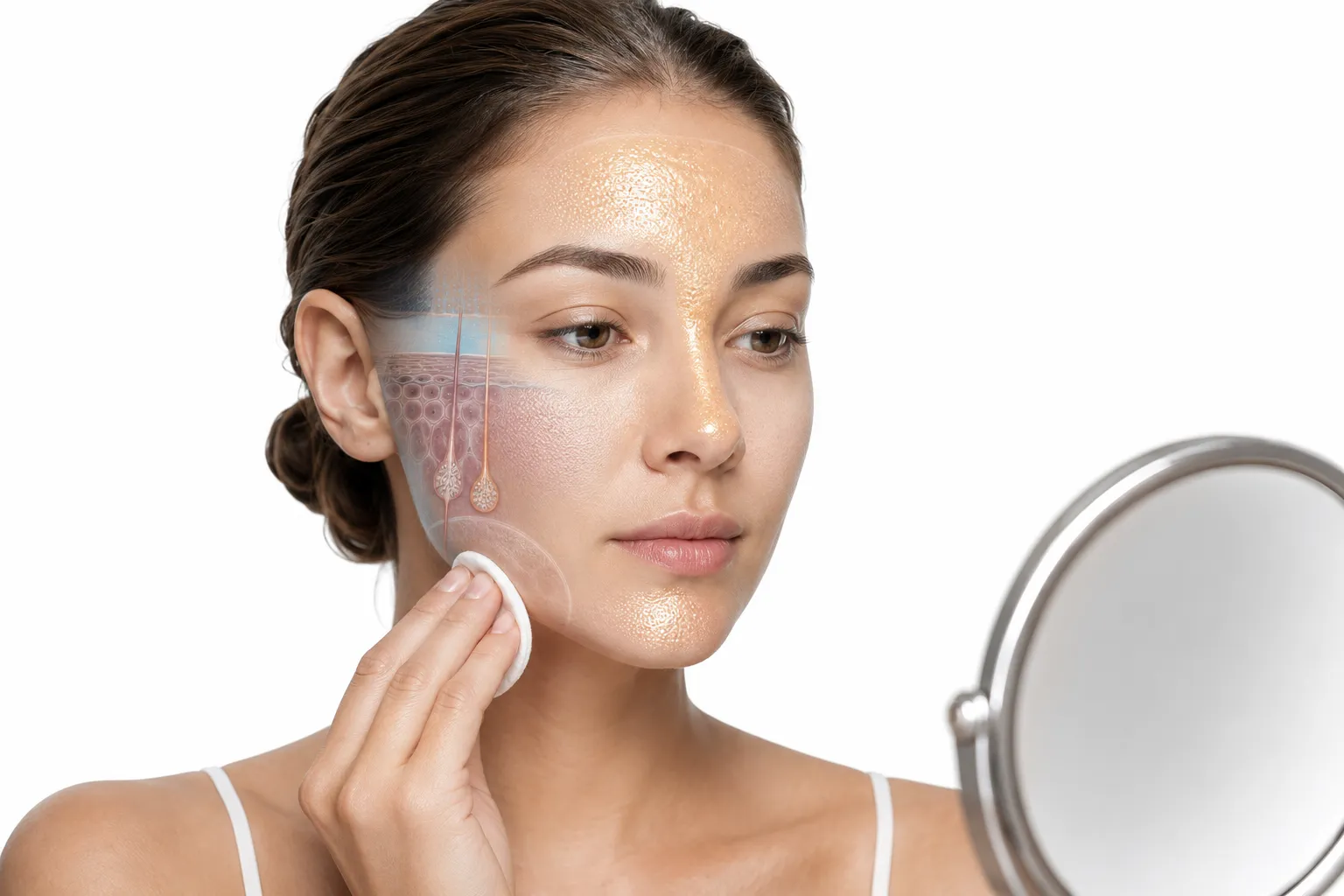
Combination skin is a skin type where different areas of the face have different oil production levels. The classic pattern is an oily T-zone - forehead, nose, chin - and normal to dry cheeks and jawline. This is due to the uneven distribution of sebaceous glands across the face.
- Oily T-zone with visible shine and enlarged pores
- Normal or dry cheeks with finer pores
- Occasional breakouts or blackheads in the T-zone
- Product performance varies across different facial areas
- May feel tight on cheeks but oily on the nose
Explanation
The 5 key signs of combination skin
Here are the most reliable indicators that you have combination skin rather than oily or dry skin.
Benefits
How to manage combination skin once you've identified it
Management strategies for combination skin focus on treating different areas differently.
- Use a gentle, balanced cleanser that doesn't strip your cheeks
- Apply a lighter moisturizer to your T-zone and a richer one to your cheeks
- Use oil-controlling treatments only on your T-zone, not all over
- Consider using a hydrating serum on your cheeks and a pore-clearing serum on your T-zone
- Adjust your routine seasonally - your cheeks may need more moisture in winter
Questions
Frequently asked questions
Can combination skin change over time?
Yes. Age, seasons, hormones, and environmental factors can all shift your skin's balance.
Is combination skin the same as normal skin?
No. Normal skin is balanced all over. Combination skin has different needs in different areas.
Why is my T-zone oily when I use dry skin products?
Dry skin products are often too heavy for your T-zone and can clog pores. You need different products for different zones.
Can I use the same moisturizer all over my face?
You can, but it's better to use a lighter product on your T-zone and a richer one on your cheeks for optimal results.
References
Sources
The notes below are drawn from the evidence already cited in this guide. They are not a complete bibliography.
- The pattern of sebaceous gland distribution is well-established in dermatology.
- Clinical observations confirm the T-zone/cheek dichotomy in combination skin.
- These identification signs are consistent with dermatological definitions.
- Individual variation means the pattern may present differently in some people.