Evidence
What the evidence shows
Combination skin is a skin type, not a temporary condition - it's your skin's natural baseline, influenced by the distribution of oil glands on your face.
Use this section to decide
Does this advice apply to me?
Find the concern or goal closest to yours, then use the fit signal to decide how much weight to give this guide.If your goal is
Key SignUse caution- Fit signal
- Limited evidence
Oily T-zone, dry cheeks
If your goal is
Most CommonUsually relevant- Fit signal
- Often useful
Yes - #1 skin type
If your goal is
TestUse caution- Fit signal
- Limited evidence
Bare-faced observation
If your goal is
CareUsually relevant- Fit signal
- Often useful
Zone-specific
Research notes already in this guide
- Dermatologists use standardized typing systems to identify skin types.
- They assess sebum production and barrier function in different facial zones.
- Professional assessment can distinguish between combination skin and other types.
- Most people can identify their type reliably with careful observation.
Expected results
Results and timeframe
The pattern results from the natural distribution of oil glands.
Observations over time are more reliable than a single check.
Practical use
How to use it
Observe your skin bare-faced
Wash your face, skip products, and check the T-zone vs cheeks after 2 hours.
Track patterns over time
Note how your skin behaves across different seasons for a full picture.
Confirm with a professional
If you're uncertain, consult a dermatologist for an accurate diagnosis.
Safety
Side effects and cautions
- Diagnosing based on a single observation
Observe your skin over time for consistent patterns.
- Confusing combination skin with seasonal changes
Combination skin is consistent year-round, though it may shift slightly.
- Treating the whole face the same way
Combination skin needs zone-specific care.
Fit
Who should be careful
- Those who need professional confirmation
Worth noting
Small details that can change the answer
- Most Common. Combination skin affects the majority of adults.
- T-Zone Focus. The T-zone has the highest density of sebaceous glands.
- Cheek Variation. Cheeks have fewer oil glands and are often the driest area.
- Seasonal Shift. Combination skin can shift - more oily in summer, drier in winter.
Combination skin is the most common skin type.
It's characterized by an oily T-zone and normal or dry cheeks.
Combination skin requires zone-specific care.
Definition
Key signs of combination skin
Combination skin has several distinct characteristics that make it identifiable.
- Oily T-zone (forehead, nose, chin) - shiny, visible pores
- Normal or dry cheeks - may feel tight or look dull
- Pores are larger in the T-zone, smaller on the cheeks
- Breakouts typically occur in the T-zone
- Skin may feel oily in the center and dry on the edges
Explanation
Why combination skin happens
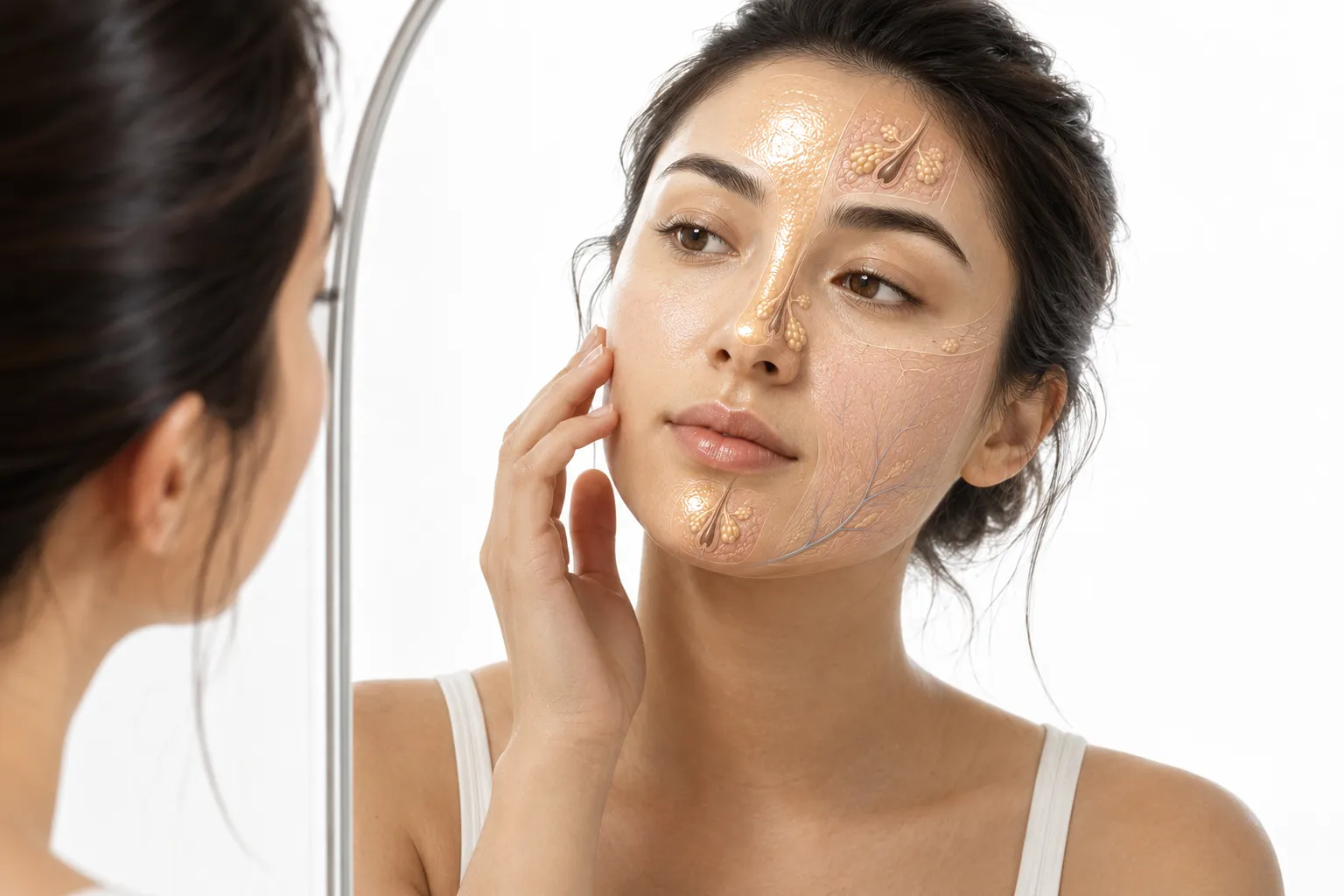
The combination pattern results from the natural distribution of sebaceous glands on the face. The T-zone has a higher density of oil glands, leading to more sebum production. The cheeks have fewer glands, producing less oil. This difference is determined by genetics and is a normal variation in skin structure.
Questions
Frequently asked questions
Can I have combination skin if my T-zone is only slightly oily?
Yes - combination skin exists on a spectrum from mild to pronounced.
Does combination skin change with age?
It can - the T-zone may become less oily with age.
Can I treat combination skin with one product?
One product can work if it's balanced, but zone-specific care is often better.
Is combination skin the same as oily skin?
No - oily skin affects the whole face, while combination skin only affects the T-zone.
References
Sources
The notes below are drawn from the evidence already cited in this guide. They are not a complete bibliography.
- Dermatologists use standardized typing systems to identify skin types.
- They assess sebum production and barrier function in different facial zones.
- Professional assessment can distinguish between combination skin and other types.
- Most people can identify their type reliably with careful observation.