Evidence
What the evidence shows
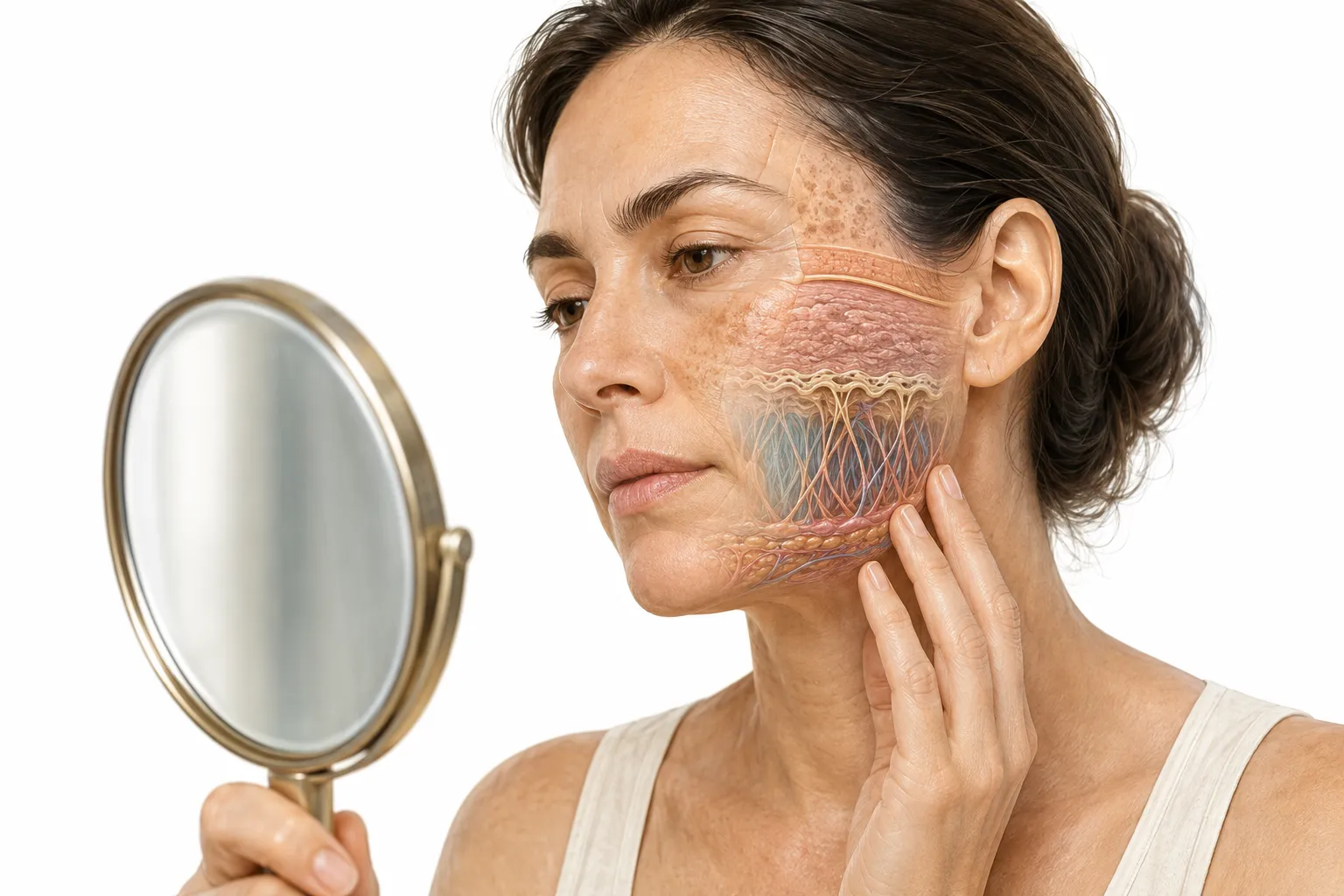
The signs of sun-damaged skin are often in plain sight once you know what you're looking for. They are not hidden; they just require a trained eye.
Do you have fine lines around your eyes?
This is a common sign of photoaging.Do you have age spots?
These are a classic sign of sun damage.Is your skin rough or leathery?
This can indicate actinic elastosis.
Use this section to decide
Does this advice apply to me?
Find the concern or goal closest to yours, then use the fit signal to decide how much weight to give this guide.If your goal is
AssessmentUsually relevant- Fit signal
- Often useful
Self-examination
If your goal is
Key SignsDepends- Fit signal
- Possible fit
Wrinkles, pigmentation
If your goal is
Next StepUse caution- Fit signal
- Limited evidence
Dermatologist
If your goal is
PreventionUse caution- Fit signal
- Limited evidence
Sunscreen daily
Research notes already in this guide
- Regular self-assessment can help you catch early signs of skin cancer.
- It can motivate you to adopt protective measures.
- It provides a baseline for tracking changes over time.
Expected results
Results and timeframe
Sun damage may not be visible for years after exposure.
Practical use
How to use it
Perform a self-assessment
Use a mirror and good lighting to examine your skin for signs of sun damage.
Take a photo for comparison
Photograph your skin to track changes over time.
Schedule a dermatology appointment
If you notice any concerning changes, see a dermatologist for a professional evaluation.
Safety
Side effects and cautions
- Only checking the face
Sun damage can appear on any area of the skin that has been exposed to the sun.
- Assuming that no signs mean no damage
Sun damage may not be visible for years after the exposure.
- Ignoring small or subtle changes
Small changes can be early signs of skin cancer.
Fit
Who should be careful
- Those who need a definitive diagnosis, which requires a dermatologist
Worth noting
Small details that can change the answer
- The Glogau Scale. Dermatologists use this scale to classify photoaging from mild (Type I) to severe (Type IV).
- Self-Assessment. You can perform a basic self-assessment at home with a mirror and good lighting.
- UV Photography. A dermatologist can use UV photography to reveal hidden signs of sun damage.
- Cumulative Nature. Sun damage is cumulative, so even if you don't see signs now, they may appear later.
You can assess your own skin for sun damage with a mirror and good lighting.
Look for fine lines, wrinkles, pigmentation changes, and rough texture.
A dermatologist can provide a more comprehensive assessment.
Regular self-assessment can help you catch early signs of skin cancer.
Definition
A step-by-step guide to assessing your skin for sun damage
To assess your skin for sun damage, follow these steps. First, ensure you have a mirror and good lighting. Second, examine your face, neck, chest, and hands, paying attention to areas that have received significant sun exposure. Third, look for the specific signs of photoaging.
- Step 1: Gather a mirror and good lighting.
- Step 2: Examine your face, neck, chest, and hands.
- Step 3: Look for fine lines and wrinkles.
- Step 4: Look for uneven pigmentation and age spots.
- Step 5: Feel for changes in texture and firmness.
- Step 6: Look for broken capillaries.
Explanation
What to look for in each area of the skin
Different areas of the skin will show different signs of sun damage. The face is the most common area, but the neck, chest, and hands also suffer from chronic UV exposure. Wrinkles around the eyes and mouth are common, as are age spots on the hands. The chest can show broken capillaries and a reddened appearance.
Science
How dermatologists assess sun damage
Dermatologists use a variety of tools to assess sun damage. The Glogau Photoaging Scale is a classification system that grades photoaging from mild to severe. UV photography can reveal damage that is not visible to the naked eye, providing a more comprehensive assessment. Skin biopsies can also reveal the extent of structural damage.
- Glogau Photoaging Scale
- A system used by dermatologists to classify the severity of photoaging.
- Dermoscopy
- A technique using a specialized instrument to examine the skin.
Questions
Frequently asked questions
Can I perform a self-assessment at home?
Yes, with a mirror and good lighting, you can examine your skin for the classic signs of sun damage.
How often should I check my skin for sun damage?
It is recommended to perform a self-assessment monthly and to see a dermatologist annually.
Will my skin feel sun-damaged?
Sun damage can cause dry, rough skin that feels less elastic.
Should I see a dermatologist even if I don't see signs?
If you have a history of sun exposure, it is still a good idea to see a dermatologist for a professional evaluation.
References
Sources
The notes below are drawn from the evidence already cited in this guide. They are not a complete bibliography.
- Regular self-assessment can help you catch early signs of skin cancer.
- It can motivate you to adopt protective measures.
- It provides a baseline for tracking changes over time.